
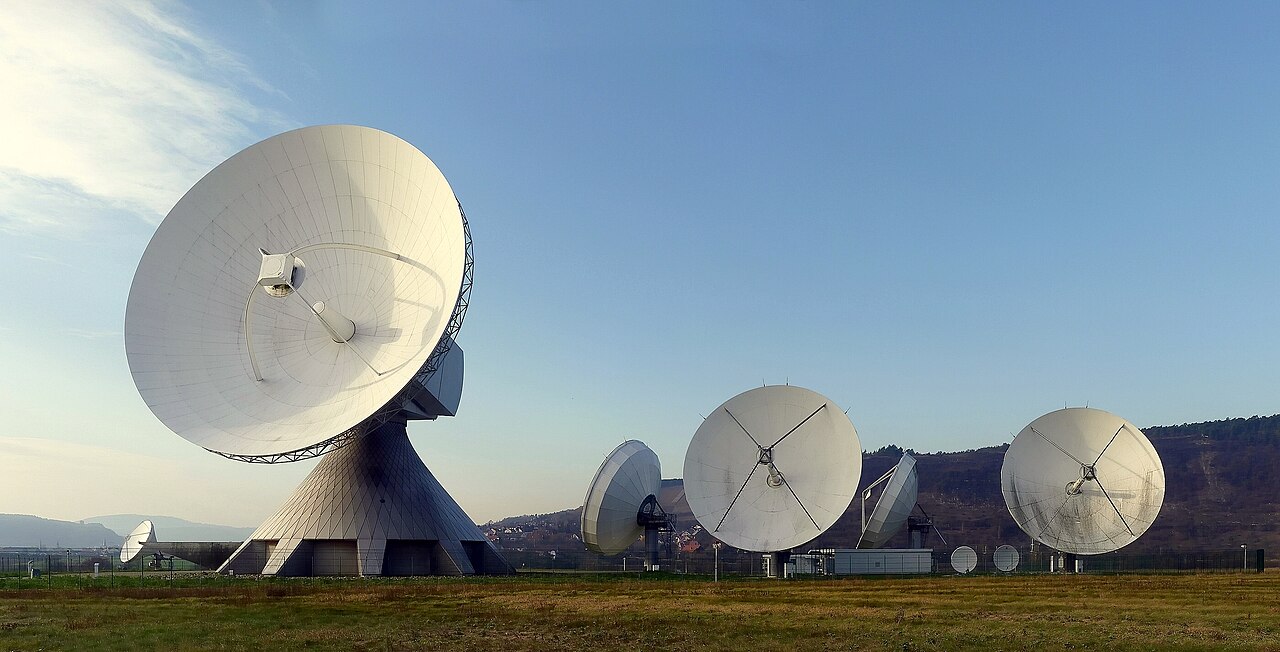
The Air Force awarded Inmarsat Government Inc. a $307,102,288 firm-fixed-price contract on May 8 for global communication connectivity under the U.S. Marine Corps Enterprise Commercial Satellite Services program, known as MECS2. The contract covers access to multi-orbit commercial satellite communications in all commercially available frequency bands via orbital and terrestrial resources, along with bandwidth management, analysis tools, and satellite network monitoring capabilities. Work is expected to be completed by March 16, 2031. Inmarsat Government, a Reston, Virginia-based subsidiary of Viasat Inc., held the predecessor MECS2 contract and was the only firm to submit a proposal when the government opened the competition to the market.
The MECS2 Program and Viasat's Role
MECS2 is the Marine Corps' primary vehicle for procuring commercial satellite bandwidth and associated management services for expeditionary and garrison operations. It covers a wide range of frequency bands — L-band, Ku-band, Ka-band, and X-band — spanning geostationary, medium Earth orbit, and low Earth orbit constellations, which gives Marine units the ability to shift between services depending on operational environment, latency requirements, and availability. The program supports everything from command-and-control communications at forward operating bases to logistics coordination, personnel connectivity, and intelligence uplinks.
Viasat's 2023 acquisition of Inmarsat created one of the few companies with deep operational roots across multiple commercial satellite architectures, including Inmarsat's I-6 geostationary fleet and ViaSat-3, the company's high-capacity Ka-band constellation. That breadth of owned and managed capacity, combined with Inmarsat Government's decades-long relationship managing MECS2, largely explains why the competitive reopening attracted no other bidders. SpaceNews reported the sole-source dynamic directly, noting the government acknowledged only one proposal was received before making the award.
Sole-Source Outcome in a Consolidating SATCOM Market
The lack of competing proposals in a notionally competitive procurement reflects broader consolidation across the government satellite communications market. Intelsat Government, SES Government Solutions, and Hughes Network Systems remain significant providers for DoD SATCOM vehicles, but each serves distinct frequency band niches, and the MECS2 requirement for multi-orbit, multi-band seamless connectivity narrows the competitive field substantially. The Marine Corps last year opened the procurement through the Government Point of Entry, but the requirement scope — essentially duplicating an entire enterprise SATCOM operations function — favored an incumbent with live network infrastructure and established network operations center support in place.
The five-year, four-month contract value of $307 million represents roughly $61 million per year in commercial SATCOM spending for the Marine Corps, a number consistent with the growing bandwidth demands of Marine Expeditionary Forces deploying with increasingly sensor-intensive equipment and distributed operations doctrine under Force Design 2030.
What It Means for Contractors
The MECS2 award is a firm-fixed-price, sole-source contract with no task order competition underneath it. Subcontracting opportunities will flow through Inmarsat Government's program management and network operations structure rather than through any government-run competitive process.
- Firms providing cybersecurity monitoring for commercial satellite terminals, network operations center staffing, or spectrum management software should contact Inmarsat Government's supplier programs office in Reston to understand subcontracting opportunities under MECS2.
- Small businesses with SB set-aside capabilities in IT services or communications infrastructure should monitor whether Inmarsat Government files a subcontracting plan as required under FAR 52.219-9 for contracts of this size.
- Competing for future MECS2 recompetes — the current contract runs through 2031 — will likely require demonstrating multi-orbit, multi-band managed SATCOM capacity at enterprise scale, a technical and infrastructure threshold that currently favors large integrated providers.
- DoD's broader Commercial SATCOM strategy, managed through the Space Systems Command Commercial Satellite Communications Office, is worth monitoring for future vehicle structures that may open portions of this requirement to more suppliers.
DoD's PACE SATCOM Architecture and Where MECS2 Fits
DoD's communications strategy organizes satellite connectivity into a hierarchy of Primary, Alternate, Contingency, and Emergency (PACE) paths, a doctrine designed to ensure that no single point of failure — whether a jamming event, a ground station outage, or a constellation degradation — can deny a commander the ability to communicate. Commercial SATCOM, of which MECS2 is one instance, typically fills the Primary and Alternate tiers for low-to-medium sensitivity traffic, freeing up protected military satellite bandwidth on systems like the Advanced Extremely High Frequency constellation for critical command-and-control links. The Marine Corps' reliance on MECS2 for its enterprise SATCOM reflects this doctrinal framework: commercial multi-orbit capacity provides the bandwidth and availability for logistics, administrative, and day-to-day operational traffic, while specialized military systems handle the highest-priority missions.
The emphasis on multi-orbit in the MECS2 requirement specification is directly responsive to DoD's recognition that purely geostationary SATCOM can be disrupted by adversary jamming or directed-energy weapons. Low Earth orbit constellations like Starlink and OneWeb provide resilience through sheer node count — thousands of satellites make pinpoint jamming economically and technically difficult — while GEO systems provide the high-capacity, low-latency connections that bandwidth-intensive enterprise applications require. Viasat's ability to offer access across both orbital regimes through a single contract management structure is the technical foundation of its competitive position in MECS2 and similar enterprise commercial SATCOM vehicles.
For the Marine Corps, having a single contractor manage multi-orbit bandwidth access, network monitoring, and technical support simplifies both the contracting and operational coordination burden. Managing separate GEO and LEO providers, each with distinct network operations centers, service level agreements, and billing structures, would require dedicated program office staff resources that the Corps' SATCOM program office cannot justify for what is fundamentally a utility service. The MECS2 structure trades some pricing competition for operational simplicity — a trade the Corps' program office has consistently made, given the sole-source outcome of this and the predecessor competition.
The five-year contract ceiling of $307 million represents a meaningful portion of the Marine Corps' annual communications budget and reflects the service's recognition that commercial SATCOM is now a permanent, funded line item rather than a surge or contingency resource. As Marine units operate with more bandwidth-intensive systems — from intelligence, surveillance, and reconnaissance feeds to real-time logistics tracking and distributed command networks — the MECS2 vehicle will likely require future modifications or follow-on awards to accommodate growing throughput demands within its current performance period.