
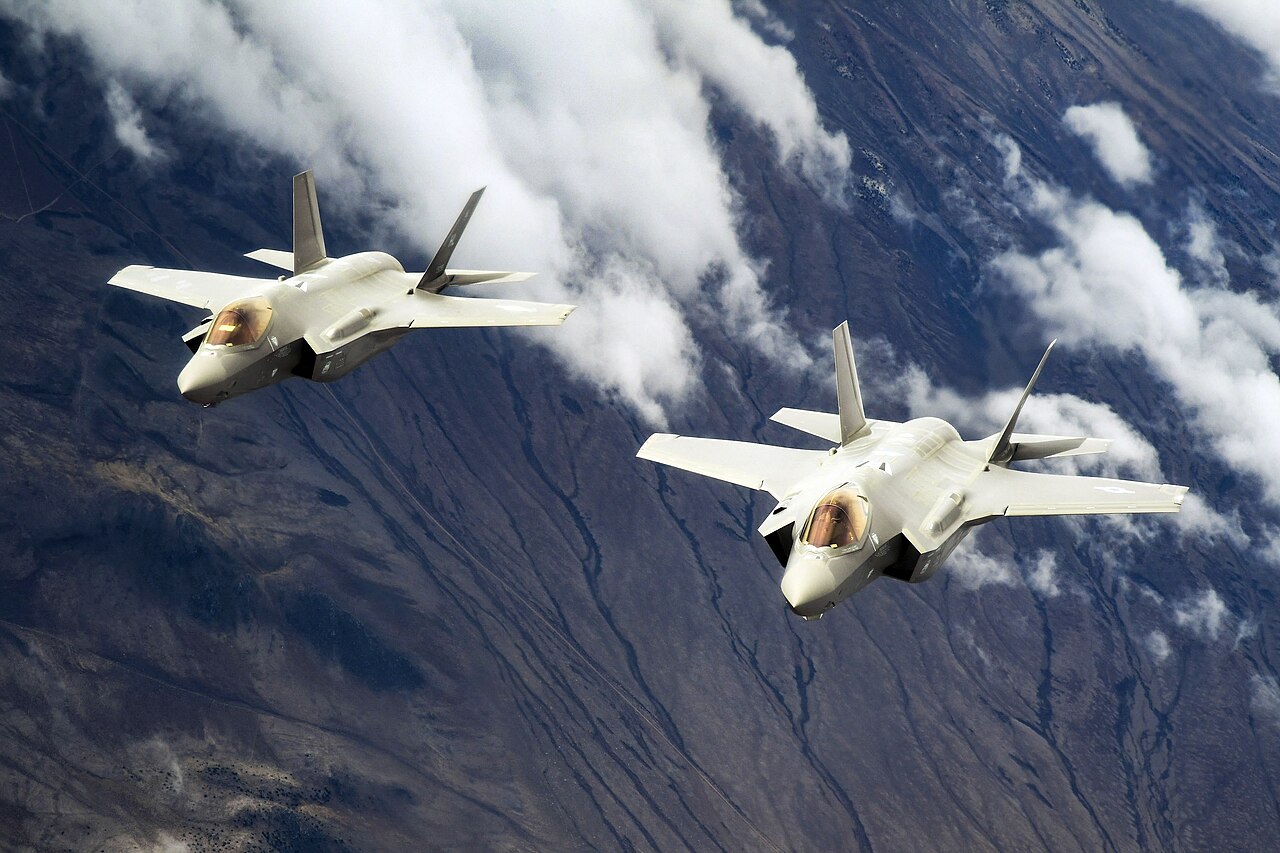
The Air Force is telling Congress it needs hundreds more combat-coded fighters than it flies today, with F-35s making up about two of every five jets by 2035. A new fighter force structure report sets a goal of 1,509 combat-coded aircraft by that year, a target that Air & Space Forces Magazine reported depends on Congress paying for the jets and on Lockheed Martin and Boeing building them fast enough.
The service submitted the report to Congress on Oct. 16. Lt. Gen. David Tabor, deputy chief of staff for plans and programs, walked reporters through its estimates at an Oct. 20 Pentagon media roundtable. The Air Force did not give reporters a full copy, and as of Oct. 21 no unclassified version had been released publicly, according to The War Zone.
How the 1,509-Fighter Goal Compares With Last Year’s Numbers
The new target replaces figures from last year’s report, which estimated the service would have 1,271 combat-coded fighters in 2026 and aimed for 1,369 by 2030. Tabor said the additional 140 jets above that 2030 mark would be a mix of F-35s, F-15EXs and F-47s.
The baseline depends on how A-10s are counted. The War Zone reports that the Air Force had 1,168 combat-coded fighters at the start of fiscal 2026, not including 103 A-10 Warthogs; together those total the 1,271 figure from last year’s estimate. The plan now is for the last A-10s to retire by 2030. The War Zone also notes that last year’s report described an eventual inventory goal of 1,558 combat-coded fighters. The 2035 figure does not count the Collaborative Combat Aircraft drones the service wants to have acquired by that time.
Tabor said the data behind the previous report was "pretty old," so analysts compiled fresher information. The new figure rests on geographic combatant commanders’ reported requirements to achieve their goals at "medium risk." He said the analysis began before combat operations against Iran broke out earlier this year and was not driven by the war, and he cautioned that the number will move. "Certainly, world events and changing requirements in the combatant commands will change that number," Tabor said.
Which Jets Make Up the 2035 Fleet?
Under the target mix, about 40 percent of the fleet would be F-35s. Another 20 percent would be F-22 Raptors and F-47s, as the sixth-generation F-47 replaces the Raptor. Tabor said the service still plans to replace the 186 F-22s the Air Force built with roughly an equivalent number of F-47s. The remaining 40 percent would likely be split evenly between F-15 variants and F-16s.
That marks a shift from today. Excluding A-10s, the current fleet is about 45 percent F-16s, 30 percent F-35s, 15 percent F-15s and 10 percent F-22s. If the remaining 40 percent splits evenly, the F-16 share would fall from about 45 percent to about 20 percent, less than half its current share, while the F-35’s would rise by about 10 points.
Can 62 Jets a Year Reach the Target?
Air Force leaders have said for years that the service needs to buy 72 new fighters annually to replace retiring jets and modernize. The fiscal 2027 budget request falls short, proposing 38 F-35s and 24 F-15EXs for a total of 62. Tabor said those purchases can "ramp over time" to the needed levels, but he put the production question squarely on industry.
"The question is, can industry produce at those levels?" Tabor said. "They’ve assured us that they can, and we believe them, but we also actually need to see it manifest."
Money is the other variable. The administration’s fiscal 2027 strategy relies on a budget reconciliation bill to add funding on top of base appropriations. The Air Force request counted on $2.34 billion from reconciliation to pay for 14 of the 38 F-35s. If reconciliation fails, Tabor said the service could pull the money from the base budget, at the expense of other programs, or push those buys to 2028 and fall further behind its fleet goals.
"We just lose 14 times [an] F-35’s worth of other capabilities that we were planning on," Tabor said of the first option.
Tabor also pointed to the Pentagon’s push for expanded multiyear procurement authority. The Air Force is eyeing multiyear deals for the F-35 and F-15EX, a request pending before Congress, which he said would give industry more financial stability and could make it easier to expand and stabilize production.
Why a New-Build F-16G Decision Can Wait
Older F-16s reach the end of their service lives in the mid-2030s, Tabor said. The Air Force is weighing a new version of the jet, tentatively called the F-16G, which The War Zone reports Lockheed Martin pitched last month based on the Block 70 now in production at its Greenville, South Carolina, plant. Tabor said no decision has been made "and we’re not in a position where that decision has to be made immediately." He said it likely will not come as part of the fiscal 2028 budget process.
"There is a spectrum of capability that we might want to replace the F-16s with," Tabor said. "It’s not urgent, frankly."
He called automatically replacing old F-16s with new ones the simple "and maybe the lazy" approach, while saying a new F-16 is "practically a ready-made aircraft" if the Air Force wants to stick with the same type of capabilities. The War Zone notes that Lockheed’s order books are already very full with foreign F-16 demand, and that Boeing faces similar questions about meeting Air Force demand for F-15EXs.
Drones are not yet changing the math. The Air Force aims to field 500 Collaborative Combat Aircraft airframes by 2032, but Tabor said the current CCA does not reduce the fighter requirement. He said CCAs are advancing quickly and expects them to play a major role in future versions of the report.
What It Means for Contractors
For Lockheed Martin and Boeing, the report puts a number on sustained demand: the Air Force needs to buy faster than the 62 jets in its fiscal 2027 request to reach 1,509 by 2035, and its top planner is openly asking whether industry can deliver. Suppliers across the F-35 and F-15EX chains should watch the reconciliation bill, since its outcome determines whether 14 F-35s are bought in 2027, slip to 2028 or displace other base-budget programs. Pending multiyear procurement authority for both jets would give industry more financial stability if Congress approves it.
The F-16G question stays open beyond the fiscal 2028 budget, which leaves room for competing proposals across what Tabor called a "spectrum of capability." Because the replacement decision is not imminent, suppliers to the existing F-16 fleet may have a longer runway while the service studies options. CCA developers have reason to track how the next force structure reports treat drones, since Tabor said CCAs could eventually mitigate the number of fighters required.
