
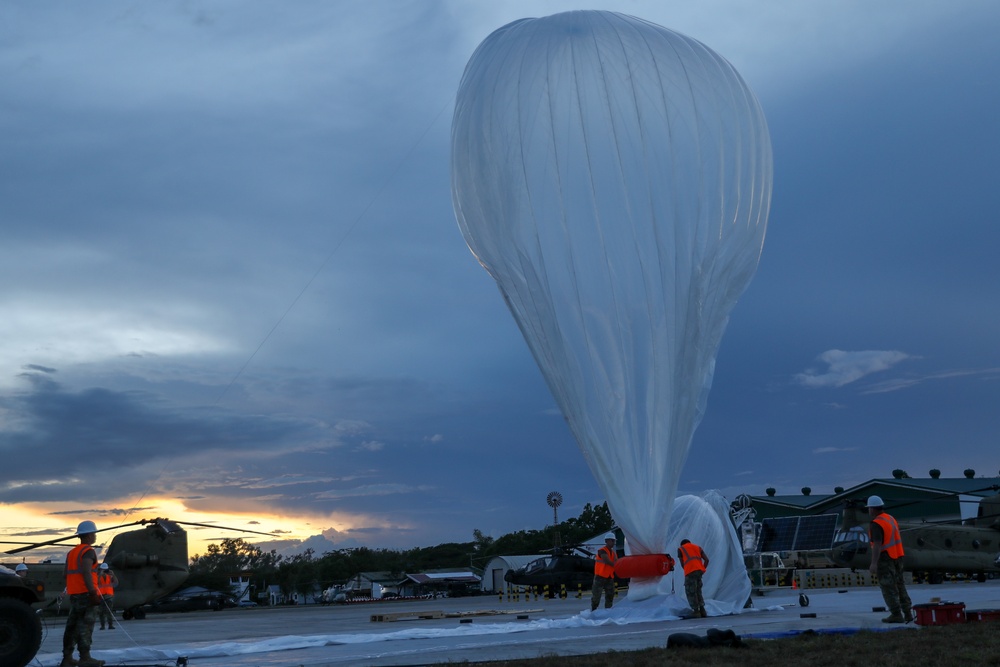
The Air Force is spending $64.4 million on a high-altitude balloon prototype that it has not explained, and the contract went to Aerostar without competition. According to Defence Blog's reading of the notice, the project is called Swamp Gas, and the Pentagon describes the requirement only as a "High-Altitude Balloon Operational Urgency."
Aerostar Technical Solutions LLC of Arlington, Virginia, received a $64,437,723 firm-fixed-price and cost-reimbursable contract, the Department of War's Sept. 28, 2026 contract announcement shows. The award date was Sept. 25, 2026. The Air Force Life Cycle Management Center at Wright-Patterson Air Force Base, Ohio, is the contracting activity under number FA8691-26-F-B014.
What the Swamp Gas Notice Actually Says
The announcement is short. Its operative language reads: "This contract provides for developing a minimum viable product prototype to support a High-Altitude Balloon Operational Urgency." Work will be performed in Arlington, Virginia, and is expected to finish by March 23, 2028.
The notice states that the contract "was a sole source acquisition." It does not give a justification for going without competition. The announcement lists two funding streams obligated at the time of award:
- $57,717,332 in fiscal 2025 research, development, test and evaluation funds
- $6,270,388 in fiscal 2026 research, development, test and evaluation funds
Together those two figures come to $63,987,720, which is nearly the entire $64,437,723 contract value. The notice does not itemize the remaining $450,003. The fiscal 2025 money is the larger share by a wide margin, so most of the funding comes from the earlier fiscal year.
Defence Blog, the outlet that flagged the award, explains the terminology. "Operational urgency is the term the military uses for a need from the field that has to be met faster than normal acquisition allows," wrote Colton Jones. A "minimum viable product" is, in the same article's words, an early working version with just enough capability to be tested and used.
What the Air Force Left Out
The gaps in the announcement are the main story. Jones put the omission plainly: "The notice does not say what the balloon is meant to do, which U.S. military command or unit asked for it, what it will carry or where it could be used."
That leaves four open questions:
- The mission. The notice does not say whether the balloon is meant for communications, sensing, or something else.
- The sponsor. No command or unit is named as the requester.
- The payload. Nothing describes what the balloon would carry.
- The theater. Nothing indicates where it might be used.
Defence Blog also notes that the project name echoes an old episode. In 1966, Air Force consultant J. Allen Hynek suggested that "swamp gas" could explain a wave of UFO sightings in Michigan. The Air Force has not said why it chose the name, and nothing in the announcement connects the project to that history.
Why Aerostar, and What It Builds
The award gives the Air Force no public reason for choosing Aerostar, but the company's record is public. Defence Blog describes Aerostar as a builder of stratospheric balloons that fly far above commercial airliners. Its larger Thunderhead balloon operates between about 55,000 and 75,000 feet, can stay aloft for 60 days or more, and can carry up to about 200 pounds of equipment, according to the company. It also makes a smaller balloon, Lightning, designed to carry a single payload and be launched by a small team without a runway.
The Pentagon has bought from Aerostar before. In 2021, the Defense Innovation Unit hired the company to demonstrate how stratospheric balloons could carry communications relays and sensors for U.S. forces.
Balloons are also drawing new attention from the Army. Defence Blog reports that the service has tested balloon-carried drones in at least three exercises this year. The most recent launched micro high-altitude balloons, one carrying an Apollo-R drone, on Japan's Hokkaido island on Sept. 18 during Exercise Orient Shield 26. Earlier launches took place off Morocco during African Lion 26 and on Guam during Valiant Shield 2026.
Aerostar has paired its balloons with the solar-powered Apollo-R drone built by Icarus. The balloon lifts the drone into the stratosphere before it flies on its own. Aerostar executive Russ Van Der Werff told The War Zone in July that a Thunderhead could act as a "mothership" for several drones, per Defence Blog's account. Neither the contract announcement nor Defence Blog connects that work to Swamp Gas. The Air Force has not said what the prototype will do, so any link remains unconfirmed.
The broader appeal of the technology is cost. Supporters argue balloons are cheaper than satellites and aircraft such as the Global Hawk, and that they can linger over an area for weeks.
What It Means for Contractors
Three points follow from the record as published.
Operational urgency is a route to fast, unadvertised awards. The Air Force used a sole-source path for a $64 million research effort, with nearly all the money obligated at award. Companies that build stratospheric platforms, payloads, launch systems or ground equipment should not expect a public solicitation for a requirement like this one. Visibility comes from prior demonstrations, agency contacts and prime-contractor relationships, not from an open notice.
Subcontract and teaming openings sit behind the prime. The announcement names one company, and Aerostar alone holds the contract. Firms with payload, communications, sensor or launch capabilities have no public entry point other than approaching the prime. The notice does not say whether Aerostar will subcontract any of the work.
The mission stays hidden, so the follow-on is hard to size. A minimum viable product is a starting point. The contract runs to March 2028, and the announcement says nothing about production quantities, transition or a follow-on award. Competitors cannot tell from public information whether a production buy will come, or in what form. The Air Force Life Cycle Management Center is the office to watch for any later notice.
The firm-fixed-price and cost-reimbursable structure also matters to anyone considering a similar bid. The notice does not say which portions carry which type. Cost-reimbursable elements typically bring accounting and reporting obligations, so firms weighing a teaming arrangement should ask about that early.
For now, the public record on Swamp Gas is one paragraph of contract language and one news story that points out what is missing. The dollar figures, dates, funding and contracting office are all on the record. The mission, the customer and the payload are not.
