
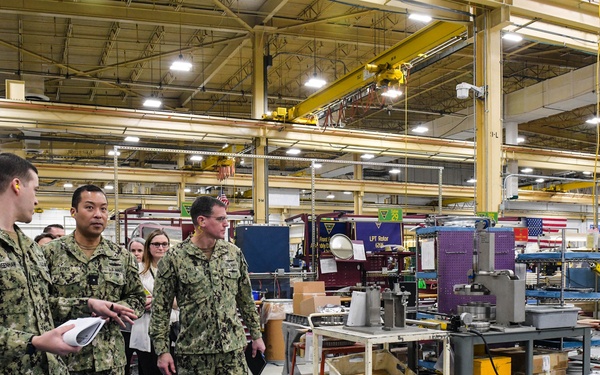
Anduril Industries announced ArsenalOS, an integrated software platform designed to connect every stage of defense hardware production — from initial design through field sustainment — across its Arsenal-1 manufacturing campus near Columbus, Ohio. The announcement marks the formal operational debut of the software layer Anduril is using to run what it describes as a reconfigurable, hyperscale defense manufacturing operation, producing the Roadrunner interceptor drone, the Barracuda cruise missile family, the YFQ-44A Fury Collaborative Combat Aircraft, and at least one classified program on the same production floor with the same workforce.
Background
Arsenal-1 is Anduril's primary manufacturing campus, located roughly 20 miles south of Columbus near Rickenbacker International Airport in Pickaway County, Ohio. The company committed to investing more than $900 million of its own capital to construct the manufacturing facilities on the property. The workforce stood at approximately 250 employees at Arsenal-1, with a stated goal of scaling to 4,000 workers within the decade.
Anduril had already begun production at Arsenal-1 before the ArsenalOS announcement. The facility came online ahead of its original July 2026 target, with production starting at the end of March 2026. The company raised $5 billion in a Series H funding round in May 2026, led by Thrive Capital and Andreessen Horowitz, at a reported valuation of $61 billion. That capital raise was explicitly tied to expanding manufacturing capacity, research and development, and infrastructure — the context in which Arsenal-1 and ArsenalOS sit.
The broader defense industrial base problem Anduril is addressing is not unique to the company. The Department of Defense and Congress have scrutinized for years whether traditional prime contractors can produce munitions and autonomous systems fast enough to meet peer-competitor threat timelines. Arsenal-1 and ArsenalOS represent Anduril's direct answer to that production rate challenge, funded with private capital rather than DoD investment and structured to avoid the program-specific factory lock-in that has historically constrained surge capacity across the defense industrial base.
Key Details
ArsenalOS functions as a unified software layer that aggregates data across four domains: product development, manufacturing execution, supply chain management, and field sustainment. Production leads at Arsenal-1 access a real-time dashboard that surfaces schedule status, quality defects, and safety issues across active programs simultaneously.
The central manufacturing capability enabled by ArsenalOS is reconfigurability. According to Anduril, a production line at Arsenal-1 can be switched from one system — for example, Fury airframes — to a different system, such as Roadrunner or Barracuda, in days to weeks rather than months to years. That reconfigurability is made possible in part because ArsenalOS maintains a consistent data and workflow environment across programs, reducing the retooling time typically required when a factory shifts between product lines. Roughly 90 percent of Arsenal-1's products use commercially available parts, a design choice that further compresses the time needed to reconfigure lines and qualify suppliers.
The four programs currently produced at Arsenal-1 span the autonomous systems portfolio Anduril has built since its founding: the Roadrunner interceptor drone; the Barracuda, a family of cruise missiles; the YFQ-44A Fury, the autonomous fighter variant Anduril is developing for the Air Force's Collaborative Combat Aircraft program; and at least one classified program. All four run on the same production floor, using the same workforce, under ArsenalOS coordination.
Arsenal-1's supplier network spans more than 6,000 suppliers worldwide. Anduril has not disclosed specific production throughput figures for individual programs under ArsenalOS.
What It Means for Contractors
ArsenalOS introduces a software-first model for defense manufacturing that contrasts with the facility-specific, program-segregated production lines that characterize most traditional prime contractors. For companies competing in autonomous systems and munitions production, the competitive implications are structural: Anduril is demonstrating that the same workforce, physical plant, and software stack can produce qualitatively different systems without the dedicated tooling, capital investment, and ramp-up time that fixed production lines require.
For the supply chain, Anduril's approach has immediate implications for subcontractors and component suppliers working across its programs. ArsenalOS's supply chain management module means production scheduling, demand signals, and quality data all flow through a single platform — suppliers that can integrate into that environment gain visibility and responsiveness advantages over those that cannot, a gap that will widen as Arsenal-1 scales toward its 4,000-worker target.
The $5 billion Series H and the more than $900 million capital commitment to Arsenal-1 signal that Anduril intends to sustain this investment at a pace most defense startups cannot match. For program offices evaluating vendors for high-rate munitions and autonomous system production contracts — particularly under the YFQ-44A CCA program — the existence of a functioning, software-controlled, multi-program production campus shifts what contract performance benchmarks look like in practice. DoD program managers writing solicitations for production rate requirements now have a private-sector comparator that did not exist two years ago.
Contractors in the autonomous systems space that lack a comparable integrated manufacturing software layer face a near-term strategic question: whether to build a proprietary equivalent, license an existing platform, or pursue a partnership that provides equivalent capability. ArsenalOS's public announcement compresses that decision timeline for anyone competing on CCA, loitering munitions, or medium-altitude long-endurance platform production contracts over the next 18 months.
The Ohio location also signals a deliberate workforce and logistics choice. Rickenbacker International Airport is a major air cargo hub with direct freight capacity to defense prime contractors and logistics networks across the Midwest. Suppliers within the existing Ohio and broader Great Lakes manufacturing corridor — which retains significant machining, electronics assembly, and composite fabrication capacity — are geographically well-positioned to serve Arsenal-1 as it scales. State-level incentives for defense manufacturing investment are a factor as well, and Ohio officials have been active in recruiting advanced manufacturing facilities. Companies already operating in the region should be actively developing relationships with Anduril's supply chain organization well ahead of the production ramp that the ArsenalOS announcement indicates is already underway at scale.
