
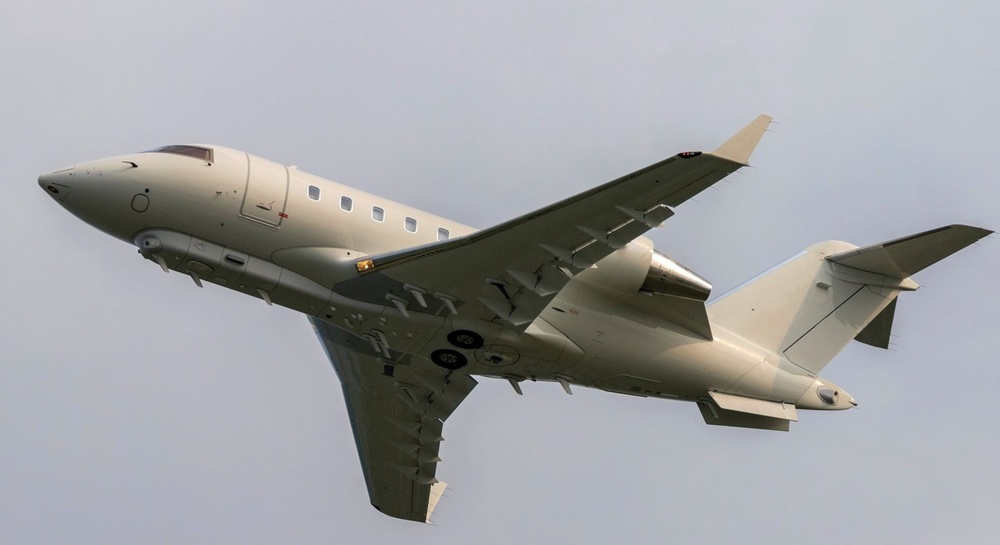
The Army's only contractor-owned spy jet over Europe is staying in the air through the summer of 2027, and the company flying it just locked in another shot at the work beyond that. Leidos will continue operating the ARTEMIS airborne intelligence, surveillance and reconnaissance mission for the Army under a contract extension worth up to $127 million, the company announced Sept. 22, 2026. The award keeps ARTEMIS flying within the European Command area of responsibility through next summer, with two additional option years the Army can exercise afterward.
Leidos has run the mission since 2020, and the new award simply extends a relationship the Army has leaned on for six years rather than opening a competition for a new operator. The company issued the extension through its existing Common Hardware Systems-6 (CHS-6) contract vehicle, the same umbrella the Army uses to buy a wide range of command, control, communications, computers, cyber, intelligence, surveillance and reconnaissance hardware and services.
For Army commanders in Europe, the practical effect is continuity: no gap in coverage, no new contractor to onboard, and no interruption to a surveillance capability that has become a fixture of NATO's watch on Russian forces along the Ukrainian border since its first deployment to the continent in November 2021.
How a Modified Business Jet Became an Army Spy Plane
ARTEMIS — the Airborne Reconnaissance and Targeting Exploitation Multi-Mission Intelligence System — is not a purpose-built military aircraft. It is a modified Bombardier Challenger 650, the kind of jet corporate flight departments buy for executive travel, fitted instead with antennas and processing equipment that intercept and analyze adversary communications. The platform operates above 40,000 feet, high enough to collect signals at long range while staying out of the engagement envelope of surface-to-air missile systems.
What sets ARTEMIS apart from a typical military ISR program is who owns it. Leidos runs the aircraft as a contractor-owned, contractor-operated capability: the company supplies the jet, the mission systems, the flight crews and the support services, while the Army pays by the hour and taps into the sensor data remotely over satellite links rather than putting its own personnel in the cockpit. That arrangement lets the Army field a high-end collection capability without the years-long acquisition cycle and sustainment tail that come with buying and owning the aircraft outright.
"ARTEMIS combines the flexibility of commercial aircraft with military-grade sensing to deliver timely intelligence wherever commanders need it," said Jason McCarthy, Leidos senior vice president, Airborne & Mission Solutions. "As threats continue to evolve, we're providing the Army with a proven, rapidly deployable ISR capability that helps commanders stay ahead of the fight and make decisions with greater confidence."
The program has quietly built a substantial flight record. Leidos pitched the concept to the Army in January 2019, delivered the first aircraft in July 2020, and deployed it to Europe in November 2021 as part of an Army exercise that folded into NATO's monitoring of Russian forces near Ukraine. A second aircraft joined Army control in late 2022. Both jets were originally fielded as technology demonstrators under the Army's High Accuracy Detection and Exploitation System program, itself built to replace the turboprop ISR aircraft the service had flown over Iraq and Afghanistan.
Why the Award Runs Through Leidos' $7.9 Billion Hardware Vehicle
The Army didn't write a standalone contract for this extension — it issued the award through CHS-6, a potential 10-year, $7.9 billion vehicle that Leidos won in 2023 to supply C5ISR hardware and related services to the Army, every other military service branch and federal agencies. Routing ARTEMIS through CHS-6 means the extension rides on procurement infrastructure the Army already has in place, rather than requiring a new stand-alone acquisition with its own timeline and justification paperwork.
That matters for how fast the Army can move on a mission that operates on an ongoing, hour-by-hour basis. A dedicated sole-source ISR services contract would typically require its own justification-and-approval process each time the Army wanted to extend or expand scope. Folding ARTEMIS support into an existing multi-billion-dollar vehicle gives the service a faster lane for exercising options and adjusting the work, which is likely part of why the Army built CHS-6 broad enough to cover hardware procurement and operational support like this in the first place.
What It Means for Contractors
The ARTEMIS extension is a reminder that the Army's biggest, broadest contract vehicles are not just hardware catalogs — they're increasingly the mechanism agencies use to keep ongoing services running without a fresh competition. Companies holding large IDIQ or multiple-award vehicles should look at whether their own contracts have room to absorb adjacent service work the way CHS-6 absorbed ARTEMIS support, because that flexibility is turning into a competitive advantage in its own right.
The award also underscores how far the CO/CO model has moved from novelty to standard practice for time-sensitive ISR missions. Leidos owning and operating the aircraft — rather than the Army buying, maintaining and staffing it — let the service field a globally deployable high-altitude collection platform in roughly 18 months from pitch to first delivery. Contractors pursuing ISR work, particularly in signals intelligence and airborne collection, should expect more solicitations structured around pay-by-the-hour, contractor-owned arrangements rather than traditional government-owned, contractor-operated setups, since the model lets the Army scale coverage up or down without carrying the capital cost or the personnel bill.
Finally, the six-year run without a re-compete is notable in a market where incumbents can't always assume continuity. Leidos' performance since 2020, including more than 370 missions and 3,200 flight hours logged by the end of 2022, appears to have been enough to keep the Army extending rather than opening the mission to competitors as CHS-6 gave it an easy vehicle to do so.
