
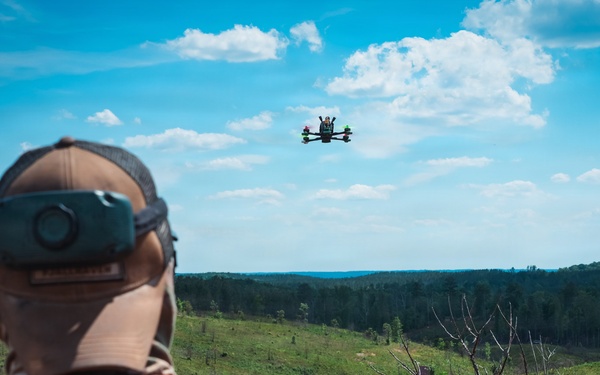
Army Secretary Dan Driscoll and acquisition chief Brent Ingraham announced June 23 that the Army will open domestic test ranges to defense vendors within four to six weeks, cutting through a 12-to-18-month booking backlog that has kept commercial counter-drone technology off the battlefield. At least two of those ranges will be reconfigured to simulate Ukrainian forward-line conditions — contested electronic warfare environments where drone manufacturers and counter-drone system builders can test their hardware alongside soldiers, not wait in line for a range slot that won't open for another year or more.
Background
The announcement came at the Army's low-cost interceptor industry day on June 23, a forum that drew vendors across the full spectrum of intercept technologies and was organized around one of the service's most acute cost problems. As Dwayne Hynes of the Army's intelligence staff described at the industry day: “We just shot an exquisite $2 million interceptor against a $20,000 drone made out of commercial off-the-shelf components.” Russia produces more than 5,000 Shahed-type drones and approximately 600,000 first-person-view drones per month, a combined production volume that makes missile-for-drone attrition economically unsustainable at any realistic engagement rate.
Closing that cost gap requires faster access to capable commercial solutions across every intercept discipline — kinetic kill systems, electronic jamming platforms, net-capture devices, and directed energy weapons. The Army's existing range scheduling process has been the structural bottleneck. Established defense prime contractors hold long-term range agreements and dedicated test infrastructure that keeps them in the evaluation pipeline regardless of scheduling pressure. Small businesses and nontraditional vendors — the companies most likely to generate the low-cost, rapidly iterable counter-drone solutions the Army needs — have faced booking windows stretching 12 to 18 months, long enough to eliminate promising technologies from active procurement cycles before they receive any evaluation at all.
Ukraine changed the Army's reference point. Ukrainian forces built a culture of rapid battlefield experimentation that the U.S. has struggled to replicate under domestic acquisition constraints. The Army treated that battlefield culture as a direct design requirement for the June 23 initiative.
Key Details
Driscoll and Ingraham directed range commanders to identify at least two domestic facilities within four to six weeks capable of replicating the forward line of troops environment found in Ukraine. Those ranges will host drone manufacturers and counter-drone vendors simultaneously, placing both inside contested electromagnetic environments where active jamming, spoofing systems, and physical intercept platforms interact under real operational conditions — not the sanitized test scenarios where demanding threat environments are absent by design.
The Army is also planning at least one international testing range through an unspecified allied partner nation, described by officials as enabling tests that domestic regulatory constraints prevent. FAA airspace rules and FCC spectrum restrictions on radio frequency jamming limit what can be reproduced on U.S. soil. The allied-nation facility will allow vendors to test capabilities that domestic law currently prevents them from demonstrating, expanding the competitive aperture for companies with advanced electronic attack or directed energy systems.
Brig. Gen. Guy Yelverton III, capability program executive for the Army's defensive fires, participated in the industry day alongside Driscoll and Ingraham, as did Dwayne Hynes from the Army's intelligence staff. Their presence signals this is not a vendor outreach event disconnected from procurement — it connects directly to formal acquisition requirements and intelligence-defined threat parameters. Companies that demonstrate capability at these ranges will be feeding performance data into the Army's active evaluation framework, not a pilot program that runs parallel to the acquisition system.
The Army's decision to convene Driscoll, Ingraham, Yelverton, and Hynes at a single industry day — spanning secretarial, acquisition, fires, and intelligence functions — signals that the range opening is connected to active procurement decisions rather than a stand-alone outreach initiative. The Army is actively mapping commercial solutions across kinetic, electronic, and directed energy disciplines and intends to move qualifying systems into formal evaluation on compressed timelines.
What It Means for Contractors
Defense companies developing counter-drone systems should expect specific range availability announcements from Army range commanders within four to six weeks of June 23. Companies that have been blocked from access by booking backlogs should begin preparing testing documentation, capability briefs, and performance specifications now — the Army indicated it wants vendors ready to mobilize as soon as sites are configured. The initiative favors companies that can move quickly over those that wait for official announcements before starting internal preparations.
The Ukrainian environment simulation requirement sets a concrete evaluation bar. Systems will be assessed in contested electromagnetic conditions — active jamming, spoofing, and GPS denial — rather than on ranges where the radio frequency environment is cooperative. Counter-drone solutions that rely on GPS-dependent navigation or unencrypted command links and perform adequately in benign conditions but degrade under EW threat will face a harder evaluation path than vendors who built contested-environment resilience into their core system architecture from the start.
The international range option is most relevant for companies developing electronic attack payloads, high-power microwave systems, or directed energy capabilities facing domestic airspace and spectrum restrictions. The Army's decision to route those tests through an allied nation facility rather than exclude them from the program opens a meaningful competitive lane for vendors whose highest-performing systems currently cannot be demonstrated on U.S. soil.
Small businesses and nontraditional vendors benefit most from the backlog reduction, but they also face the tightest operational constraints on rapid test mobilization. Companies should engage Army program offices immediately to understand queue priority and range configuration timelines. The Army's stated objective is speed — vendors that cannot mobilize at pace with an initiative designed to compress years off the counter-drone fielding timeline will lose evaluation opportunities to competitors who can.
The cost-curve math creates real urgency. The Army cannot sustain a $2 million interceptor economy against an adversary producing $20,000 drones by the thousands each month. Every month a viable low-cost intercept system spends waiting for a range booking is a month that system is not in soldiers' hands. The range initiative removes one of the primary structural barriers that has slowed commercial solutions from reaching procurement decisions, and Army program offices have clear institutional incentives to move qualified systems through evaluation and into fielded capability as fast as they can demonstrate performance.
