
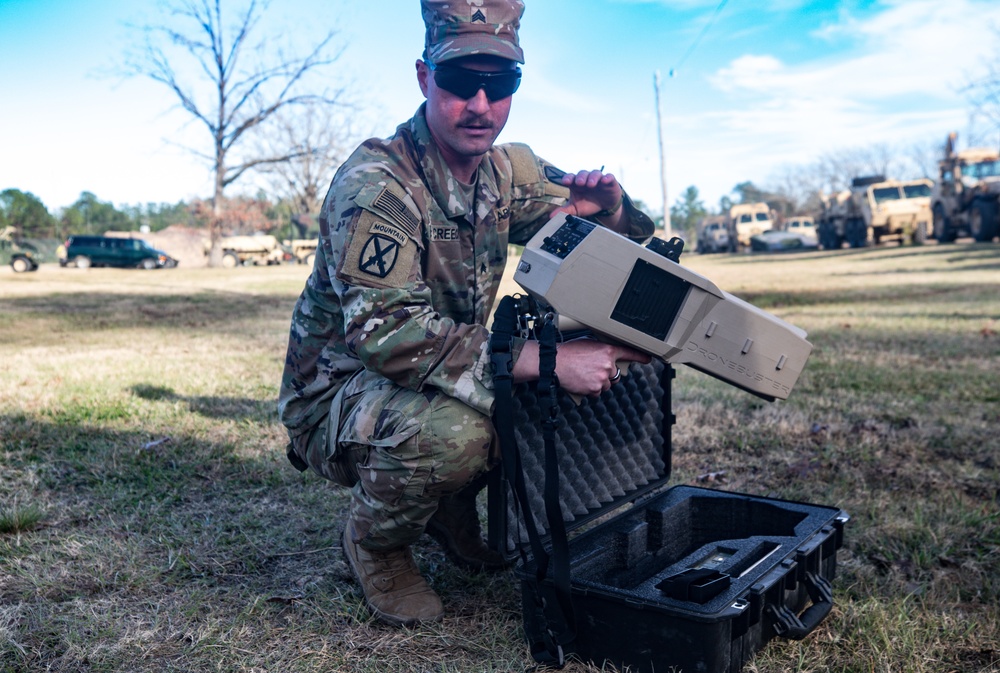
Ten companies now hold a place on a new Army counter-drone contracting vehicle, and officials say more awards are coming. Army acquisition leaders and Joint Interagency Task Force 401 (JIATF-401) officials announced Sept. 29 that the Army awarded multiple contracts worth up to $7 billion for counter-drone capabilities, with awards beginning Monday, Sept. 28.
The contracts sit under an indefinite delivery, indefinite quantity (IDIQ) vehicle. It supports the Pentagon's drone and counter-drone marketplace and the Domestic Shield program, which aims to protect U.S. military installations and critical infrastructure from small drones. The vehicle also supports other counter-UAS requirements across the federal government, according to Breaking Defense.
Who Holds the Ten Counter-Drone IDIQs?
Breaking Defense listed the following base values for the ten awardees:
- Allen Control Systems: $500 million
- Digital Force Technologies: $500 million
- DroneShield: $500 million
- Echodyne: $250 million
- Napatree Technology: $500 million
- PVP Advanced EO Systems: $250 million
- RADA Technologies: $500 million
- SmartShooter: $150 million
- SRC: $500 million
- L3Harris WESCAM: $500 million
Those base values add up to $4.15 billion, which matches the figure in Defense Daily's account. Defense Daily reported that the task force listed 10 single-award, three-year ID/IQ contracts amounting to $4.15 billion, and said more awards will be made as requirements are developed. Only the opening of that report is public, so the vendor list rests on Breaking Defense.
The gap between the $4.15 billion in listed base value and the headline figure of up to $7 billion is not itemized in the sources reviewed here. Defense Daily's lede describes the awards as valued at nearly $7 billion. The sources do not explain how the difference is divided among the vendors or reserved for later awards.
The Army did not detail which capability each company will provide, so the list does not reveal who supplies detection, who supplies defeat, and who supplies the software that ties them together.
Why Did the Army Choose Ten Vendors Instead of One?
The structure is deliberate. Brent Ingraham, Assistant Secretary of the Army for Acquisition, Logistics and Technology, told reporters the vehicles span a range of counter-drone capabilities. He also made the case against picking a single supplier.
"These vehicles we awarded yesterday span a range of counter-UAS capabilities — from sensors to effectors to C2 [command and control] systems. [They] really give us options as newer requirements emerge. The Army wants competition. The JIATF-401 team wants competition. We want to bring better technology forward every day, and we don't want to be locked into a single vendor as that threat evolves," Ingraham said. "We've laid the contracting foundation before the next requirement hits."
Brig. Gen. Matt Ross, JIATF-401's commanding general, framed the technical logic. The goal, he said, is a "layered defense" that can detect, track, identify, mitigate and capture drones. Rather than relying on a single "system of systems," the Army is buying multiple interoperable systems to perform those functions, Ross said.
"There's no silver bullet. I think at times in the past, people thought that we could just down-select to a really good counter-UAS capability and give one to everybody," Ross said. "What we've seen is that there is no single solution."
That reasoning fits a vehicle that spans sensors, effectors and command-and-control systems. As a general matter, a radar or electro-optical sensor is of little use without a way to cue an effector, and no single effector handles every drone profile. Ten separate single-award IDIQs would let buyers draw pieces from different holders and combine them as a site's needs dictate, though the sources do not describe how task orders will be run.
What Does a $7 Billion Ceiling Do for the Domestic Shield Program?
Domestic Shield targets small drones over U.S. military installations and critical infrastructure. An IDIQ vehicle does not obligate money by itself, so the awards create a pre-competed path for buying rather than a guaranteed stream of orders. Ingraham said the point was to have the contracting foundation in place before the next requirement arrives.
Ingraham said he expects the counter-drone marketplace to be as successful as the Army's drone marketplace, which he said has made over $800 million in sales to date. Through the marketplace, he said, soldiers, other federal agencies and allied nations can purchase various counter-drone capabilities. Ross described the marketplace as a way to connect producers with customers so they can see demand across the United States and among partners and allies.
Ross also said demand for such systems "exceeds available supply right now," and argued that a large IDIQ helps producers plan for it:
"A large IDIQ contract will allow companies to raise additional capital to build up their inventory because they have a reasonable expectation that we're going to continue to partner with them," Ross said.
What Remains Unanswered About Delivery?
Several basic questions are open. Neither Ingraham nor Ross answered questions about when the systems are expected to be delivered or to whom, according to Breaking Defense. The Army also did not detail which vendor provides which capability, and the sources reviewed here do not say which installations come first or how task orders will be competed among the ten holders.
Ingraham and Ross also said the Army will use multiple acquisition channels for buys, such as commercial solutions openings, a Common Command and Control Enterprise License Agreement, existing service contracts and the Pentagon's drone and counter-drone marketplaces. The IDIQ is therefore one route among several, not the sole path to a fielded system.
What It Means for Contractors
For the ten holders, the awards are a license to compete for task orders, not revenue. The base values range from $150 million for SmartShooter to $500 million for seven of the awardees, and the sources do not say how much of any base value will be ordered. Contract holders should expect the real competition to happen at the task-order level, where the Army has said it wants options and does not want to be locked into one vendor.
For companies not on the list, the door may not be shut. Defense Daily reported that more awards will be made as requirements develop. Firms that make sensors, effectors or command-and-control software for small-drone defense should track JIATF-401 announcements and position for later additions. Nothing in the sources reviewed says how or when a new on-ramp would open, so that remains a question to put to the task force directly.
For primes and integrators, the message is that interoperability matters more than a single product. Ross's rejection of a single "system of systems" suggests an advantage for vendors whose products can plug into a shared command-and-control layer. Subcontractors and suppliers to the ten holders may also see teaming demand, since a vehicle this broad could draw partnerships to fill capability gaps.
Finally, the Army is telling the market that demand outruns supply. Vendors that can show production capacity, and that can use a vehicle of this size to justify raising capital for inventory, are the ones Ross's comments were aimed at.
