
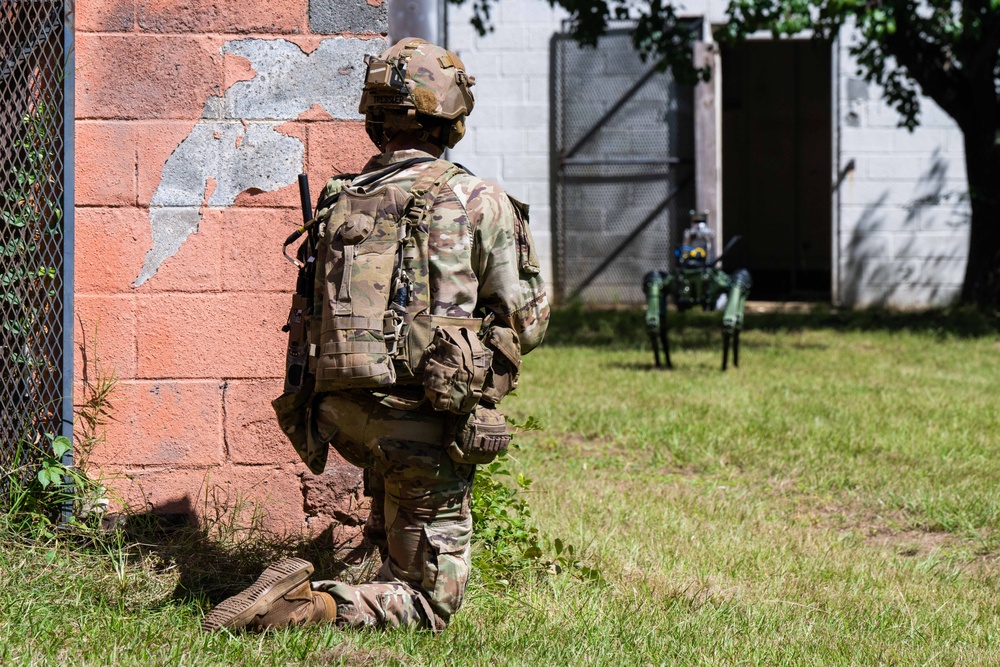
Army Contracting Command-Aberdeen Proving Ground published a request for information on June 17, 2026, seeking industry input on an autonomous ground vehicle capable of recovering disabled or destroyed military vehicles from contested combat zones without exposing recovery crews to direct fire. The market survey closes July 31, 2026.
Background
Military vehicle recovery operations rank among the most dangerous missions in ground warfare. Recovery crews must approach disabled equipment on the battlefield — tanks, artillery pieces, wheeled vehicles — sometimes while under direct fire or in terrain controlled by the adversary. Attaching tow cables, rigging lift points, and operating winches requires personnel to dismount and work within reach of the disabled platform. Current recovery operations are resource-intensive, demanding significant manpower, specialized teams, and extended periods of exposure — conditions that multiply risk when an adversary can observe and engage the recovery site.
Ukrainian forces adapted by fielding small unmanned ground vehicles equipped with nets and hooks to pull disabled unmanned vehicles and drones off the battlefield without exposing soldiers to hostile fire. The tactic demonstrated that autonomous or semi-autonomous recovery was operationally practical — not a laboratory concept — and that it reduced both personnel casualties and equipment loss rates. U.S. ground force planners are now examining whether autonomous recovery scales to heavier platforms: infantry fighting vehicles, tanks, and self-propelled artillery. The weight and mechanical complexity of recovering a disabled armored vehicle differ sharply from retrieving a drone, but the core operational logic — remove the human from the recovery point — holds.
The Army's June 17 RFI formalizes that lesson into a structured requirements-gathering process. Rather than specifying a platform or mandating a technology path, the Army is surveying industry on what exists, what is being developed, and where the capability gaps are. Market surveys of this type precede a formal solicitation: they let the Army calibrate requirements to real industrial capacity rather than build a specification in isolation. The survey also signals intent — when the Army formalizes a question in a public RFI, it is indicating that a procurement path is under active consideration.
Key Details
The RFI identifies four capability requirements the Army wants industry to address.
Autonomous rigging and towing without ground personnel. The vehicle must approach a disabled platform, connect to its tow points or recovery hard points, and extract it from a contested zone without dismounted soldiers. That requires manipulator arms, purpose-built rigging attachments, or alternative mechanical interfaces capable of operating on damaged vehicles under field conditions — uneven terrain, debris fields, and extreme weather — rather than in a structured maintenance depot.
Navigation in DDIL environments. The system must function in Denied, Degraded, Intermittent, and Limited network conditions. GPS jamming, cellular disruption, and contested electromagnetic warfare are baseline features of peer conflict. A recovery vehicle that requires continuous GPS lock or a stable data uplink is operationally useless precisely in the scenarios the Army is preparing for. The RFI demands autonomous navigation that works when networks are absent or unreliable.
Ruggedization for contested terrain. The platform must operate across the full range of battlefield conditions: mud, rubble, steep slopes, and under direct and indirect fire. Testing-range performance on paved surfaces does not satisfy the requirement.
Reduced manpower. The Army does not specify a headcount target, but the direction is clear: fewer soldiers exposed per recovery event than current manual recovery team procedures.
The Army stated it is open to modifications of existing platforms and clean-sheet designs, a signal intended to attract both established defense primes with ground vehicle portfolios and robotics startups with novel autonomous systems. DefenseScoop first reported the RFI on June 22. Responses due July 31, 2026, will shape future solicitation requirements and may influence the performance thresholds the Army writes into any follow-on contract.
What It Means for Contractors
The response window is tight but workable for vendors already tracking Army autonomous systems programs. The competitive landscape is wide. Defense primes with active robotic combat vehicle programs are natural respondents, given their existing ground vehicle portfolios and familiarity with Army acquisition processes. So are specialist robotics companies focused on DDIL navigation, autonomous manipulation, field logistics, and unmanned ground vehicle development. The RFI's explicit openness to clean-sheet designs lowers the barrier for newer entrants who have demonstrated autonomous capability but lack an established ground vehicle platform. Both incumbents and newer entrants should assess quickly how their existing work addresses the four stated requirements.
The hardest technical challenge is integrating DDIL navigation with autonomous rigging. GPS-denied navigation has fielded solutions — inertial navigation, visual odometry, and terrain-relative guidance — and autonomous manipulation in structured environments is achievable. Combining both into a single platform ruggedized for contested terrain, capable of connecting to an asymmetrically damaged vehicle, and doing so without GPS or reliable communications is the harder engineering problem. A system that excels at navigation but cannot reliably connect to a damaged vehicle fails the core requirement; one that rigs efficiently but depends on GPS fails in the precise environments the Army is planning for. Vendors should address that integration challenge directly in their responses rather than treating each requirement as separately solved.
The Ukrainian precedent sets an implicit performance floor. The Army is not looking for a depot-level recovery system or a rear-area maintenance vehicle. It wants a platform that operates at or near the forward line of troops, survives battlefield damage, and keeps functioning without persistent human oversight. Responses framed around operational availability, ease of field maintenance, and forward-deployed robustness will carry more weight than those built around laboratory precision or controlled testing environments.
This market survey does not obligate the Army to a specific procurement or schedule. But the convergence of Ukraine battlefield lessons and the Army's urgency to field capable autonomous ground systems points toward a contract taking shape. Vendors who engage through the RFI process establish technical credibility early in a competition that is gaining momentum and have the opportunity to influence how requirements are ultimately written.
