
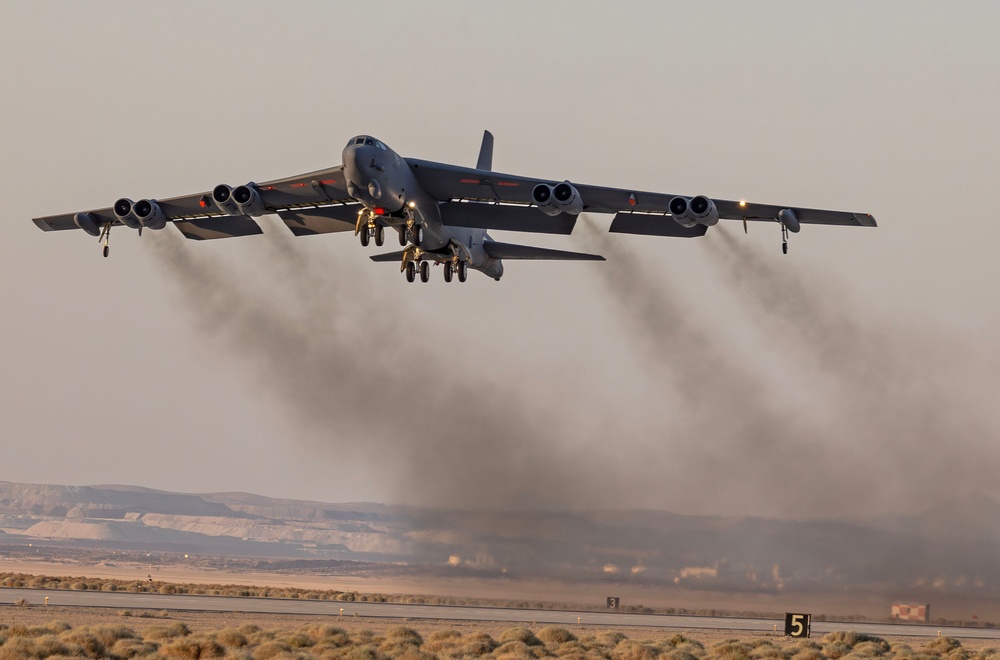
A B-52 Stratofortress assigned to the B-52 Radar Modernization Program crashed shortly after takeoff at Edwards Air Force Base on June 15, 2026, killing all eight people aboard in what the Air Force described as an unexplained catastrophic loss, according to Air and Space Forces Magazine.
The crash occurred at 11:20 a.m. PDT during a scheduled developmental test sortie. The eight fatalities included active-duty aircrew, government civilian testers, and at least two Boeing employees confirmed dead by the company in a statement released the same day. It is the deadliest accident at Edwards Air Force Base since 1951, when a B-50D crash at the base also claimed eight lives. Families of all eight victims have been notified, and the Air Force has asked the public and media to respect their privacy during the ongoing investigation period. The aircraft erupted in flames so severe the fire consumed practically the entire airframe, and no survivors were located at the crash site.
The aircraft, reportedly carrying tail number 061 though the Air Force has not officially confirmed that designation, was the first B-52H in the entire fleet to be outfitted with the AN/APQ-188 Active Electronically Scanned Array radar, a Raytheon Technologies-developed system at the heart of the B-52J modernization effort. The test sortie was designed to gather early flight data on the new radar performance envelope during an initial airborne evaluation phase. Investigators have not identified a cause, and the Air Force says a definitive accounting may take as long as six months to complete.
Edwards AFB closed its airfield immediately following the crash and suspended all visitor passes as emergency and recovery teams secured the site and began wreckage documentation. The base has since restored limited flight operations for other test programs, though the B-52J radar test effort remains grounded and the accident investigation continues under Air Force Safety Center authority.
The loss of this aircraft is a significant blow to one of the Pentagon's highest-profile bomber recapitalization programs—one already running years behind schedule before this accident occurred.
Program Context: What Was at Stake
The B-52 Radar Modernization Program, the centerpiece of the broader B-52J effort to extend the bomber's operational life deep into the 21st century, was already under serious pressure before June 15. Program managers had previously acknowledged a three-year slip in the B-52J initial operational capability target, attributed in part to integration challenges between the new AESA radar and the aircraft's legacy avionics architecture developed decades earlier.
The AN/APQ-188, built by Raytheon Technologies, replaces the mechanically scanned AN/APQ-166 radar that has served the fleet for decades. The upgrade is meant to give the B-52 improved target discrimination, enhanced electronic protection, and precision mapping capability relevant to both nuclear and conventional missions across a wide range of threat environments. The radar is load-bearing to the bomber's future utility in contested airspace, where adversary electronic warfare systems have increasingly neutralized older sensor packages and reduced platform effectiveness against modern threats.
Boeing holds the prime integration contract for the B-52J modification package, which also includes new commercial derivative engines under a separate Rolls-Royce contract. The radar modernization work flows through Raytheon as a major subcontractor. Both companies now face unusual public scrutiny at a moment when one of them has confirmed employees were killed during a program test event.
The investigation will examine airworthiness documentation, test card planning, crew qualification records, maintenance logs, and whether any anomalies were flagged prior to the sortie. Until investigators report findings, the radar integration test program is expected to remain grounded, an outcome that could further compress the already strained schedule for fleet-wide installation across the remainder of the active B-52 fleet.
What It Means for Contractors
For the defense contracting community, the June 15 crash surfaces several immediate concerns that extend well beyond the human tragedy.
Schedule impact is the most direct consequence. The B-52J IOC date had already slipped three years before this accident. A six-month investigation combined with any flight test hold extends the gap further and narrows the margin available to recover lost time. Boeing and Raytheon program managers will need to present updated integrated master schedules to Air Force Materiel Command, and those updates are unlikely to be favorable. Contractors with downstream work tied to radar delivery milestones should expect schedule change proposals and potential claims activity in coming quarters.
Contractor employee safety in government flight test programs is a less-discussed but real liability exposure. Boeing's confirmation that two of its employees were aboard raises questions about informed consent procedures, hazard pay classifications, and whether contractor personnel on developmental test sorties are covered under Defense Base Act insurance. DBA applies to contractor employees working overseas on U.S. government contracts, but domestic test flight participants occupy a different statutory space. Contractors embedding personnel on high-risk government flight test programs should review indemnification clauses and FAR 52.228-7 insurance requirements with program counsel before the next sortie.
Independent safety oversight of developmental test programs may receive renewed congressional attention. The Air Force's 412th Test Wing at Edwards manages a broad portfolio of high-risk flight test operations across multiple platforms. Whether the B-52J program's test planning documentation, risk acceptance chain, and go/no-go criteria met applicable standards will be central to the investigation findings. Contractors bidding on future developmental flight test support work should anticipate tightened safety plan requirements and more rigorous pre-flight risk reviews as program offices absorb lessons from this accident.
Cost growth is a near-certainty regardless of what investigators find. The program office will incur unplanned costs tied to recovery operations, potential replacement test airframe scheduling, additional system-level reviews, and possible redesign work. If the cause points to a hardware or integration defect, Boeing or Raytheon could face contract modifications and delays in milestone payments that cascade to lower-tier suppliers throughout the supply chain.
The Air Force has stated it will release findings once the investigation concludes. The contracting community should not wait for that report. Programs with personnel embedded in government flight test operations, hardware under active developmental evaluation, or schedule commitments dependent on B-52J milestone events should begin internal risk assessments now rather than after the next program review cycle.
