
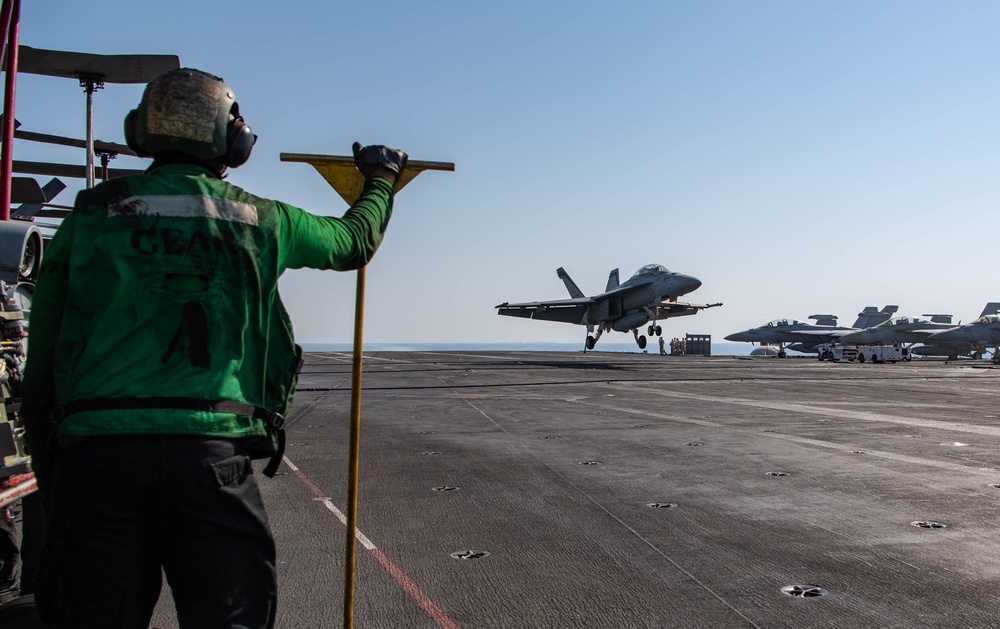
Boeing will build the Navy's next carrier fighter, ending years of uncertainty over what replaces the F/A-18E/F Super Hornet on the flight deck. The Pentagon announced the F/A-XX award on Sept. 29, 2026. As The Aviationist reported, the contract is valued at more than $20 billion for the full-scale development phase. The win gives Boeing a second sixth-generation fighter program, following the Air Force's F-47 award in 2025.
Defense News quoted the Pentagon release on the scope of the work: the contract "procures multiple test aircraft for ground, airworthiness, systems, and weapons integration testing." Boeing's own release, datelined St. Louis, calls it a "multi-billion-dollar contract" under which the company will design, build and deliver the Navy's sixth-generation fighter.
What Does the $20B F/A-XX Contract Actually Buy?
The award covers full-scale development, not production. That phase funds the engineering work and a set of test aircraft. Neither the Pentagon announcement as reported by The Aviationist and Defense News nor Boeing's release discloses a production quantity, a delivery schedule or a first-flight date. Naval News speculated that, if F/A-XX follows the F-47's pace of roughly three years between award and first flight, it could fly as soon as the end of the decade, provided there are no delays.
The technical content is closed. Boeing states that "the technical and programmatic details of F/A-XX remain classified under U.S. national security and export laws." The Navy released an artist's rendering of the Boeing design, cleared for public release, but little else about the aircraft.
Congress had already started paying for it. The Aviationist reports that the Fiscal Year 2026 Defense Appropriations Act allocated $897 million specifically to F/A-XX and directed the Pentagon to award a development contract aimed at accelerating initial operational capability, with wording that called out the department for the slow pace of the program.
Timing matters. Defense News says the carrier jet is expected to replace the aging inventory of F/A-18E/F Super Hornets and EA-18G Growlers beginning in the 2030s, and to operate alongside the F-35. The Aviationist adds that Navy officials have previously cited approximately 25 percent more range than the F-35C.
Why Did Boeing Beat Northrop Grumman for the Navy Fighter?
Defense News describes Northrop Grumman as what was considered Boeing's biggest competitor, iced out in late-stage negotiations. Neither the Pentagon release nor Boeing's release, as reported, explains the selection rationale, so the reasons are open to inference.
Naval News offers one. It notes that speculation over U.S. industrial capacity ran between the F-47 and F/A-XX awards, since both Boeing and Northrop already held a sixth-generation program (the F-47 and the B-21). The outlet concluded that Boeing's several-billion-dollar expansion of its fighter development and manufacturing capability "likely proved critical" to its success. That is Naval News's judgment rather than a stated Navy finding, and this article treats it the same way.
Boeing's release leans on the same theme. The company says construction continues on a secure manufacturing facility in St. Louis that it describes as the largest in the U.S., and that it will be part of what Boeing calls an all-digital aerospace design and manufacturing system.
Steve Parker, president and CEO of Boeing Defense, Space & Security, addressed the concurrency question directly: "Delivering two advanced fighters in parallel was always our plan, and we invested accordingly. We are ready and able to build multiple concurrent future combat aircraft franchise programs." Defense News said the win has all but guaranteed Boeing a monopoly on sixth-generation fighters across the services.
How F/A-XX Fits the Navy's Crewed-Uncrewed Air Wing
The Navy intends F/A-XX to lead a mix of crewed and uncrewed aircraft. The Aviationist quotes Adm. Daryl Caudle, the Chief of Naval Operations, on why the jet matters:
"The next-generation airframe, F/A-XX is so vital. It's vital because of, one, the CCAs it will command and control. Its penetration – the Growlers won't last forever, so it'll be our electronic attack airplane as well. Its range will be coupled with the MQ-25 for clandestine refueling and organic refueling from the carrier." (Adm. Daryl Caudle, as quoted by The Aviationist)
Caudle also said: "Our ability to fly with impunity with our existing airframes is fleeting." Rear Adm. Michael Donnelly, director of the air warfare division in the Office of the Chief of Naval Operations, said in earlier remarks cited by The Aviationist that F/A-XX "is intended to be a manned platform" and will be the pivot point from a manned air wing to a hybrid manned-unmanned one.
Pentagon and Navy leaders framed the award as a capability leap. Michael Duffey, Under Secretary for Acquisition and Sustainment, said in the release that "F/A-XX will dominate contested airspace, extend operational reach, and deliver a decisive combat advantage for the warfighter." Acting Secretary of the Navy Hung Cao said the award "marks a new era for the U.S. Navy."
What It Means for Contractors
For Boeing, the award locks in a development program of more than $20 billion and adds a second sixth-generation franchise to its defense portfolio. It also raises the stakes on execution. Defense News reports that the F-47 has entered its engineering and manufacturing development phase, with first flights expected as early as 2028, so any slip on either aircraft will draw scrutiny.
For the rest of the industrial base, three points stand out.
- Suppliers and subcontractors. Boeing says F/A-XX will be tied to its new secure St. Louis facility. Sub-tier firms in avionics, mission systems, propulsion, stealth materials and test equipment may see teaming and flow-down activity as development ramps up, though that is an expectation, not a reported fact. The public record does not yet show who the suppliers are, and the program's classification will limit what primes can say.
- The losing side. Defense News names Northrop Grumman as Boeing's main rival. Neither release, as reported, explains the decision, so bidders on future Navy programs should await any debrief before concluding how the service weighs capacity against technical merit.
- Autonomy vendors. Because Caudle describes F/A-XX as the aircraft that will command and control collaborative combat aircraft, CCA developers have a defined crewed platform to integrate with.
The announcement leaves open questions that contractors will want answered: the production quantity, the delivery schedule and how much of the more than $20 billion goes to test aircraft versus engineering. None appears in the announcement as reported. Annual appropriations will show how quickly the money moves from the $897 million in the fiscal 2026 act to the larger development spending that a $20 billion contract implies.
Sources
- Boeing Awarded Contract to Build U.S. Navy's F/A-XX Fighter (The Aviationist)
- US Navy selects Boeing to build next-generation F/A-XX fighter (Defense News)
- Boeing Wins U.S. Navy's F/A-XX Next Generation Fighter Contract (Naval News)
- U.S. Navy Selects Boeing for F/A-XX Program (Boeing press release, Sept. 29, 2026)
