
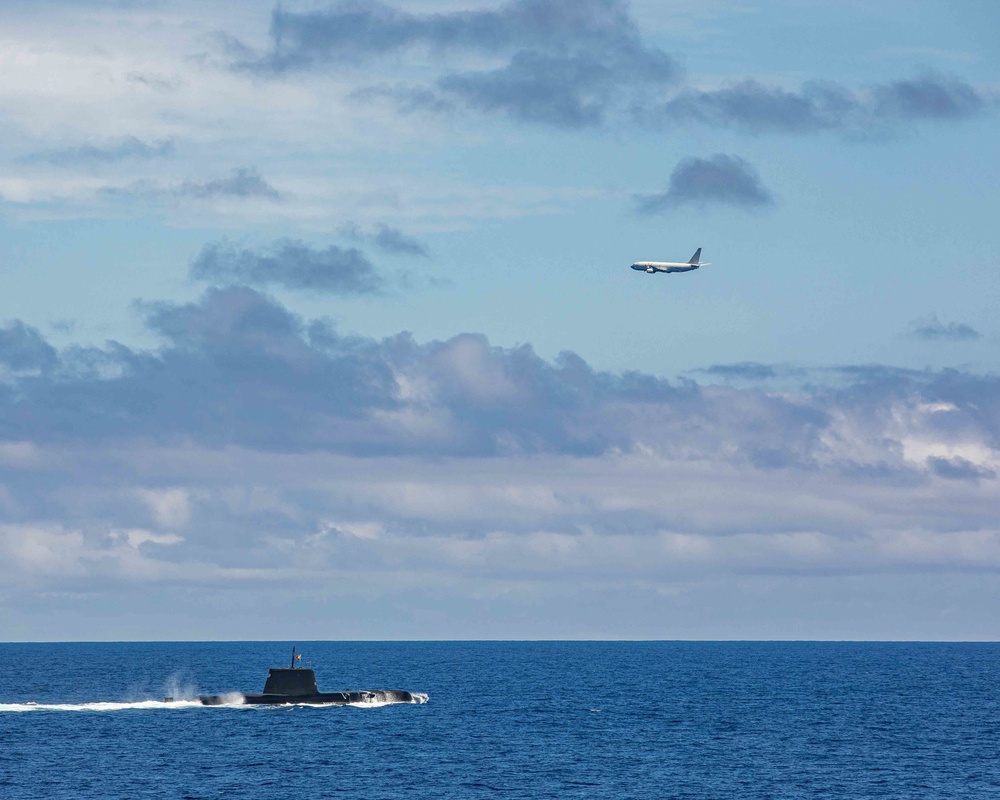
The U.S. Navy awarded Boeing a $121,195,041 cost-plus-fixed-fee order on June 22, 2026, to install Increment 3 Block 2 (I3B2) upgrades on nine P-8A Poseidon maritime patrol aircraft — six belonging to the U.S. Navy and three to the Royal Australian Air Force. The order, designated N0001926F1095, was placed against a previously issued basic ordering agreement and covers retrofit A-kit hardware incorporating Engineering Change Proposal Six (ECP-6) capabilities, three full A-kit installations aboard Navy aircraft, and non-recurring engineering to address diminishing manufacturing sources within the I3B2 program. Contracting activity is Naval Air Systems Command (NAVAIR), Patuxent River, Maryland, with work expected to conclude by May 2029.
Background
The P-8A Poseidon is the Navy's primary manned maritime patrol and reconnaissance aircraft, replacing the aging P-3C Orion fleet. Built by Boeing on a modified 737-800ERX airframe, it carries sensors and systems for anti-submarine warfare (ASW), surface warfare, and intelligence, surveillance, and reconnaissance missions. The Royal Australian Air Force (RAAF) operates P-8As under a Foreign Military Sales arrangement with NAVAIR acting as the procuring and contracting agent on the RAAF's behalf.
The Increment 3 Block 2 upgrade cycle represents the latest hardware-and-software modernization pass for the platform. Previous increment blocks have progressively enhanced the aircraft's acoustic processing, multi-static active coherent sonar integration, and communications interoperability with allied navies. ECP-6, the specific engineering change package in this order, addresses sensor-suite refinements and communications upgrades; the contract notice references work on diminishing manufacturing sources — components whose original suppliers have ceased production — a routine but operationally critical challenge for a mature platform.
The retrofit A-kit is the aircraft-specific wiring harness, rack, and structural provisions that allow mission systems to be installed inside the fuselage. Delivering nine A-kits ahead of the three scheduled Navy installations allows Boeing to prepare the remaining six Navy kits and all three RAAF kits for installation in subsequent periods without waiting for hardware production to catch up to the schedule.
Contract Details
The $121,195,041 order is funded from three appropriations streams. U.S. Navy fiscal year 2026 aircraft procurement funds account for $92,809,039 — roughly 77 percent of the total. Navy FY2024 aircraft procurement funds contribute an additional $8,272,791, reflecting prior-year funding that was obligated as part of the ordering agreement mechanism. The Royal Australian Air Force contributes $20,113,211 in direct foreign partner funds, covering its three-aircraft share of the hardware and associated engineering.
Work will be performed across three Boeing facilities: Jacksonville, Florida handles 80 percent of the workload and is where the P-8A maintenance, modification, and upgrade flow line operates. St. Louis, Missouri accounts for 11 percent, and Mesa, Arizona for the remaining 9 percent. The geographic spread reflects Boeing Defense's distributed production model, where avionics integration and structural modification work are split across specialized facilities rather than concentrated at a single site.
This order is separate from an $880 million P-8A training systems indefinite-delivery/indefinite-quantity contract that the Naval Air Warfare Center Training Systems Division awarded Boeing on June 19, 2026, which covers procurement, sustainment, and modernization of crew training devices — simulators, part-task trainers, and courseware. The June 22 hardware order addresses the operational aircraft themselves, not the training infrastructure. Both contracts are active simultaneously, reflecting the breadth of the P-8A's sustainment and modernization pipeline.
RAAF Participation and Allied Integration
Australia's inclusion in this order underscores the depth of U.S.-Australia defense industrial cooperation on maritime patrol. The RAAF's P-8As are maintained on a common configuration with U.S. Navy aircraft, which reduces lifecycle costs for both nations and allows crews to cross-train on the same systems. When RAAF P-8As are upgraded to ECP-6 standards, they will be interoperable with U.S. Navy aircraft during joint exercises and coalition patrols in the Indo-Pacific.
Australia's contribution of $20,113,211 directly funds its share of the nine retrofit kits. Under the FMS arrangement, NAVAIR acts as the procuring and contracting agent on behalf of the RAAF, bundling the foreign purchase into the same Boeing order that covers U.S. Navy aircraft. This approach gives Australia access to a mature production run rather than a separate, smaller and more expensive procurement.
Diminishing Manufacturing Sources
The non-recurring engineering scope — addressing diminishing manufacturing sources — is a significant and often underreported aspect of long-duration aviation programs. When original component suppliers exit the market or discontinue a part, the program office must either qualify a new supplier, redesign the affected subsystem to accept a replacement component, or accept the risk of future parts shortages. For the P-8A, which the Navy intends to operate for decades, resolving these gaps now prevents a compounding maintenance burden as the fleet ages.
NAVAIR has addressed similar challenges across other mature platforms — the F/A-18 Super Hornet, the E-2D Advanced Hawkeye, and the MH-60R Seahawk. The inclusion of diminishing manufacturing source engineering in this P-8A order follows the same pattern: upgrade work is bundled with supply-chain remediation so that the modernized aircraft emerges with a cleared parts horizon, not just improved capability.
What It Means for Contractors
- Boeing Defense, Space & Security is the sole awardee on this order. The three-facility work split — Jacksonville (80%), St. Louis (11%), Mesa (9%) — is already established; subcontract opportunities at this stage would flow through Boeing's existing supplier relationships for avionics, wiring harnesses, and structural components.
- Suppliers whose parts appear on the P-8A's diminishing manufacturing sources list should contact Boeing's P-8A program team in Jacksonville. NAVAIR has authorized non-recurring engineering funding specifically to qualify replacement sources, which opens the door to new supplier qualification contracts.
- Australian defense contractors should note that $20,113,211 in RAAF-funded work flows through this U.S.-managed order. While Boeing performs the primary integration work, Australian Industry Capability obligations under the RAAF's FMS case may create subcontracting opportunities for in-country sustainment and logistics support firms.
- The May 2029 completion date, combined with the existing $880 million training IDIQ, indicates the Navy is managing the P-8A fleet through a multi-year modernization cycle. Companies offering avionics integration, testing, and logistics support services should watch forthcoming task order activity under both vehicles.
- Firms tracking the P-8A program should note that NAVAIR uses a basic ordering agreement structure for these modifications. New ECP packages and future block upgrades will likely generate additional orders against the same or successor ordering agreement, creating recurring work for qualified suppliers who are already on the vehicle.
