
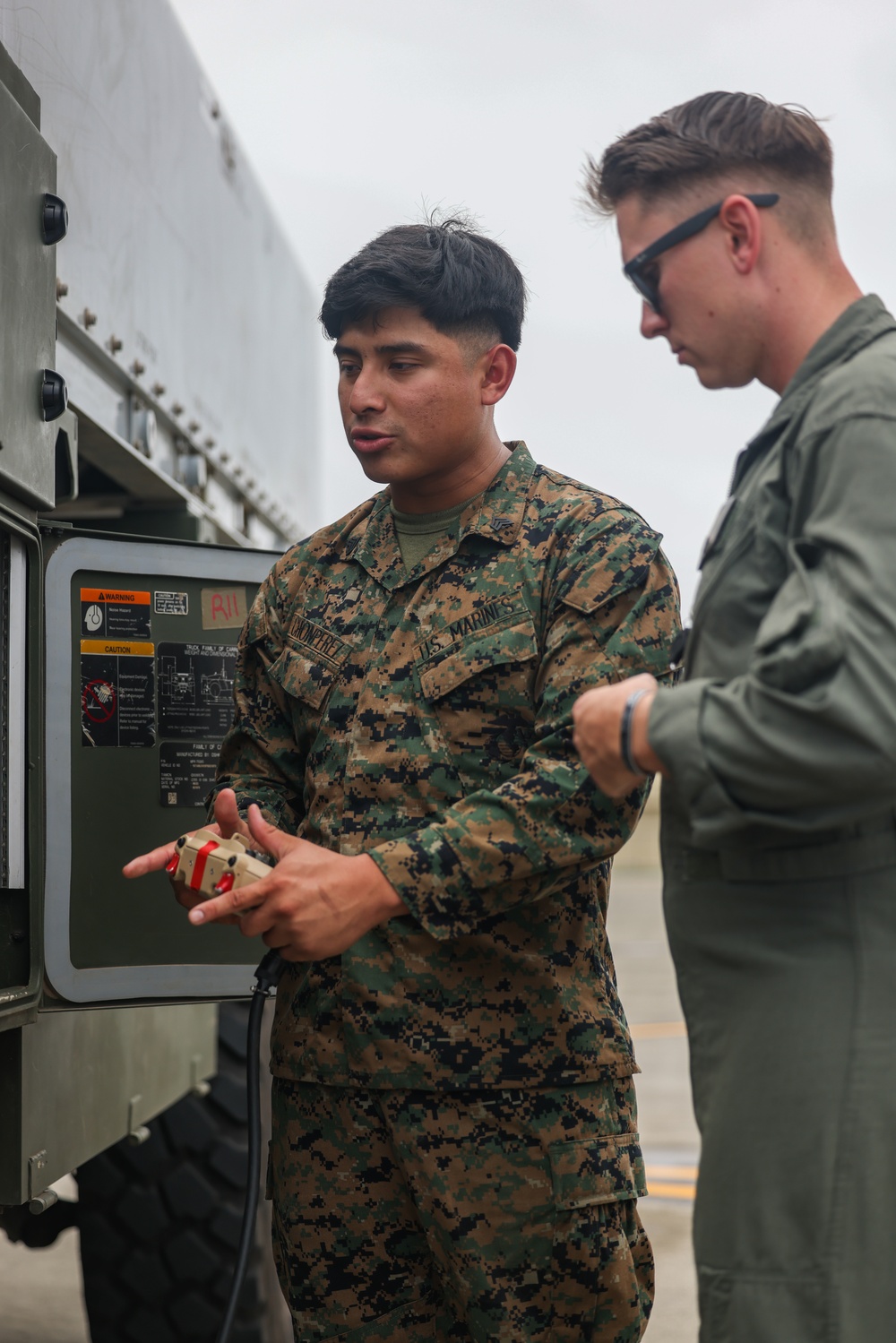
The Navy and Marine Corps have awarded a $33.86 million contract to Corvid Technologies LLC of Mooresville, North Carolina, to manufacture weapon-sled assemblies for the Navy/Marine Expeditionary Ship Interdiction System, the Marine Corps' land-based anti-ship missile launcher. The award, published in the Department of War's Aug. 21, 2026 daily contracts announcement, covers production and sustainment support through August 2034.
Background
NMESIS pairs a remotely operated launcher built on a Joint Light Tactical Vehicle chassis with two Naval Strike Missiles, giving Marine littoral units a mobile, land-based means of holding enemy shipping at risk from shore. The system grew out of the Marine Corps' broader shift toward Force Design, which reorganized the service around small, dispersed units able to operate inside contested waters and threaten adversary naval movement with precision fires rather than mass formations.
The Corps fielded its first NMESIS batteries to the 3d Marine Littoral Regiment in 2023. That early fielding has since matured into forward deployment: the system reached the 12th Marine Littoral Regiment in Okinawa, Japan, in June 2026, placing NMESIS batteries within reach of the East China Sea amid heightened Indo-Pacific tensions with China.
Corvid Technologies' Mooresville, North Carolina facility is where the new sled assemblies will be produced.
NMESIS batteries operate dispersed across small islands and coastal terrain, moving between firing positions to avoid detection — a concept the Marine Corps calls Expeditionary Advanced Base Operations. That mode of employment puts heavy wear on the launcher hardware, since the JLTV chassis and its missile-carrying sled absorb repeated off-road movement and rapid setup-and-displacement cycles a garrisoned system would rarely see. Reliable, field-replaceable sled assemblies are central to keeping batteries mission-capable once dispersed across a theater rather than staged at one fixed site.
Key Details
The $33.86 million award is structured as an indefinite-delivery/indefinite-quantity contract that blends firm-fixed-price, cost-plus-fixed-fee, and cost-reimbursement line items — a combination the Navy typically uses when a program needs predictable production pricing alongside flexibility to fund evolving repair and sustainment tasks under the same vehicle. Work runs through August 2034, an eight-year window that extends well past the initial production run and signals the Navy expects to keep ordering sled assemblies and related support under this contract for the better part of a decade.
The weapon sled is the structural assembly that carries the Naval Strike Missile canisters on the NMESIS launcher and interfaces with the JLTV platform underneath. As NMESIS moves from early prototype units to units actually sitting in Okinawa, the Navy needs a steady, contracted source for replacement sleds and spare parts — the unglamorous logistics tail that turns a fielded weapon into a sustained one. The contract notice does not break out individual task orders, so specific quantities and delivery dates under the $33.86 million ceiling are not yet public.
The award was made without competition, listed as a sole-source action justified by the value of a single qualified source for a component tied directly to missile safety and launcher performance.
What It Means for Contractors
The Corvid award is a marker of where NMESIS sits in its life cycle. The Marine Corps has stated it wants 18 launchers per battery by fiscal 2033, which means the program is moving from a handful of demonstrator units toward a fleet-scale inventory that has to be maintained, repaired, and resupplied across multiple littoral regiments simultaneously. Contracts like this one — an IDIQ vehicle for sled assemblies and follow-on task orders rather than a single production lot — are the kind of sustainment work that follows a system once it leaves the prototype phase and enters the hands of operating forces.
For manufacturers positioned in the Marine littoral warfare supply chain, the contract underscores that NMESIS sustainment dollars are now flowing at a level separate from the missile itself. The missile and the launcher vehicle each have their own established production lines, but the structural and integration hardware that connects the two, like the weapon sled, represents a distinct sourcing lane that a mid-sized specialty manufacturer such as Corvid can capture and hold as a sole-source vendor. Companies with structural engineering, vehicle-integration, or munitions-carriage expertise should treat this as a signal that the Navy is willing to contract out discrete NMESIS subsystems rather than folding all sustainment into a single prime's umbrella contract.
The sole-source nature of the award also matters for firms hoping to compete for future NMESIS work. Once a vendor is locked in as the qualified source for a structural component tied to missile carriage, displacing that vendor on a later recompete becomes difficult without a compelling technical or cost case, since safety-critical hardware changes typically require requalification testing that adds time and risk the government would rather avoid. Companies that want a piece of NMESIS sustainment work going forward may have a stronger case entering through adjacent scopes — training devices, technical publications, or depot-level repair services — where Corvid's award does not already establish an incumbent lock, rather than trying to unseat the sled-assembly contract itself.
The Okinawa deployment referenced in coverage of this award also points to where near-term demand could concentrate. As additional Marine Littoral Regiments stand up NMESIS batteries, the logistics tail behind each battery will need to scale with them, and the eight-year period of performance on this contract suggests the Navy structured it with recurring, incremental demand in mind rather than a one-time buy.
Small and mid-sized manufacturers watching the NMESIS program should note the pattern this award may fit: the Navy structuring sustainment around separate, sole-source IDIQ vehicles for individual hardware elements as the program matures, rather than bundling everything into one omnibus contract. That would create multiple entry points into the same program over time, even as the sled-assembly line stays with Corvid through 2034. Firms tracking NMESIS should watch for parallel solicitations covering training devices, technical manuals, and depot-level maintenance as the program scales toward its fiscal 2033 fielding target.
