
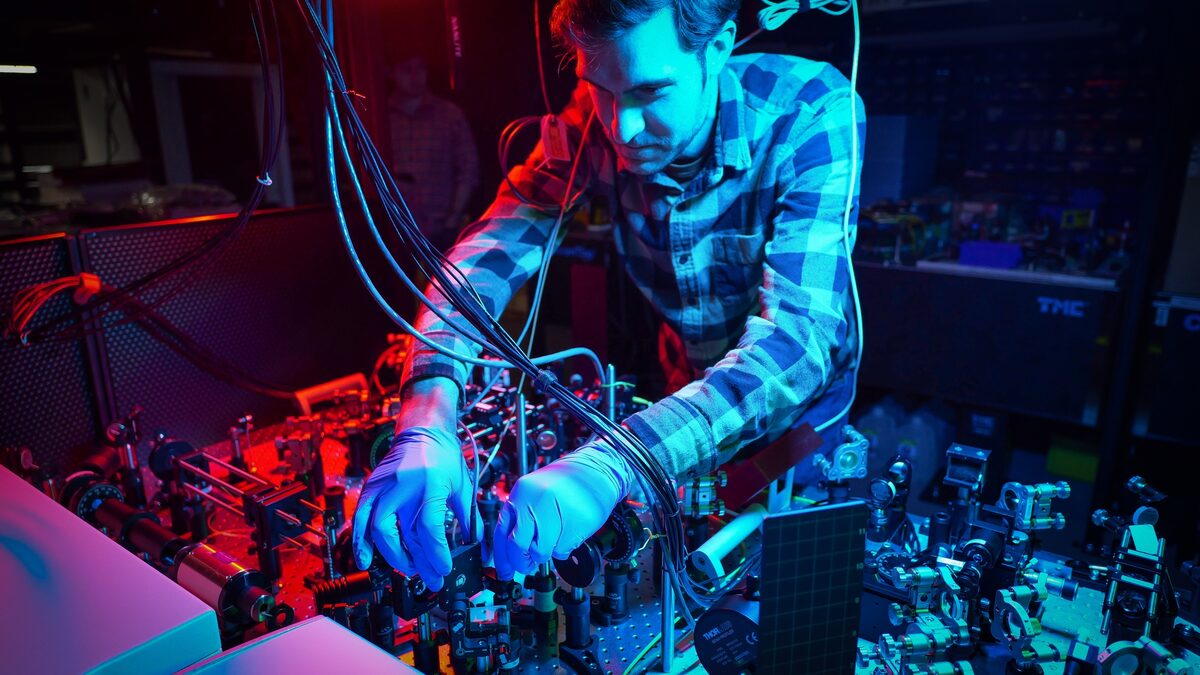
The Defense Advanced Research Projects Agency has awarded IonQ a $28 million contract under its "It's About Time" program to build a pilot manufacturing line for tactical-grade optical atomic clocks that operate without GPS.
Background
DARPA's timing and positioning portfolio has spent years chasing an alternative to GPS-dependent navigation for military platforms. GPS signals are precise but fragile: they can be jammed, spoofed, or denied outright in contested environments, and every system that relies on satellite timing for navigation, communications, or weapons guidance inherits that vulnerability by default. The agency's earlier ROCkN and OASIC programs pushed laboratory-grade optical atomic clocks toward higher precision, but Program Manager Mukund Vengalattore said that work rarely made it out of the lab and into fielded systems. "For too long, the quantum community has driven the state-of-the-art exclusively within the laboratory, but these innovations rarely make it into the field," Vengalattore said in DARPA's announcement of the award.
"It's About Time" is designed to close that gap by funding not just clock design but the manufacturing capacity needed to build clocks in volume rather than one at a time on a lab bench. IonQ, a quantum computing company that acquired optical-clock developer Vector Atomic in October 2025, is the only awardee named under the effort so far. The underlying hardware, the Evergreen-05 optical atomic clock, was originally developed by Vector Atomic before the acquisition folded the technology into IonQ's broader quantum hardware business.
Key Details
DARPA's award is valued at $28 million. IonQ is adding $15 million of its own capital on top of that figure, directing the combined roughly $43 million toward manufacturing infrastructure, production equipment, and testing capability rather than further clock redesign. The goal is a repeatable production pipeline capable of turning out units on a schedule, not another one-off prototype demonstration.
The Evergreen-05 clock is rated for 50-femtosecond timing stability at one second. DARPA says integrating clocks at that performance level into Department of War platforms will introduce picosecond-level timing precision into operational systems that currently rely on GPS. That level of stability matters for systems that need synchronized, accurate timing to function in a denied or degraded satellite-navigation environment, including networked sensors, secure communications links, and precision-guided systems that today lean on GPS timing signals to stay coordinated.
IonQ's manufacturing facility is targeted to open in mid-2027. Under the program's production milestones, IonQ is expected to deliver 125 clock units to U.S. government customers within one year of the facility's completion, a schedule that treats "It's About Time" as a manufacturing scale-up effort with a hard delivery commitment rather than a research contract that ends with a single demonstration unit.
What It Means for Contractors
The award signals where DARPA wants to spend the next phase of its quantum-timing budget: not on incremental precision gains in the lab, but on standing up production lines that can actually supply hardware to the field on a set timeline. Contractors chasing "It's About Time" follow-on work, or future timing and positioning solicitations more broadly, should expect DARPA to weight manufacturing readiness and delivery cadence alongside raw clock performance. A company with a technically superior clock but no credible path to volume production is a weaker bid under this program's stated logic than one that can point to a concrete 125-unit-in-a-year delivery plan backed by real facility investment.
The IonQ-Vector Atomic acquisition also offers a template other quantum and photonics firms may want to follow: buy an early-stage hardware developer that already has a working lab-grade device, then use a DARPA production award to fund the transition from prototype to manufacturable product. Subcontractors and suppliers in precision optics, vacuum packaging, and specialized test equipment should watch IonQ's facility buildout as a near-term sourcing opportunity, since a mid-2027 facility opening implies procurement and tooling contracts well before then, likely starting within the next several quarters.
For primes building platforms that currently depend on GPS timing, the program is an early signal that DARPA expects GPS-independent timing sources to become available for integration on a multi-year but concrete timeline rather than an open-ended research promise. Program offices planning platform upgrades or new designs with resilience requirements now have a specific technology and a specific delivery date to plan against. Companies bidding future Department of War timing, navigation, or resilient positioning-navigation-and-timing work should also expect DARPA to point to this award's production-first structure as a model going forward, meaning proposals that pair a mature technical solution with a funded, credible manufacturing plan are likely to score better than pitches built around pure research and development.
The contract also underscores a broader shift in how DARPA is structuring quantum-technology procurement. Rather than funding successive rounds of laboratory demonstrations, the agency is now willing to put manufacturing dollars behind a specific device with a named performance spec and a named acquisition target attached. That is a meaningfully different risk posture for the small and mid-size quantum firms that make up much of this supplier base, many of which have struggled for years to translate strong lab results into actual defense contracts precisely because they lacked a funded path to production at scale. Firms in that position should look closely at the cost-share structure here, DARPA's $28 million against IonQ's own $15 million, as an indication of how much financial skin in the game the agency now expects from award recipients pursuing manufacturing-stage funding under programs like this one.
No follow-on solicitation details or additional awardees under "It's About Time" have been announced publicly as of this contract's disclosure. Companies with mature optical or chip-scale atomic clock hardware, or with acquisition targets that already hold such hardware, should track DARPA's timing and PNT program office closely for the next award cycle, since this contract establishes both the funding scale and the delivery expectations the agency is likely to apply again when it selects future participants in the broader manufacturing push. Firms that can show a working device today, a realistic production timeline, and a willingness to co-invest alongside DARPA are the most likely candidates for the next round of awards under this effort.
