
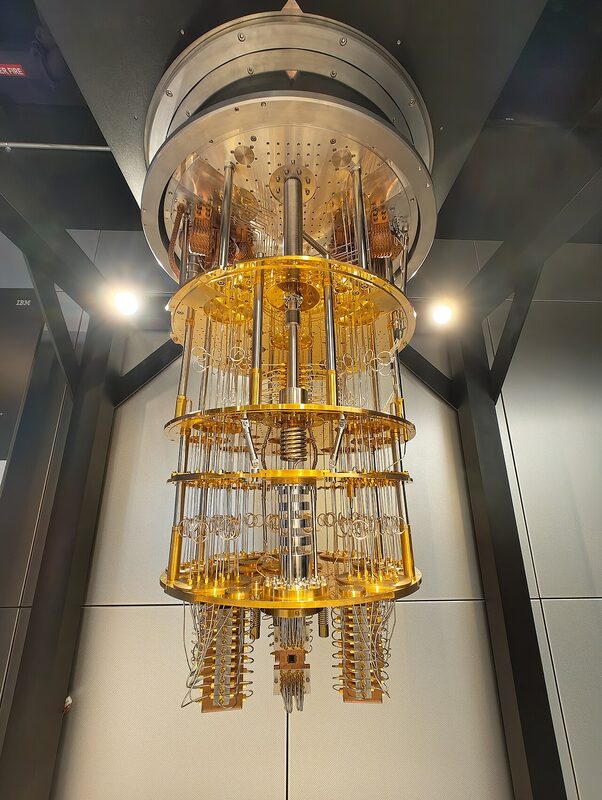
Four more quantum computing developers will now have their hardware, not just their paper designs, put through government testing to see whether their machines can reach useful scale by 2033. The Defense Advanced Research Projects Agency said Wednesday it moved Atom Computing, Diraq, IBM and IonQ into Stage C, the final phase of its Quantum Benchmarking Initiative, GovConWire reported. IonQ said its Stage C agreement with DARPA is worth up to $300 million, the only dollar figure the two sources attach to the new round.
The four companies join Microsoft and PsiQuantum, which entered Stage C after taking part in Underexplored Systems for Utility-Scale Quantum Computing (US2QC), a DARPA pilot that preceded QBI. That brings the Stage C field to six companies pursuing different qubit technologies.
Which Qubit Approaches Reached QBI Stage C?
DARPA said each of the four new Stage C performers is pursuing a different qubit technology, according to GovConWire:
- Atom Computing: scalable arrays of neutral atoms
- Diraq: silicon CMOS spin qubits
- IBM: quantum computing with modular superconducting processors
- IonQ: trapped-ion quantum computing
The spread matters because QBI does not pick a single winner. GovConWire describes the initiative as an assessment of the current state of commercial quantum computing and of whether each approach offers a credible near-term route to utility scale. DARPA defines utility scale as the point at which a system's computational value outweighs its cost.
Micah Stoutimore, managing director of QBI at DARPA, framed the field's momentum this way: "The quantum computing field is moving quickly, and we increasingly expect that someone will build a utility-scale quantum computer by 2033," he said, as quoted by GovConWire. "What we don’t yet know is which team or teams, or which technical approach or approaches, will get there."
What IonQ's Up-to-$300M Agreement Covers
IonQ said it signed a Stage C agreement with DARPA worth up to $300 million. The ceiling is not guaranteed money. According to the company, funding beyond the initial obligation depends on future appropriations and DARPA funding actions. Neither source disclosed the size of the initial obligation.
The agreement runs through 2029. Under it, DARPA's team will test several generations of IonQ's Superion quantum systems against the company's technical road map, GovConWire reported.
"Advancing to Stage C is a significant vote of confidence in IonQ’s technology roadmap and architecture for delivering quantum computing at utility scale," said Niccolo de Masi, chairman and CEO of IonQ.
The sources did not report dollar values for the Atom Computing, Diraq or IBM Stage C agreements.
IBM Ties Stage C Testing to Its 2029 Starling Target
IBM announced its selection in an Oct. 7 press release. The company said Stage C will move it through DARPA's verification process, "in which independent experts extensively test and measure quantum hardware, technology, systems engineering, and architectures to determine if a company can build a fault-tolerant quantum computer."
"Advancing to the third stage of DARPA's Quantum Benchmarking Initiative validates the strength of IBM's path to building a fault-tolerant quantum computer," said Jay Gambetta, Director of IBM Research and IBM Fellow. "IBM expects to deliver the first fault-tolerant system in 2029, and we plan to scale the value of quantum computing well beyond that timeline."
That system is IBM Quantum Starling, which IBM laid out last year as its planned first fault-tolerant quantum computer. IBM said Starling will combine advances in error correction, processor design and systems engineering, and that the company has since demonstrated core hardware components for fault tolerance. IBM also said more than 340 organizations across financial services, healthcare, materials science, academia and government use its quantum computers today.
How QBI Narrowed More Than 20 Companies to Six
DARPA launched QBI in 2024 to determine whether an industrially useful fault-tolerant quantum computer can be built by 2033, according to IBM. Since the initiative began in mid-2024, more than 20 companies have gone through its evaluation, GovConWire reported.
The program runs in three stages:
- Stage A: In 2025, DARPA chose an initial group of 15 companies for a six-month phase in which participants submitted detailed technical concepts for a fault-tolerant quantum computer. Quandela became the newest Stage A participant in May.
- Stage B: During this yearlong phase, QBI reviewed each organization's research and development plans, including technical risks, mitigation strategies and the prototypes needed to show progress.
- Stage C: The QBI government evaluation team works with selected companies to verify whether their proposed utility-scale systems could be built according to their designs and function as planned. IBM's release says DARPA's independent verification and validation (IV&V) team tests the companies' hardware in this phase.
Stoutimore said, according to GovConWire: "Stage C is where we begin moving from plans to proof. Our team will be closely scrutinizing the hardware and systems as they develop to determine whether the technology performs the way the models and roadmaps say it should."
The pipeline remains open. DARPA released a solicitation earlier this year seeking new Stage A entrants and expects to select more companies from the proposals it received. The agency also expects to promote more companies to Stage C as performers in Stages A and B progress.
What It Means for Contractors
Stage C shifts QBI from document review to hardware evaluation, and that changes who has work to do. The six Stage C performers now face government testing of physical systems, with IonQ's agreement alone running through 2029. Neither source names subcontractors or teaming partners on the Stage C work.
The IonQ terms also show how the money is structured. Only an initial obligation is committed under IonQ's ceiling of up to $300 million; the remainder depends on future appropriations and DARPA funding actions. Companies sizing their own quantum-related pipelines should treat Stage C ceilings as contingent, not committed, funding, and watch annual defense appropriations for the lines that would fund later increments.
For quantum firms not yet in the program, the door has not closed. DARPA said it expects to select more Stage A entrants from the proposals it received under this year's solicitation, and Quandela's entry in May shows the agency is still adding participants. Because QBI evaluates each approach on its own merits rather than ranking companies against each other, a new entrant with a distinct qubit technology is competing against the 2033 utility-scale bar, not against IBM or IonQ.
Federal buyers and integrators outside quantum hardware should note the 2029 marker: IBM's Starling delivery target and the end of IonQ's agreement. If those roadmaps hold, Stage C testing could give agencies independent government evaluation of fault-tolerant systems ahead of the 2033 benchmark.
