
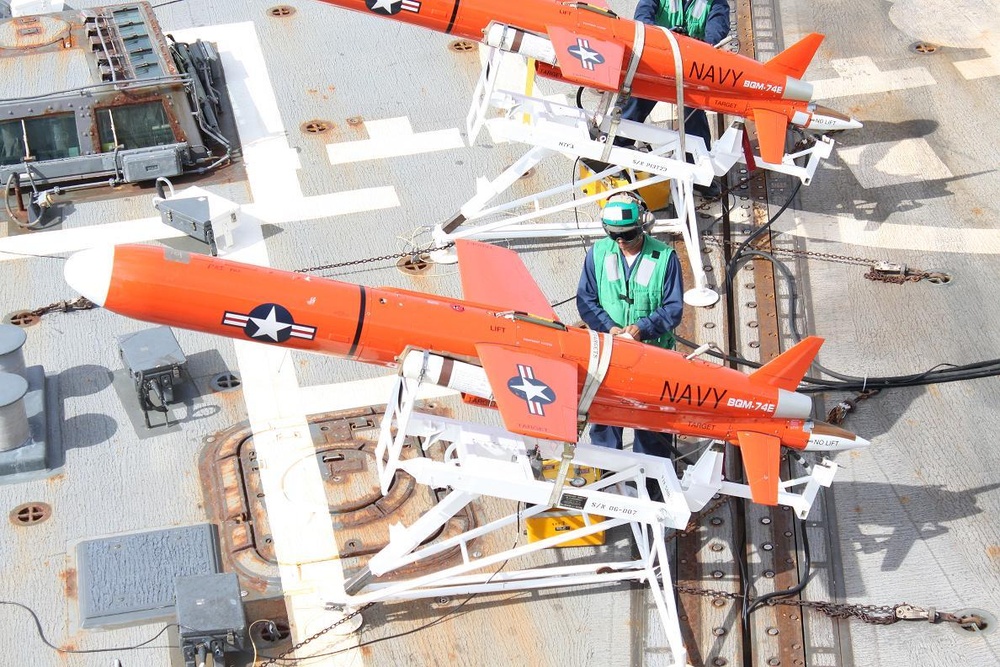
The Defense Innovation Unit (DIU) awarded contracts on June 16, 2026, under the Runway Independent Maritime Expeditionary Strike (RIMES) program to three companies — Mach Industries, Shield AI, and AeroVironment — to develop a ship-launched, long-range strike drone capable of operating from Arleigh Burke-class destroyers without a flight deck. Contract values were not disclosed. Physical prototyping must begin within 12 months of award.
Background
The Navy’s problem statement driving the RIMES solicitation — published in February 2026 — centers on a structural gap in how surface combatants sustain long-range strike operations. According to the solicitation language cited by Breaking Defense, surface ships face “limited magazine capacity and minimal at-sea munition resupply capabilities” that constrain how long and how far they can strike in a contested environment. A drone that can launch, conduct long-range missions, and return — from a destroyer rather than a carrier — would give combatant commanders a strike asset that resupplies differently from conventional missiles and doesn’t require a dedicated aviation ship.
DIU’s RIMES program is designed to answer that requirement with a runway-independent platform — meaning vertical take-off and landing (VTOL) operation from a surface combatant’s existing deck space. The solicitation attracted multiple vendors, and DIU selected three teams in parallel, a competition structure the unit has used in prior programs to keep commercial innovation driving toward the requirement rather than locking into a single vendor early.
Mach Industries and the Atlas Drone
Among the three awardees, Mach Industries has disclosed the most detail about its offering. The Huntington Beach, California company — founded in 2023 — will build a drone designated “Atlas” in partnership with Whisper Aero, which supplies the JetFoil hybrid-electric propulsion system. The propulsion choice is meaningful: the JetFoil system is designed to enable a radically reduced acoustic signature, an attribute that matters when a drone must operate near or return to a ship in a contested acoustic environment.
Atlas specifications released by Mach Industries describe a 1,000-pound payload capacity and a 1,400 nautical mile range — a figure that, if achieved in testing, would allow a destroyer operating in the Philippine Sea to strike targets deep into contested littoral zones without repositioning the ship. The platform is designed for VTOL operation, allowing it to use the existing deck of an Arleigh Burke-class destroyer with no structural modification to the ship.
Mach Industries President Nathan Diller stated that the platform “can redefine how the Joint Force projects power.” Mach Industries reports it has manufactured more than 250 aircraft and designed more than 1,000 solid rocket motors since its founding.
Shield AI and AeroVironment
DIU confirmed that Shield AI and AeroVironment also received RIMES contracts, but the agency did not release details on the contract values or the specific platforms those companies intend to develop. Shield AI brings its Hivemind autonomy stack, previously integrated into F-16s and other tactical aircraft under prior Pentagon programs, while AeroVironment has extensive prior art in ship-launched loitering munitions through its Switchblade family. Both companies bring distinct technical lineages to the RIMES requirement. The parallel-award structure means all three teams will advance through prototyping on competitive timelines. DIU has not indicated when it will down-select to a single vendor or whether the program envisions a follow-on competitive production phase. The agency's past parallel-competition programs suggest it will maintain competitive pressure across all three teams until prototype performance data compels a consolidation decision.
Program Timeline
The 12-month prototyping clock is the sharpest constraint in the award. Starting from June 16, 2026, all three awardees must have physical prototypes underway by mid-June 2027. That timeline compresses traditional defense development schedules and reflects DIU’s standard approach of pushing vendors to demonstrate hardware rather than studies. All three vendors will need to manage procurement lead times for propulsion, structures, and avionics in parallel with design work to have hardware ready for meaningful testing within the 12-month window. For a platform with Atlas’s stated specifications — 1,000-pound payload, 1,400 nautical miles, VTOL from a destroyer — achieving meaningful flight testing within that window would represent a substantial industrial and engineering achievement.
The February 2026 solicitation did not specify a fielding date, and DIU has not publicly indicated when the Navy expects operational capability. Given that RIMES contracts were just awarded in June 2026, an initial operational capability within the current decade would require sustained funding and rapid follow-on contracting after prototyping concludes.
What It Means for Contractors
- The three RIMES awardees — Mach Industries, Shield AI, and AeroVironment — are now in a competitive prototyping race with a 12-month clock that started June 16, 2026. Subcontractors and component suppliers seeking to participate should contact each prime’s supply chain teams now.
- Mach Industries has named Whisper Aero as a key propulsion partner on the Atlas platform. Other system-level suppliers — structures, avionics, payload integration — have not been publicly identified, leaving open opportunities for companies with relevant capabilities.
- The Arleigh Burke compatibility requirement drives significant constraints on size, weight, and deck interface. Suppliers with prior experience on ship-based unmanned systems hold an advantage in understanding the maritime environment and shipboard integration demands.
- DIU’s parallel-award structure means the program is not a single-award vehicle. All three teams will receive prototyping resources, and a competitive down-select is likely at a later phase. Companies positioned with multiple teams carry less risk than those tied to a single awardee.
- The program’s acoustic-signature reduction emphasis — reflected in Whisper Aero’s JetFoil propulsion selection — signals that quieting technologies will be a differentiator at the competitive phase. Suppliers in electric motors, noise reduction structures, and low-observable materials should take note.
- No follow-on production solicitation has been published. Watch SAM.gov and DIU’s program announcements for a request for proposals once prototype evaluations are complete.
Sources
- Breaking Defense — Mach Industries wins DIU contract for maritime, long-range strike drone (June 2026)
- PR Newswire / Mach Industries — Mach Industries Awarded DIU Contract for Runway Independent Maritime Expeditionary Strike Capability (June 2026)
- The Defense Post — Mach Industries Lands US DIU Contract for Long-Range Strike Maritime Drone (June 19, 2026)
