
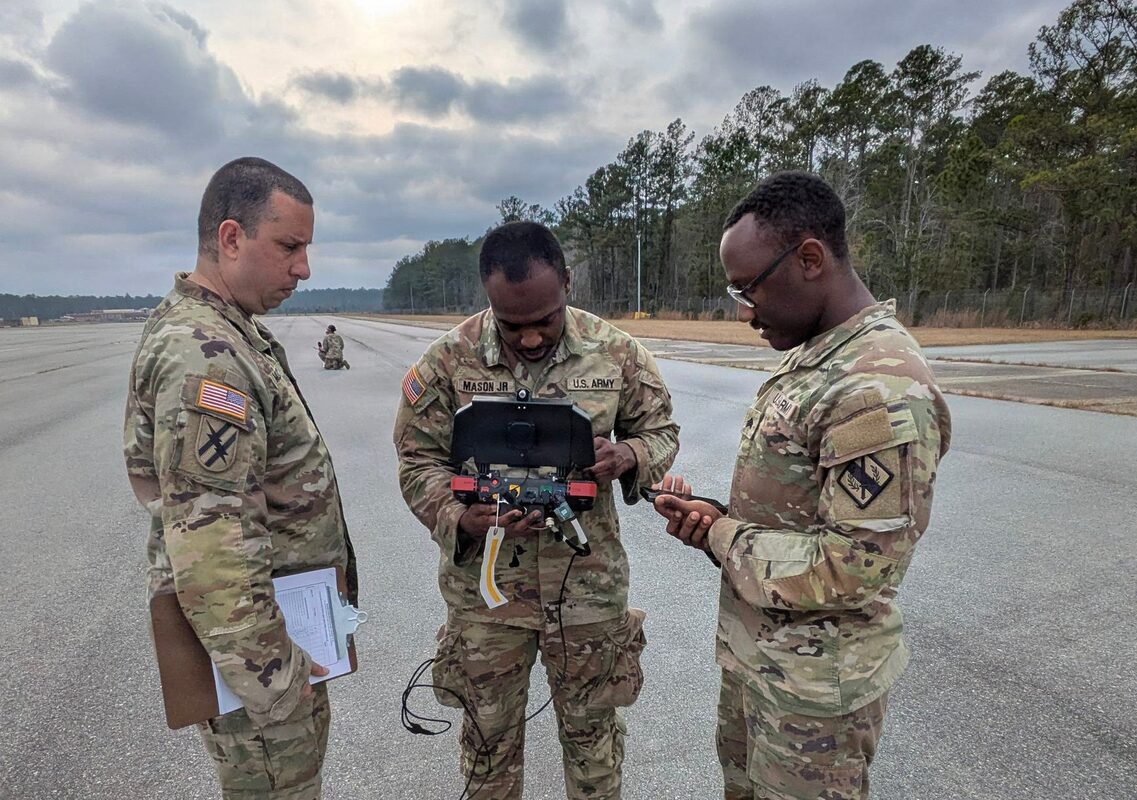
The Department of War wants a drone that bombs a target and comes home. On July 22, 2026, the department added a reusable bomber element, designated Mission C, to its Drone Dominance Program, widening an effort that until now centered on one-way attack aircraft. Initial prototype orders total roughly $32 million for about 1,200 night-vision-equipped bomber drones with logistics packages, and Inside Unmanned Systems reported a price ceiling of $20,000 per aircraft. Industry responses are due August 5, 2026.
Background
The Drone Dominance Program is the Pentagon's attempt to buy small lethal drones at commercial speed and commercial prices. The program site describes an iterative $1 billion plan to buy small, lethal drones over two years, with the intent to acquire more than 200,000 by 2027. Trade coverage puts the numbers higher: Inside Defense reported an overall program budget of $1.1 billion aimed at more than 300,000 small one-way attack drones by 2027. The .mil figures are the program's own; the trade totals are reporting.
Until this month, the buying centered on one-way attack drones, aircraft that fly into a target and are consumed. Mission C changes the economics. A reusable bomber flies out, releases a munition, and returns to be reloaded. DefenseScoop reported the department's framing: "While one-way attack (OWA) is critical on the battlefield, additional strike capability is required to support warfighters at low cost, at scale, and from a supply chain that is resilient." That phrasing puts as much weight on the industrial base as on the weapon.
The bomber competition sits inside Phase II of a four-phase program structure, according to Inside Defense, so the $32 million on the table now is an entry fee rather than the prize. Inside Unmanned Systems reported that the effort continues into Phases 3 and 4, with additional orders expected in those later rounds.
Key Details
Mission C sets hard technical thresholds. Aircraft must have a gross takeoff weight of 55 pounds or less, excluding payload, and carry at least 8 kilograms, roughly 17.6 pounds. Inside Unmanned Systems reported compatibility with 60mm and 81mm mortar shells; DefenseScoop described the payload as commensurate with mortars and similar munitions. Range runs 15 to 30 kilometers, or 9.3 to 18.6 miles. The system must be man-packable or transportable in a light-duty combat vehicle.
Durability separates this from the attack-drone lines. Inside Unmanned Systems reported a minimum of 30 missions before loss, with a stated preference for 150. Aircraft must operate in all weather and all lighting conditions, carry multiple warheads, and engage moving and stationary targets in succession, and DefenseScoop reported they must hold up against jamming of command and satellite navigation links. Autonomy features and advanced engagement capabilities such as pixel-lock, predictive release and automatic target recognition are not mandatory but will be rated favorably. The target set is broad: personnel, light armor, heavy armor, and maritime surface and landing craft.
The money is structured to force price discipline. Alongside the $20,000 unit cap, Inside Unmanned Systems reported a roughly $5,000 logistics package covering batteries, spare parts and inert payloads. Orders are expected to split among the top three rated vendors on a 600/400/200 unit basis, so second and third place still ship hardware, an unusual structure that keeps three production lines warm.
Selection runs through a qualifier event in October 2026, from which roughly eight vendors are down-selected to compete in the Gauntlet proper, held 48 hours later. The program site lists this as Gauntlet 2.5, the Bomber Platform Mission. Vendors fly scripted and dynamic scenarios, and scoring blends performance outcomes, operator evaluation and production capability. Prototype contracts follow for top performers.
Delivery terms are aggressive: 50 percent of ordered systems within two and a half months of the delivery order, and all systems within five months. The solicitation is posted at dronedominance.mil, with participation routed through the NSTXL consortium portal. The program contact is [email protected].
What It Means for Contractors
Run the arithmetic first. A $20,000 ceiling on an airframe that carries 17.6 pounds, flies 30 kilometers, survives 30 to 150 sorties, and holds a link through jamming is a demanding bill of materials before a bidder adds any of the optional autonomy and engagement features that earn favorable ratings. Designs leaning on a premium autopilot, a gimbaled sensor ball, or expensive propulsion will struggle to close the price case. The $5,000 logistics allotment is separate money for batteries, spares and inert payloads, and it deserves careful modeling: battery replacement across 150 missions is a real cost driver.
The delivery clock is the second filter. Half the units in two and a half months means a bidder needs tooling, suppliers and an assembly cell identified now, not after award. A 600-unit allocation to the top-rated vendor implies roughly 300 aircraft out the door in about ten weeks. Firms without existing capacity should be lining up contract manufacturers and reserving long-lead components now; the schedule leaves no room to industrialize a prototype after award.
The three-way split changes the bid math in a favorable direction. In a winner-take-all competition, a mid-tier firm with a good airframe and no political weight has little reason to spend on a demonstration. Here, third place is 200 units and a production reference. That raises the expected value of participating for smaller firms and non-traditional entrants that have never held a defense prime contract.
The October event is where proposals stop mattering. A qualifier followed two days later by a scored fly-off, with operators in the loop, rewards reliability, reload speed and tolerance for rough handling far more than a specification sheet does. Companies should test against the failure modes an operator will actually generate, including mud, cold batteries, dropped airframes and degraded links. Performance in poor lighting is likely to separate the field, since the requirement explicitly spans all-weather and all-lighting operation.
Access runs through the NSTXL consortium portal rather than a conventional solicitation channel, so companies that are not consortium members need to sort out membership before August 5. Teams should also read the resilient-supply-chain language as a screening criterion in disguise: bidders who can document sourcing for motors, batteries, flight controllers and radios will have an easier time at every subsequent phase, and the program posts a supply chain framework alongside the solicitation.
Finally, treat this as a foothold rather than a program of record. Thirty-two million dollars against a $1 billion plan means the bomber line is being seeded, not filled. Firms that place in October are positioned for the phases that follow; firms that skip the window will later bid against three vendors holding fielded hardware and operator relationships.
Sources
- Drone Dominance Program — U.S. Department of War
- Pentagon adds 'bombers' to Drone Dominance Program — DefenseScoop
- Drone Dominance Program Launches New 'Gauntlet' Mission C Competition for Heavy Gravity-Bomber Drones — Inside Unmanned Systems
- DOD launches Drone Dominance competition for reusable bomber drones — InsideDefense.com
