
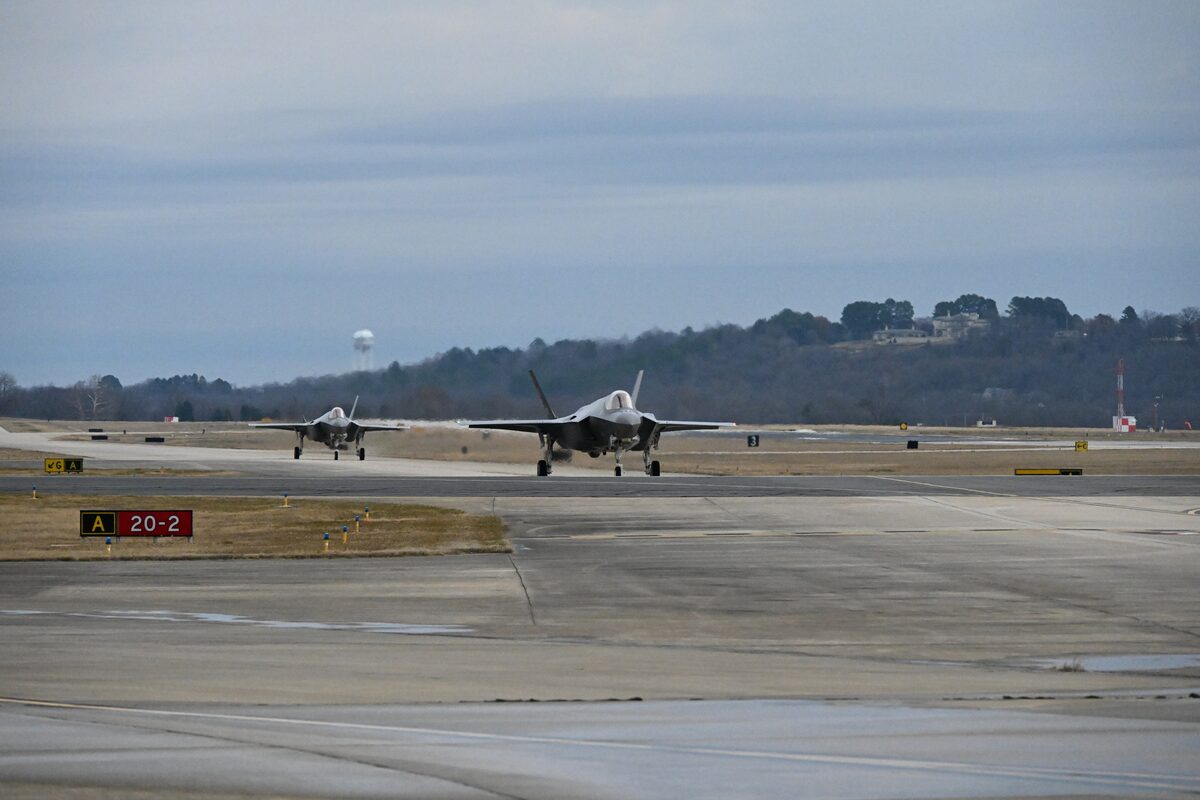
The U.S. Army Corps of Engineers has awarded a $37.6 million firm-fixed-price contract to BL Harbert International LLC for construction of a new F-35 Special Access Program Facility at Ebbing Air National Guard Base in Fort Smith, Arkansas, adding secure infrastructure to a site that is rapidly becoming an international hub for F-35 pilot training.
Background
Ebbing Air National Guard Base, home of the 188th Wing, has spent the past several years transforming from a legacy fighter training location into what officials describe as a one-of-a-kind international F-35 training complex. The 188th Wing already trains U.S. Air National Guard pilots on the F-35A, and the base has steadily added partner-nation flying units under agreements that route allied pilot training through Fort Smith rather than through each country's home airspace.
Finland, Singapore, Switzerland, Poland and Germany all now send pilots and maintainers to train at Ebbing, and the base expects Singapore's own F-35 aircraft to arrive in late 2026, with Singaporean F-16s following in the summer of 2027. Once the training complex reaches full operational capacity, officials expect up to 400 personnel assigned to the international training mission. Col. Jonathan Esparza, commander of the 188th Wing, has described the goal of the buildout as training foreign pilots "side-by-side with our American cohorts" to ensure interoperability once those partner air forces fly the F-35 alongside U.S. squadrons in real-world operations.
Supporting that growth has required a sustained military construction push. The U.S. Army Corps of Engineers' Little Rock District broke ground May 6, 2026, on a separate $74 million, 44,000-square-foot academic training center that will house classrooms and four F-35 flight simulators. That building is one piece of an estimated $807 million total training complex at Ebbing, toward which Congress has appropriated roughly $600 million in federal military construction funds since 2021. The new Special Access Program Facility contract adds a security-focused component to that broader construction pipeline, giving the growing multinational F-35 enterprise a dedicated facility for classified program material and mission planning.
Key Details
- BL Harbert International LLC, headquartered in Birmingham, Alabama, received the firm-fixed-price award for the F-35 Special Access Program Facility. The action amount obligated is $37,607,122, with a total cumulative contract value of $38,958,927.
- The U.S. Army Corps of Engineers, Fort Worth District, is the contracting activity, and the award carries contract number W9127S-26-C-A009.
- The underlying solicitation describes the project as a squad operations mission planning facility with secure flight planning and training spaces, built to controlled-access-area standards for classified program work.
- Work will be performed at Fort Smith, Arkansas — the location of Ebbing Air National Guard Base — with an estimated completion date of Jan. 31, 2029.
- The contract is funded with fiscal year 2026 military construction funds, and the full $37,607,122 action amount was obligated at the time of award.
- The award was included in the Department of War's routine daily contracts announcement for Aug. 3, 2026.
- The facility will serve the 188th Wing's expanding F-35 mission, which already includes training for U.S. Air National Guard pilots and is layered with partner-nation instruction for Finland, Singapore, Switzerland, Poland and Germany.
What It Means for Contractors
The award shows the Army continuing to fund Ebbing's expansion in discrete, purpose-built packages rather than as a single mega-project, which creates repeated bid opportunities for construction firms with secure-facility experience. A Special Access Program Facility carries security and access-control requirements well beyond a standard classroom or hangar build, and firms bidding on this kind of work typically need cleared personnel, established SAP facility accreditation processes, and experience meeting Intelligence Community and DoD physical security directives — a narrower field than general military construction attracts, and an advantage for firms that already hold that qualification when this kind of package comes up for bid.
Contractors tracking the broader Ebbing buildout should expect additional solicitations tied to the same $807 million training complex figure cited by USACE's Little Rock District. With roughly $600 million already appropriated since 2021 and construction ongoing on the academic training center, follow-on task orders for site infrastructure, housing, security upgrades and simulator-support facilities are plausible in coming fiscal years. Firms without existing SAP facility credentials but interested in this market should begin the accreditation process now, since that qualification — not price alone — appears to be the main gate on the security-related packages.
The funding mechanism is also notable: the full $37,607,122 action amount was obligated at signing rather than incrementally, a pattern typical of fixed-price military construction contracts and one that gives BL Harbert budget certainty for a build that runs past two and a half years. For subcontractors and suppliers, that full obligation also means the project's funding is locked in rather than dependent on follow-on appropriations, which lowers the risk of a stalled schedule mid-build.
Finally, the multinational character of the mission — training pilots from Finland, Singapore, Switzerland, Poland and Germany alongside U.S. Air National Guard airmen — means facility work at Ebbing sits at the intersection of domestic military construction and foreign partner coordination. Contractors should anticipate that security facility work of this kind may involve additional oversight or foreign disclosure considerations tied to the partner nations training on-site, even though the contract itself was awarded and funded entirely through U.S. Army channels.
The estimated Jan. 31, 2029 completion date, more than two and a half years out, also signals that this is a long-duration build rather than a quick fit-out, which matters for subcontractors and suppliers planning capacity around the project. Firms that specialize in secure communications infrastructure, hardened construction materials, or specialized HVAC and power systems required for SAP-accredited spaces should treat this award as an early indicator of downstream subcontracting demand at Fort Smith over the next several years, even though the prime contract itself went to a single general contractor with an established USACE track record.
