
The U.S. Army awarded General Atomics Electromagnetic Systems (GA-EMS) a contract under the Extended Range Artillery Projectile (ERAP) program, also designated XM1155, making GA-EMS the third vendor competing to develop a 155mm precision-guided munition capable of striking targets beyond 65 kilometers. GA-EMS joins General Dynamics Ordnance and Tactical Systems and BAE Systems, both of which received earlier contracts under the same program. Contract value was not disclosed.
Background
The ERAP program grew out of the Army's failed Extended Range Cannon Artillery (ERCA) effort, which sought to extend howitzer range through a new gun system. The service ultimately canceled ERCA and pivoted to a projectile-based approach — developing a smarter round compatible with cannons already in the field rather than replacing the platforms themselves. The XM1155 designation reflects that lineage: a maneuvering 155mm projectile with deployable wings and advanced guidance, including a non-GPS option intended to maintain accuracy in contested electromagnetic environments.
The program formally kicked off in 2024, and the Army has set an Initial Operational Capability target of Fiscal Year 2030, with low-rate production starting in the second quarter of FY2029. The competitive structure mirrors approaches used in other munitions programs — multiple vendors proceed through development rounds before the Army selects a primary supplier for full production.
Key Details
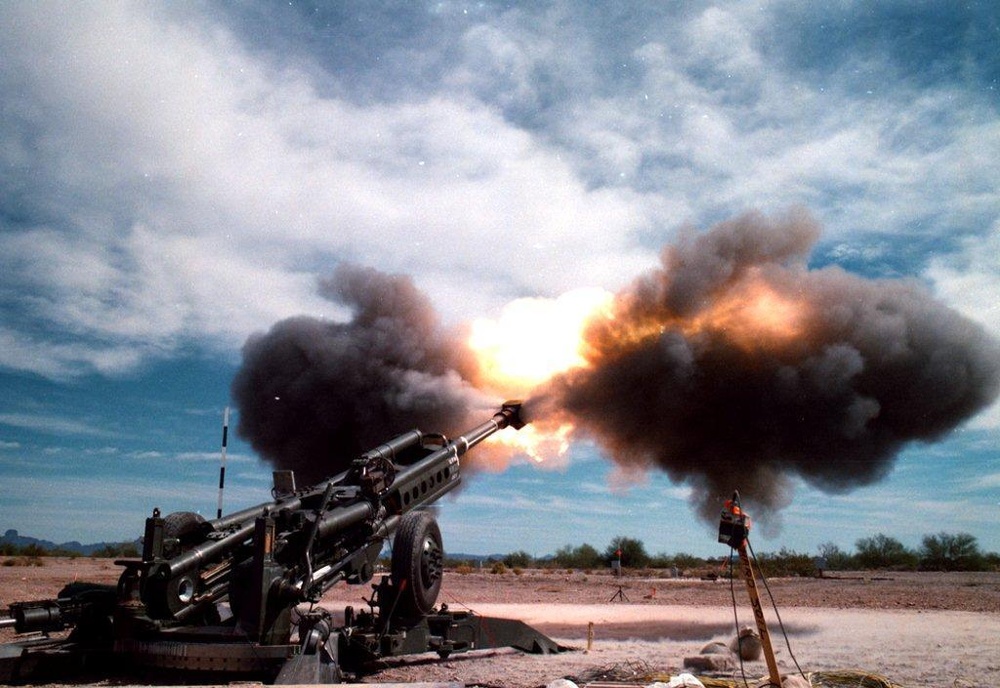
GA-EMS demonstrated the projectile at Yuma Proving Ground, Arizona in 2025, recording a successful test engagement at more than 74 miles — approximately 118 kilometers — well beyond the program's stated 65-kilometer threshold. Michael Rucker, Vice President of GA-EMS Weapons Programs, described the design as providing "extended range without rocket assist" while remaining compatible with legacy cannon platforms. That compatibility is central to the Army's calculus: fielding a new munition that works with existing M777 towed howitzers and other 155mm systems avoids the cost and logistics burden of introducing a new gun platform.
The XM1155's stated target set reflects the Army's focus on peer-competitor threats. Program requirements call for the ability to engage self-propelled howitzers, infantry fighting vehicles, multiple rocket launchers, main battle tanks, maritime surface targets, and air defense systems — the kind of high-value, mobile systems that characterize Russian and Chinese combined-arms formations. The non-GPS guidance option is particularly relevant given Russia's demonstrated ability to jam GPS signals in Ukraine and the assumption that future conflicts will include electronic warfare at scale.
General Dynamics Ordnance and Tactical Systems is developing the Vulcano 155 munition, which uses GPS and semi-active laser guidance to reach targets at distances up to 70 kilometers. BAE Systems' ERAP entry has not been characterized in detail in public sources, with the company providing no announcement or comment on its award. With GA-EMS now under contract, the Army has three active development paths for what could become the primary long-range precision fires munition for ground forces through the 2030s.
The competitive development approach also benefits the Army's budget posture. Keeping three vendors funded through the development phase is more expensive in the near term than selecting a single developer, but it preserves leverage in the production contract negotiation — a dynamic the Army exploited in the Precision Strike Missile program, where competitive pressure held unit costs below initial estimates. The Army's decision to add GA-EMS as a third entrant rather than narrowing the field early suggests program leadership is prioritizing technical diversity over near-term cost containment.
The Navy has also invested in GA-EMS's projectile technology. The service separately contracted the company in late 2024 to continue developing the projectile for maritime use, indicating that the underlying guidance and wing deployment technology has cross-domain appeal. Whether the Army and Navy efforts share components or production lines has not been publicly disclosed.
Competitive Landscape
The three-vendor ERAP competition represents the Army's standard approach to high-risk development programs: fund multiple teams through technical maturation before committing to a single producer. That approach adds near-term cost but reduces the risk of a single design failure derailing the entire program — a lesson the Army absorbed from ERCA, where a single-contractor gun system ran into persistent reliability and cost problems before cancellation.
Each vendor brings a different industrial heritage. General Dynamics Ordnance and Tactical Systems has deep roots in conventional ammunition and guided munitions, having produced large volumes of 155mm rounds for decades. BAE Systems brings aerospace guidance experience from programs including the Excalibur extended-range 155mm shell. GA-EMS enters from a different angle: the company's core identity is in electromagnetic launch systems, railgun research, and advanced energy technologies, with the ERAP effort representing its expansion into precision-guided munitions for ground forces.
The 2025 Yuma test result — 74-plus miles against a 65-kilometer requirement — gives GA-EMS a documented margin advantage heading into the competitive phase. Whether that translates into a production contract depends on additional factors including reliability across multiple shots, cost per unit, producibility, and the Army's assessment of each vendor's manufacturing readiness.
What It Means for Contractors
- The ERAP program is active and funded across three competitors: GA-EMS, General Dynamics OTS, and BAE Systems. Subcontractors supporting 155mm munitions production, inertial navigation units, wing actuation systems, or guidance electronics should monitor each prime's supply chain activity as the program moves toward the FY2029 low-rate production milestone.
- GA-EMS's contract award is the most recent entry point in the program. Suppliers not already aligned with GD-OTS or BAE Systems have an opening to pursue teaming with the newer entrant before GA-EMS's supply chain solidifies.
- The non-GPS guidance requirement creates demand for inertial measurement units and alternative positioning technologies — a growth area for firms working in GPS-denied navigation for munitions applications.
- The Army's IOC target of FY2030 and low-rate production start of Q2 FY2029 set a firm timeline. Suppliers should plan for competitive downselect activity in the FY2027-FY2028 window, when the Army is most likely to narrow from three vendors to one or two before committing to full production investment.
- The parallel Navy maritime variant contract with GA-EMS indicates potential for a joint or multi-service production program. Defense manufacturers with multi-domain munitions production experience may find opportunity in bridging Army and Navy requirements as both programs mature.
