
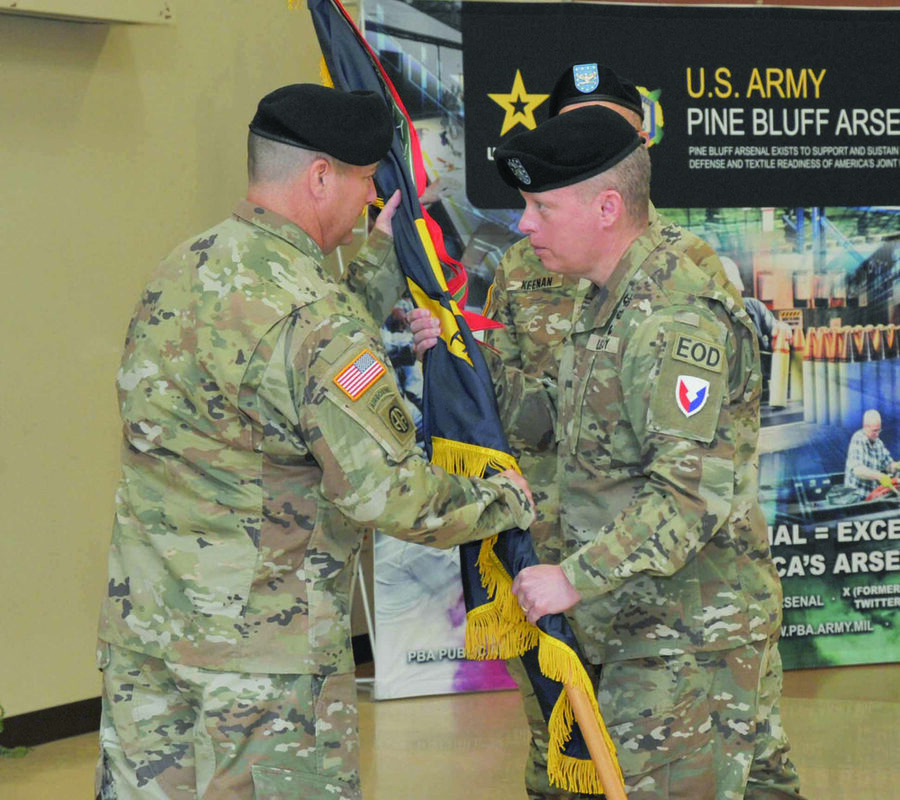
Pine Bluff, Arkansas is getting the largest economic-development project in its history, and the Army is getting a domestic supplier for an artillery component the United States has struggled to produce fast enough. Hanwha Defense USA cut the ribbon Sept. 21, 2026 on the administration headquarters for its new Hanwha Advanced Manufacturing Campus at the U.S. Army's Pine Bluff Arsenal, the first physical structure to open on a site the company now says will cost $2.2 billion to build — up $900 million from the $1.3 billion it pledged in March, when then-Army Secretary Dan Driscoll visited the Arsenal for talks on modernization and the base's long-term strategic future.
The bigger price tag comes with a bigger workforce commitment. HDUSA now expects the campus to create close to 400 jobs at an average wage of about $50 an hour, roughly double the 200 positions the company initially projected. The administration building is only the opening move: the 1,065-acre campus will be Hanwha's first munitions manufacturing facility anywhere in the United States, producing 155mm propellant charges and base bleed units — components that go directly into artillery ammunition the Army and its allies have been burning through faster than the existing industrial base can replace.
Arkansas Gov. Sarah Huckabee Sanders, U.S. Rep. Bruce Westerman, HDUSA CEO Michael Coulter, Pine Bluff Arsenal commander Col. Matthew Mason, and Jordan Gillis, Assistant Secretary of the Army for Installations, Energy and Environment, all took part in the ceremony.
Why the Investment Jumped to $2.2 Billion
Hanwha has not detailed line-by-line what pushed the project from $1.3 billion to $2.2 billion, but the company is framing the increase as a scale-up of the same mission rather than a new one. "Hanwha plans to invest around $2.2 billion in our new Advanced Manufacturing Campus that will transform the domestic munitions industrial base and further strengthen America's arsenal of freedom," HDUSA CEO Michael Coulter said in the company's announcement. The jump in projected jobs — from roughly 200 to close to 400 — tracks with the added capital, suggesting Hanwha is building out more production capacity, not just paying more for the same footprint.
Gov. Sanders cast the scale of the commitment in historical terms. "We're not just celebrating the biggest economic development project in Pine Bluff history, but also one of the biggest in Arkansas history," she said at the ceremony. "This will be Hanwha's first munitions manufacturing facility anywhere in the United States, producing artillery ammunition."
The Enhanced-Use Lease That Put Munitions Work on Army Land
The project runs through a U.S. Army enhanced-use lease rather than a conventional base realignment or a straight land sale, which lets the Army keep title to underutilized Arsenal acreage while a private company builds and operates on it. The Army opened the property to competitive bids starting in November 2025, and Hanwha was awarded the lease solicitation in January 2026. The lease itself runs an initial 50 years, with an option to extend another 25 — a long enough horizon for Hanwha to justify sinking $2.2 billion into permanent manufacturing infrastructure on federal land it doesn't own.
Jordan Gillis, the Army's Assistant Secretary for Installations, Energy and Environment, framed Monday's ceremony as a modest milestone in a much larger effort. "This ribbon cutting may just be for office space, but we celebrate each and every milestone, and I would argue this represents something bigger than just an office," he said. "It represents what can happen when Army and industry and our local communities come around a shared objective, and that is strengthening our installations and our industrial base to better support our soldiers and our nation."
What 155mm Propellant Charges and Base Bleed Units Add to the Munitions Pipeline
The products Hanwha plans to build at Pine Bluff sit at a genuine bottleneck. Propellant charges are what actually fire a 155mm artillery round out of the barrel, and base bleed units extend a shell's range by reducing aerodynamic drag at the base of the projectile as it flies. Both are components the U.S. industrial base has been racing to scale up production of after years of allied ammunition expenditure outpaced domestic manufacturing capacity. According to Hanwha, the new facility "will establish advanced domestic manufacturing capabilities spanning key stages of munitions production, supporting increased U.S. production capacity and modernizing the nation's munitions industrial base."
Placing that work inside an active Army arsenal, rather than at a standalone commercial plant, also gives Hanwha built-in proximity to existing government-owned ammunition infrastructure and a workforce base already cleared and experienced in munitions handling.
Who Gets Credit — and What's Still Undated
Arkansas' congressional delegation is framing the project as validation of a longer fight to keep Pine Bluff Arsenal open. Sens. Tom Cotton and John Boozman, along with Westerman, reached out to then-Army Secretary Driscoll in May 2025 after he issued a directive to downsize the Arsenal and possibly close it. "I've been proud to work with Senator Boozman and Congressman Westerman to ensure Pine Bluff Arsenal remains a key national security asset that is ripe for greater defense investment, and I'm grateful Hanwha is partnering with the Army to expand critical munitions production," Cotton said. Separately, the state's own courtship of Hanwha ran about 18 months, according to Arkansas Economic Development Commission executive director Clint O'Neal, including site visits across Arkansas and meetings with Hanwha executives in Korea and at the Paris and Farnborough air shows.
What hasn't been set yet: construction start and completion dates for the full manufacturing campus. Monday's ceremony covered only the administration headquarters — a milestone Gillis himself called "just office space." The propellant and base-bleed production lines that justify the $2.2 billion figure haven't broken ground, and neither Hanwha nor the Army has published a construction schedule.
What It Means for Contractors
A $2.2 billion, 1,065-acre buildout inside an active Army arsenal will generate years of subcontracting work well before the first propellant charge ships: site preparation, industrial construction, specialized munitions-handling equipment, and the security and environmental compliance work that comes with any explosives-adjacent facility on federal land. Companies already cleared to work inside government arsenals — and those with experience on enhanced-use leases elsewhere — are best positioned to bid into the build-out as Hanwha moves from administrative offices to production lines.
The bigger signal for the industrial base is what the deal tells other primes about the Army's appetite to use enhanced-use leases for expanding domestic munitions capacity rather than restarting government-owned, government-operated plants outright. If Pine Bluff's model works, similar competitive leases at other underutilized arsenal acreage could follow — worth watching for contractors positioned in ammunition components, propellants, or explosives-adjacent manufacturing who don't currently have a foothold on Army-owned land.
