
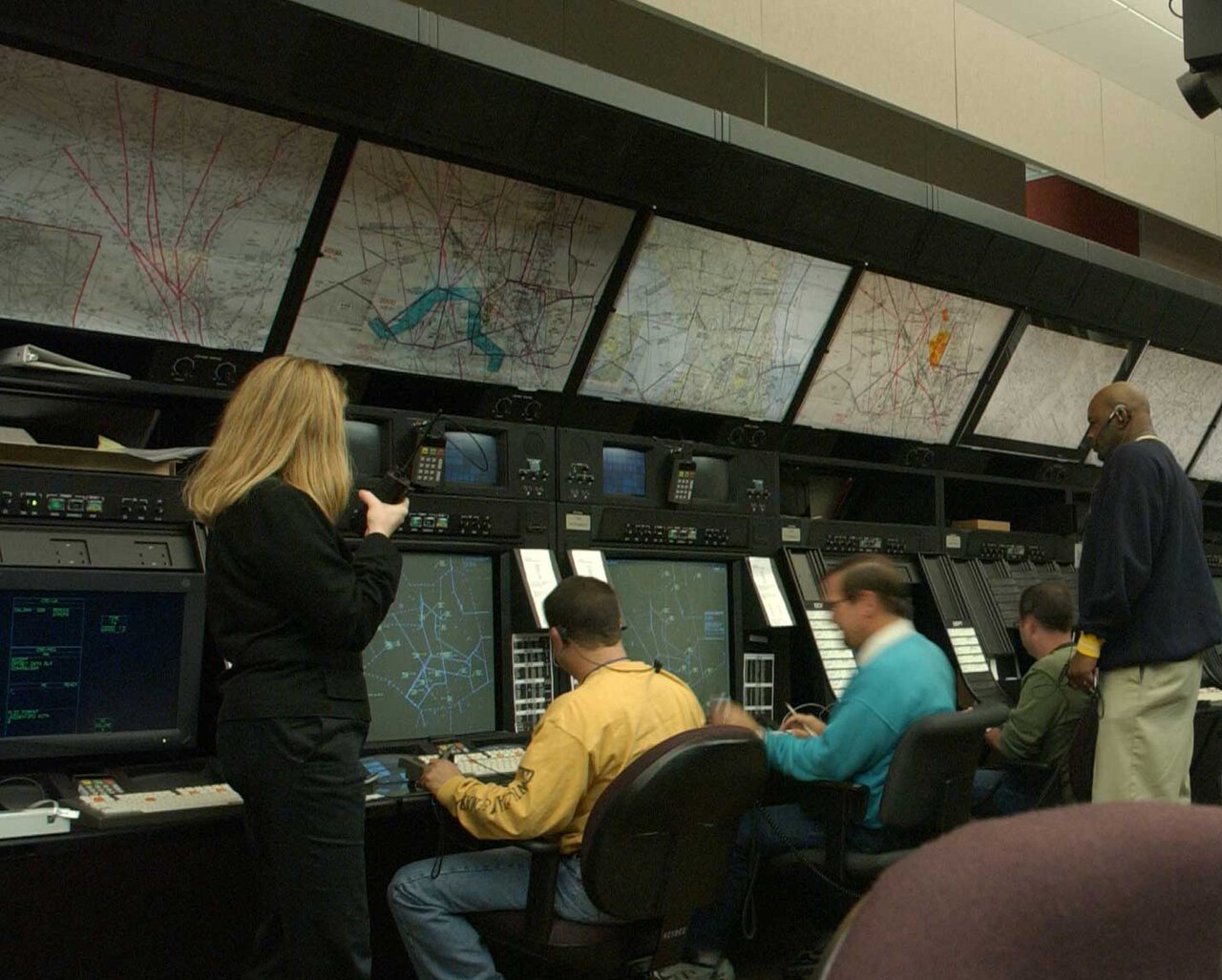
The AI tool now helping manage airspace over the nation's capital could face a congressional watchdog review of how it was built, tested and rolled out. Almost two dozen Democrats on the House Transportation and Infrastructure Committee asked the Government Accountability Office to audit how the Federal Aviation Administration built and deployed two traffic management systems supplied under a 12-year, $875 million contract with Air Space Intelligence, Nextgov/FCW reported. The Tuesday letter was led by Rep. Rick Larsen, D-Wash., the committee's ranking member, and Rep. André Carson, D-Ind., the Aviation Subcommittee's top Democrat.
The request targets the Strategic Management of Airspace, Routes and Trajectories tool, known as SMART, and Flow Management Data and Services, known as FMDS. They are the two new systems the contract supplies for a modernized Air Traffic Control System Command Center. A GAO audit would put the government's oversight of an AI-enabled, contractor-built safety system under formal review just weeks after the FAA put it to work.
What the $875M Air Space Intelligence Contract Delivers
The FAA announced the Air Space Intelligence contract in June as part of the Trump administration's air traffic control overhaul. Under the agency's plan, FMDS replaces the FAA's current traffic flow management system, and the AI-powered SMART tool serves as an enhancement inside it.
SMART is designed to combine 200 different data streams into one system, syncing information such as flight paths and weather patterns to provide better flight traffic oversight. The FAA announced on Sept. 21 that it had deployed SMART to monitor airspace in the Washington, D.C. region.
That first deployment drew the most attention. The D.C. region includes Ronald Reagan Washington National Airport, near where an Army Black Hawk helicopter and a commercial airliner collided in January 2025. Nextgov reported that the rollout was reportedly met with initial hesitation from airline executives and from Rep. Don Beyer, D-Va., whose district includes Reagan National, and that one criticism was that air traffic controllers had no input in the tool's creation.
Why Democrats Want GAO Inside the SMART Rollout
The committee Democrats framed their concern around how AI behaves in a safety-critical setting. "The use of artificial intelligence within SMART has rightfully raised serious questions about its reliability and safety benefits, particularly on its potential to interfere with decision-making by experienced air traffic controllers or to hallucinate safety-critical information," they wrote.
The letter asks GAO to do three things:
- Analyze FAA's oversight and development activities, including its safety risk management for both SMART and FMDS.
- Identify "any quantifiable performance metrics" the FAA uses to monitor the two systems.
- Evaluate the agency's deployment strategy for SMART and FMDS.
The second item could matter most to the vendor. If GAO finds the FAA has no measurable performance standard for an AI tool already in operational use, the agency could face pressure to write one, and that standard would apply to work Air Space Intelligence is already performing.
A Second Letter Set an Oct. 19 Deadline for FAA
The GAO request is not the only one. Federal News Network reported that members of Congress wrote to Transportation Secretary Sean Duffy and FAA Administrator Bryan Bedford earlier this month asking the agency to pause the use of FMDS and SMART over the National Capital Region until it puts more safety measures in place.
"There has been little transparency from either DOT or the FAA on how the AI systems underlying SMART were tested," lawmakers wrote in the Oct. 9 letter, which also noted that no information had been shared on why the region was chosen as the pilot test region. The letter asked the FAA to answer questions on pre-deployment testing and evaluation, stakeholder training, and post-deployment assessment and oversight by Oct. 19.
Lawmakers also cited training gaps among frontline staff. "We have heard from several sources that frontline aviation safety workers were notified of the SMART tool rollout mere days in advance or not at all," members wrote, according to Federal News Network.
The National Air Traffic Controllers Association told Federal News Network that any new technology should "complement and not replace the experience, training and professional judgment of air traffic controllers who are responsible for the safety of the National Airspace System."
How Duffy and the FAA Have Defended SMART
The Transportation Department has pushed back. Duffy said during a Fox News appearance last month that SMART is "a tool that’s used to better manage traffic" and that air traffic controllers "are the ones who will always manage airspace," Nextgov reported. Neither article reported an FAA response to the GAO request.
Beyer told Nextgov that a conversation with Bedford eased some of his concerns, including an assurance that SMART was designed by air traffic controllers who are not in the towers right now. Beyer and the letter's signatories still want more testing and oversight.
Cyber Findings and an Inspector General Review Add Pressure
The audit request lands on top of earlier watchdog work. GAO released two aviation cybersecurity reports in June and August finding that the FAA's air traffic and data communication systems are vulnerable to cyber threats, Federal News Network reported.
Separately, the Department of Transportation's Office of Inspector General announced on Oct. 16 that it has opened an audit of the FAA's Air Traffic Skills Assessment, the test the agency uses to identify qualified controller candidates. That review covers controller hiring, not SMART. "Section 417 of the FAA Reauthorization Act of 2024 mandated the Agency to conduct a comprehensive review of the ATSA," the OIG wrote, adding that its objectives are to assess the FAA's evaluation of the test and any actions taken to address identified areas for improvement.
The money at stake is large. Congress allocated $12.5 billion toward air traffic control modernization in the reconciliation law signed in July 2025, and the Transportation Department is seeking an additional $30 billion to finish the work, which it hopes to largely complete by December 2028.
What It Means for Contractors
For Air Space Intelligence, a GAO audit means its systems will be judged against whatever safety risk management and performance metrics the FAA can produce. If GAO finds gaps, the FAA could slow the rollout of SMART and FMDS beyond the capital region or add testing requirements partway through the 12-year contract.
For other vendors bidding on the remaining modernization work, the review signals what Congress may ask for: documented pre-deployment testing, defined performance metrics, and training plans for the controllers who use the tools. Firms offering AI-enabled capabilities should be ready for those questions in proposals and in post-award oversight, especially for systems deployed in congested airspace.
The congressional letters also give firms a checklist. The questions lawmakers sent the FAA cover testing and evaluation, stakeholder training, and post-deployment oversight, and companies can build documentation for each into their delivery plans now rather than after a watchdog asks for it.
Sources
- House Democrats seek watchdog review of AI-powered air traffic control systems (Nextgov/FCW, Oct. 14, 2026)
- FAA AI use sparks new reviews into AI safety, workforce shortages (Federal News Network, Oct. 16, 2026)
- Audit Initiated of FAA’s Air Traffic Skills Assessment (DOT Office of Inspector General, Oct. 16, 2026)
