
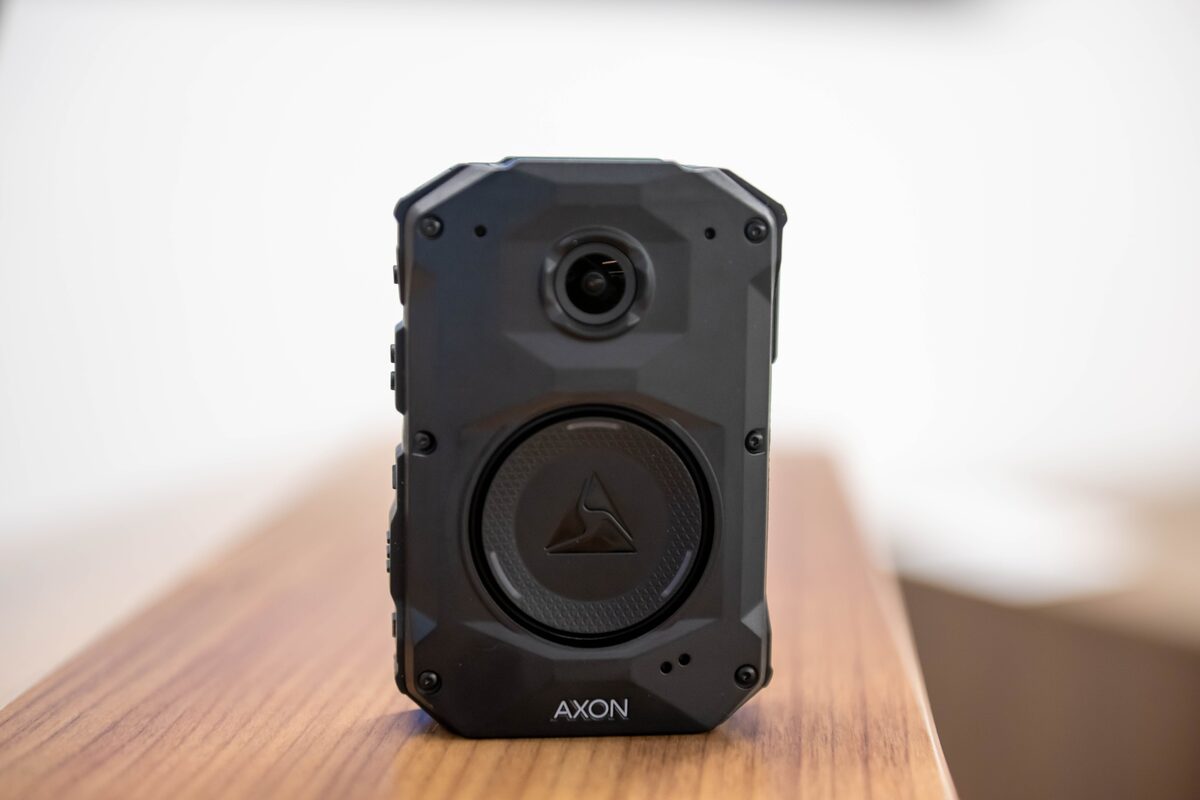
U.S. Immigration and Customs Enforcement signed two delivery orders worth a combined $30,895,177 with Axon Enterprise on July 17, 2026, buying body-worn cameras for the agency's Office of Firearms and Tactical Programs. Federal records for the larger of the two orders, posted on USAspending.gov, show ICE placed the work non-competitively against an indefinite-delivery vehicle that U.S. Customs and Border Protection — not ICE — awarded to Axon three years ago.
Background
The camera buy runs through parent IDIQ 70B03C23D00000006, described in federal contract data as "DHS SSV, IDIQ, BODY WORN CAMERAS/HARDWARE AND SOFTWARE." Customs and Border Protection awarded that vehicle to Axon Enterprise on June 13, 2023, with a period running through June 13, 2028 and a ceiling of $370 million across base and all options. Axon, headquartered in Scottsdale, Arizona, is coded in the award records as "Not Designated a Small Business," and neither July order records a set-aside.
The detail that shapes everything downstream is that the 2023 vehicle was not competed either. CBP's Air and Marine Contracting Division issued it under solicitation 70B03C23Q00000194 and received exactly one offer. The IDIQ carries the same competition coding as the orders placed against it: extent competed C, not competed; solicitation procedures SSS, only one source; and an other-than-full-and-open authority of "ONE" under FAR 6.302-1. There was no competitive event in 2023 that Axon won, only a single-source determination that the July 2026 orders inherit.
The structure is otherwise familiar across the Department of Homeland Security: one component holds an enterprise vehicle, then sister components order against it rather than running their own procurements. The awarding sub-agency on both delivery orders is U.S. Immigration and Customs Enforcement, code 7012, while the referenced vehicle sits with U.S. Customs and Border Protection, code 7014. ICE is the buyer; CBP owns the contract underneath.
Both orders fall under NAICS 334220, radio and television broadcasting and wireless communications equipment manufacturing, and product service code 5836, video recording and reproducing equipment. Both are firm-fixed-price and coded as commercial products or services. The stated purpose on both is identical: body-worn cameras for Office of Firearms and Tactical Programs field use.
Key Details
The two orders differ in size, timing and destination.
Order 70CMSW26FR0000045 carries a total obligation of $17,766,998 — the larger of the pair. It was signed July 17, 2026, with performance beginning July 20, 2026 and running through July 19, 2027, a clean twelve-month span. The place of performance is York, Pennsylvania.
Order 70CMSW26FR0000046 obligates $13,128,180. It was signed July 17, 2026 and performance starts the same day, running through September 24, 2027 — roughly fourteen months, ending on a date that does not align to the order's own start. The records do not explain the asymmetry, though a term cut to match an existing schedule would produce it. The place of performance is Fort Benning, Georgia.
Each order carries the same coding as the parent vehicle: extent competed C, SSS, FAR 6.302-1. In plain terms, ICE did not solicit alternatives. It went to Axon, through a vehicle already held by Axon, and documented a single-source justification on both actions.
Taken together, the two orders were the two largest new federal contract awards signed between July 17 and July 20, 2026 in USAspending's records, ahead of a $12.4 million DHS order to Oasys International and a $10.6 million Veterans Affairs order to First Nation Group. Two caveats apply: July 18 and 19 fell on a weekend, and Defense Department contract data reaches USAspending on a delay, so the ranking reflects civilian-agency reporting as of publication rather than a final government-wide tally.
The records do not state why the buy was split between the two sites, and they do not break out camera counts, docking hardware, or software licensing across the two actions. What the data does fix is the money, the dates and the absence of competition.
What It Means for Contractors
The first lesson is how narrow the entry point on this market actually is. A vendor watching ICE for body-camera opportunities would have seen nothing in July 2026, because there was nothing to see. A vendor watching CBP in 2023 would have seen little more — a single-source acquisition that drew one offer. The addressable moment was not a proposal deadline; it came before the requirement was written, when the agency decided a single source could meet it.
That changes how DHS enterprise IDIQs should be read. A vehicle scoped as departmental — the "DHS SSV" designation is the tell — can pull orders from components well beyond the awarding office, and a $370 million ceiling on a sole-source award closes a market segment for its duration. Sizing such a vehicle by the awarding component's own visible demand understates it badly.
Second, the sole-source coding is a signal for anyone selling hardware that carries a software ecosystem behind it. Body-worn cameras are not a commodity purchase in practice; they arrive attached to docking infrastructure, evidence storage, retention tooling and chain-of-custody records. Once an agency's evidence workflow is built around one vendor's platform, the justification for "only one source" becomes easier to write, and FPDS code C follows. Note the tension in the coding: these orders are labeled commercial products and services, a category implying a competitive marketplace, while being justified as available from a single source. Competitors engage at platform-adoption moments, not at delivery-order moments.
Third, a caution on chasing the performance locations. Fort Benning and York are the recorded places of performance, and firms in fielding, training support or field logistics may reasonably read defined end dates — July 19, 2027 for York, September 24, 2027 for Fort Benning — as a demand window. But both orders record no subcontracting plan as required and no subawards to date, so the records provide no evidence that work will flow to third parties at those sites. Treat the locations as a lead to qualify, not a pipeline entry.
Finally, the parent IDIQ expires June 13, 2028. That is the date on the calendar that matters for anyone hoping to displace the incumbent. Companies building a competing body-worn camera and digital-evidence offering have roughly two years to establish past performance, security accreditations and integration credibility before DHS decides how to handle the expiration. Given that the current vehicle drew a single offer, becoming a credible second source has to start well before any solicitation appears — waiting for the ICE order to surface in a pipeline report is waiting for the wrong thing entirely.
