
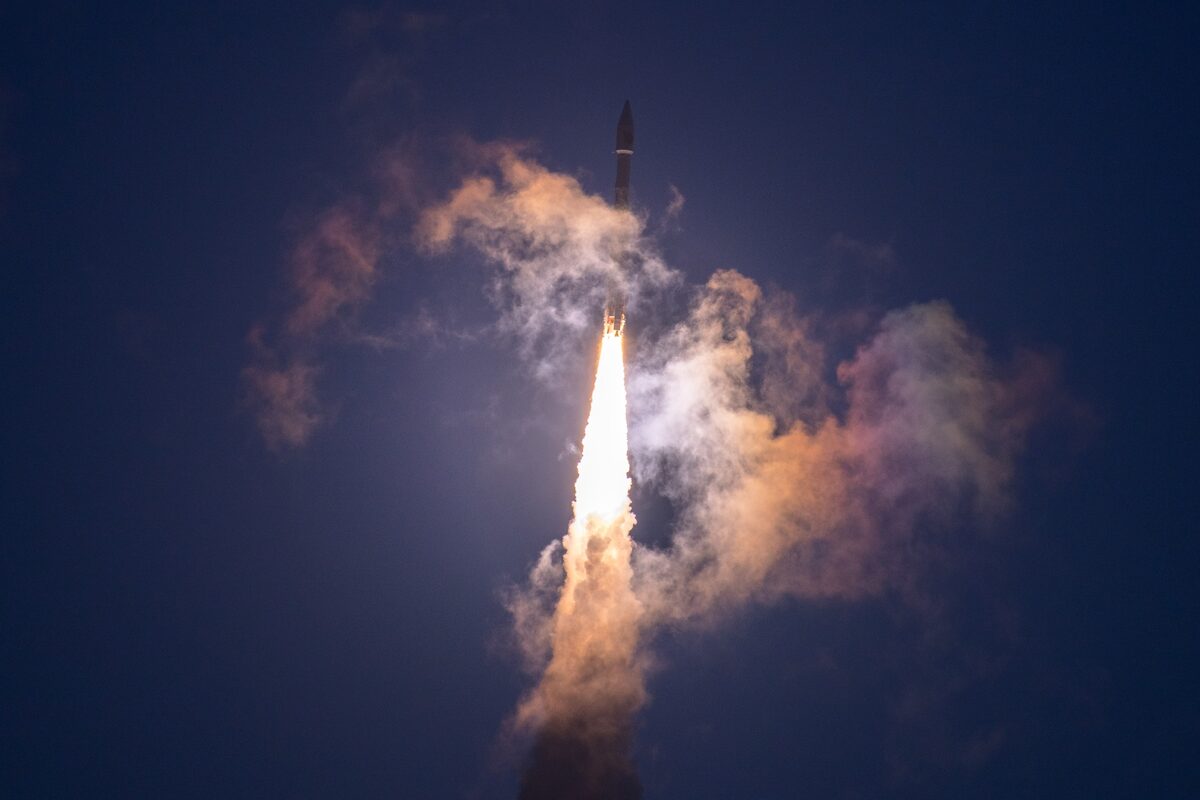
The U.S. Space Force is leaning harder on a commercial launch and satellite company to watch over geosynchronous orbit, the crowded shelf roughly 22,000 miles up where missile-warning satellites, GPS backups, and rival nations' spacecraft all operate largely beyond the reach of ground radar. Impulse Space announced Sept. 22, 2026 that it won a $28 million Space Force contract for a future space domain awareness mission, and SpaceNews reports the deal carries a ceiling of up to $31.2 million. It is the company's second major Space Force award, coming shortly after a separate $28 million contract to demonstrate in-space maneuverability operations, and it puts a government-owned sensor built by one of the country's top defense research labs into orbit to track objects that satellite operators currently struggle to see clearly.
The award is anchored by a $19.75 million Accelerate the Procurement and Fielding of Innovative Technologies grant, sponsored by U.S. Space Command. APFIT exists to push promising technology from prototype to fielded capability faster than the Pentagon's standard acquisition timeline, and Space Command's sponsorship signals that the combatant command overseeing military space operations wants the sensor data sooner rather than later.
How the Mission Will Get a Lincoln Lab Sensor Into Orbit
Under the contract, a government-provided rocket will launch Impulse's Mira vehicle into low Earth orbit carrying a government-furnished optical payload built by MIT Lincoln Laboratory. The Massachusetts-based lab, run by MIT for the Defense Department, specializes in space surveillance sensors, and its payload is designed to track and characterize objects in geosynchronous orbit, the ring roughly 22,236 miles above the equator where satellites match Earth's rotation and appear to hover in place from the ground. Because the government is supplying both the rocket and the sensor, Impulse Space's contribution is narrower and more specific than a typical satellite prime's: build, host and maneuver the spacecraft that carries someone else's instrument.
The launch is planned no earlier than 2029, which gives Impulse Space and MIT Lincoln Laboratory a multi-year runway to integrate the payload with the spacecraft and gives the Space Force time to slot the mission into its broader space domain awareness architecture. That timeline also means the contract's near-term value to Impulse Space is mostly in design, integration and testing work rather than an immediate launch campaign.
Why Mira's 850 Meters Per Second of Delta-V Matters
Geosynchronous orbit is valuable real estate precisely because objects parked there stay fixed relative to a point on the ground, but that same property makes it hard to watch from below with fixed ground sensors. A sensor hosted in low Earth orbit, by contrast, can pass by geosynchronous orbit repeatedly if the spacecraft carrying it has the propulsion to change its own vantage point. Mira can provide up to 850 meters per second of delta-v with a 100-kilogram payload using chemical propulsion, which lets the vehicle reposition the hosted sensor and change its viewing geometry over the course of the mission rather than staring at a single fixed angle the whole time. That maneuverability is the whole premise of the mission: a static sensor sees one slice of the sky, while a mobile one can chase objects of interest as they drift or maneuver themselves.
Impulse Space President and Chief Operating Officer Eric Romo pointed to the vehicle's track record as the reason the Space Force keeps coming back to it. "Mira has proven its capability and reliability as a hosting platform," Romo said. The company's announcement describes the hardware simply as a government-furnished optical payload built by MIT Lincoln Laboratory, phrasing that underscores how much of the mission's technical weight sits with the sensor rather than the spacecraft carrying it.
Impulse Space's Second Space Force Contract in Short Order
This is Impulse Space's second major Space Force contract, following a separate award to demonstrate in-space maneuverability, and it is the first of the two built around a Mira-hosted space domain awareness sensor. SpaceNews reported that the optical sensor will monitor objects across distances extending out to geosynchronous orbit, with a mission timeline pointing to that same 2029 launch window. Defense Daily likewise confirmed the deal as the company's second Space Force award in short order, underscoring that the Pentagon is willing to keep returning to the same commercial partner once it has shown its vehicle works. For a company still building out its launch and orbital-transfer business, a repeat customer inside the Space Force is a stronger signal than a single award, since it suggests satisfaction with Mira's performance on the earlier mission carried into how the service structured this one.
What It Means for Contractors
For companies competing in the fast-growing space domain awareness market, the award is a reminder that APFIT funding, created to speed proven prototypes into the field, is becoming a real channel for get-to-orbit contracts rather than just a line item in a budget request. Space Command's willingness to back a second major Impulse Space contract in short order also suggests the government is comfortable returning to a proven commercial partner for sensor hosting rather than treating each flight as a one-off demonstration, which could open the door for other commercial bus makers pitching similar hosted-payload arrangements.
Companies that can show a flight-proven vehicle with spare delta-v and payload capacity, as Impulse Space did by pointing to Mira's record in low Earth orbit, have a concrete argument to bring to the next round of Space Force sensor-hosting solicitations. The 2029 launch date also gives suppliers building optical or radar payloads for geosynchronous surveillance a multi-year window to align their own hardware schedules with a mission that is already funded and under contract, rather than waiting on a new competitive award to clear the acquisition pipeline first. It is also a reminder that prime contractor status on a space domain awareness mission does not always mean building the sensor: the government can furnish the most sensitive instrument itself and pay a commercial partner mainly for the ride, the maneuvering and the hosting.
