
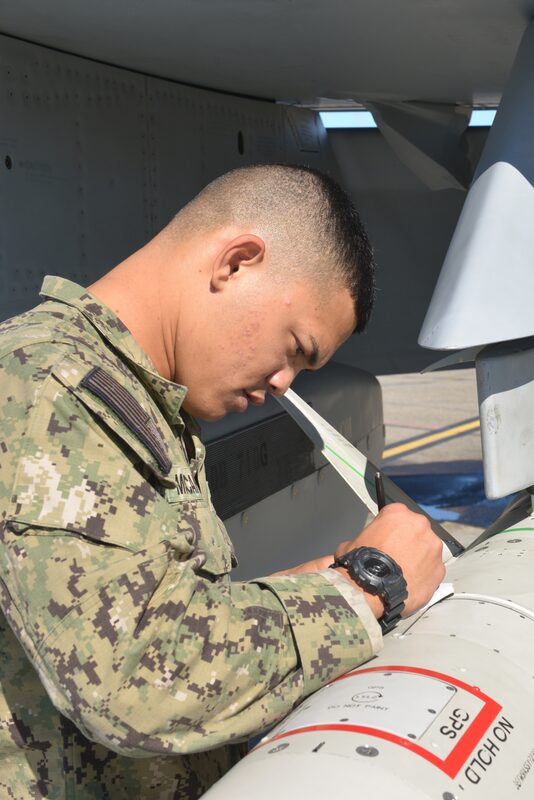
Navy and Royal Australian Air Force strike aircraft just got a firmer commitment behind the pod meant to retire one of the fleet's oldest electronic-warfare systems. The Department of War handed L3Harris Technologies Inc. an $876,440,942 undefinitized modification on Sept. 23, 2026, adding tooling, test hardware, cybersecurity work and years of logistics support to the contract building the Next Generation Jammer Low Band (NGJ-LB) — the system designed to replace the decades-old ALQ-99 pod still flying on EA-18G Growlers.
The Growler is the Navy's dedicated electronic-attack aircraft, flying ahead of and alongside strike packages to jam enemy radars and communications so other aircraft can get through. The ALQ-99 pod it has carried for decades predates modern digital threats, which is why the Navy split its replacement into three separate frequency-band programs rather than betting the whole upgrade on a single contractor or a single technology.
The action, designated P00021, modifies contract N0001924C0061, a cost-plus-incentive-fee award managed by Naval Air Systems Command in Patuxent River, Maryland, on behalf of both the U.S. and Australia. It was not competitively procured, since it adds scope to an existing contract rather than opening a new one. At the time of award, the government had obligated $3,653,866 in fiscal 2026 Navy research and development funds plus $23,044,630 in Royal Australian Air Force cooperative funds, with the rest to follow as the work is definitized. Expected completion is fiscal 2031.
What the $876M Modification Covers
The Department of War's own description lays out exactly what the money buys. "This modification adds scope to provide for the continued development of the Next Generation Jammer Low Band system, including non-recurring tooling and equipment and associated labor; delivery of system demonstration test article pods; additional cybersecurity and system security development; and product, logistics, test and evaluation, and software support for the Navy and Royal Australian Air Force (RAAF)," the Sept. 23 daily contract announcement states.
That language covers four buckets of work: the tooling and equipment needed to actually build low-band pods at scale, physical test article pods used to validate the design ahead of production, added cybersecurity and system-security engineering, and years of product support, logistics, testing and software sustainment once the system starts fielding.
Work spreads across a dozen locations, with Salt Lake City, Utah — L3Harris's home base for the program — taking the largest share at 43%. Hollywood, Alabama, follows at 14.8%, then Lansdale, Pennsylvania (8.1%), Clifton, New Jersey (8%), Boulder, Colorado (7.5%), Goleta, California (5.8%) and sites in Australia (3.4%). Smaller shares go to Carlsbad, California (3%), Edgewood, New York (2.6%), Waco, Texas (2.6%), Parsippany, New Jersey (1%) and Long Island, New York (0.2%).
A Program L3Harris Almost Lost in Court
L3Harris did not win the underlying NGJ-LB work cleanly the first time around. The company holds the low-band engineering and manufacturing development contract only because it fought for a second shot at bidding after losing the original competition.
"L3Harris filed suit in the Court of Federal Claims in September 2021 after the Government Accountability Office sided with Northrop Grumman, whose protest centered on a former Navy employee," according to GovConWire's reporting on the modification. That former Navy employee allegedly worked on the program's specifications while in employment talks with L3Harris — the conflict-of-interest allegation GAO found persuasive enough to sustain Northrop's protest. The Navy reopened the competition rather than fight the ruling, and L3Harris came out on top the second time, winning the $587 million NGJ-LB EMD contract in August 2024.
L3Harris also already holds a separate, earlier $496 million Next Generation Jammer EMD award for aircraft-based external jamming pods, won in December 2020, so a large share of the Growler's future defensive electronics already runs through the same contractor.
Why Only Two of the Three Jamming Bands Are Funded
The Navy split its jammer replacement program into three frequency segments years ago, and the three have moved at very different speeds. Raytheon won the mid-band segment in 2016. L3Harris's low-band segment, the subject of this modification, is now the second of the three moving through demonstration hardware toward production. The high-band segment has gone unfunded since at least fiscal 2020, according to DefenseScoop, leaving the top of the jamming spectrum still covered by the aging ALQ-99 with no funded successor in sight.
What It Means for Contractors
For companies working NGJ-related business, the structure of this award is as instructive as its size. An undefinitized modification means L3Harris is authorized to start the tooling, test-pod and cybersecurity work immediately while final pricing is still being negotiated with Naval Air Systems Command — standard practice on a program transitioning from development into low-rate production support, but a reminder that the $876 million figure isn't a locked final price until the modification is definitized. Prime contractors carrying undefinitized work on their books face real cash-flow exposure until that happens, and subcontractors down the chain should expect purchase orders tied to this scope to firm up on a similar timeline.
The dozen-site work split also shows how far NGJ-LB subcontracting already reaches, from Alabama tooling shops to New York and New Jersey electronics suppliers to Colorado and California engineering sites, with only a small slice of the work actually performed in Australia despite the RAAF's sizable funding contribution. That $23 million cooperative-funds line confirms Australia is now paying its way through this phase of the program, not simply waiting to buy finished pods later.
The bigger opportunity sits in the segment nobody has funded yet. With mid-band awarded years ago and low-band now moving into demonstration hardware, a future decision to fund the high-band jammer would open a competition that has effectively been dormant since fiscal 2020 — the one piece of the Growler's electronic-warfare suite still up for grabs, and the one place a competitor besides L3Harris or Raytheon could still land a piece of the program.
