
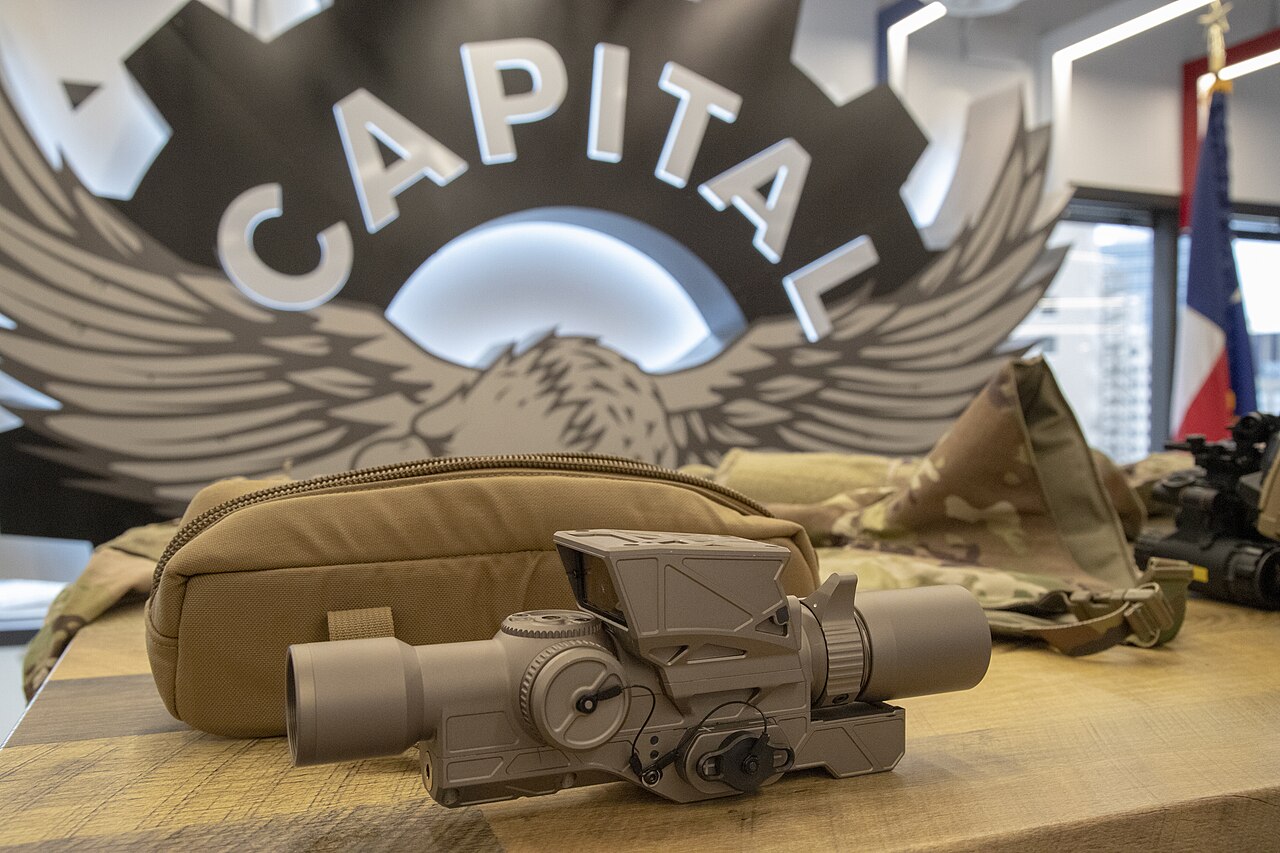
Army soldiers are set to receive L3Harris NOVA night-vision goggles from a full-rate production line, with no announced low-rate phase in between. L3Harris Technologies (NYSE: LHX) said on Oct. 12, 2026, that it received a $55 million award from the U.S. Army to support the Binocular Night Observation Device (BiNOD) program by supplying the NOVA goggle system. The company said it "will move directly into full-rate production of the system."
The order lands six months after the Army picked L3Harris as one of several BiNOD vendors. In April, the company announced a seven-year contract worth up to $465 million. The October announcement turns that selection into a funded production order, though it leaves several questions open for anyone tracking the program's size.
What the $55M BiNOD Order Buys
The October release describes the award in a single sentence: $55 million from the Army "to support the Binocular Night Observation Device (BiNOD) program by supplying the NOVA™ night-vision goggle system." L3Harris issued the announcement from Londonderry, N.H.
The release does not say how many NOVA units the $55 million covers, when deliveries begin or end, or which Army organization placed the order. It also does not say whether the award is an order under the seven-year vehicle announced in April or a separate action. Readers should not assume the $55 million draws down the $465 million ceiling; L3Harris has not said so.
What the company did say is that production starts at full rate. The company did not describe any low-rate initial phase before this order. The release's forward-looking-statements section flags that "Statements about order values, system capabilities and production capacity are forward-looking and involve risks and uncertainties," a standard caveat that applies to the production claim.
How NOVA Works and Why the Army Wants a Binocular Goggle
NOVA is a helmet-mounted binocular night-vision device. The April release says it "modernizes fielded capabilities by providing all-hour, all-weather situational awareness for the U.S. military and allies." The goggle uses image intensifier technology, which amplifies available low light rather than reading heat signatures. According to the April release, NOVA is "designed to meet the needs for the next 20-plus years," and a photo caption on that release says it relies on "unfilmed Gen III image intensifier technology."
The October release frames the same design goal slightly differently, saying the company built the system to meet the U.S. military's needs "for the next two decades and beyond."
Brenna Baker, president of Integrated Vision Solutions in L3Harris' Communications & Spectrum Dominance segment, tied the design to early Army involvement. "From day one, we partnered closely with the Army to design a binocular system tailored to the evolving demands of the modern battlefield," Baker said in the October release. "Our BiNOD solution reflects that collaboration, and we’re prepared to deliver this capability at speed and scale for soldiers."
From April Selection to October Production Order
The April announcement set expectations that the October order now meets. "We worked closely with the Army to understand their requirements for a next-generation binocular solution that is highly capable and low cost," Baker said then. "We are focused on moving directly into production to quickly put this capability into the hands of soldiers."
That April release, also carried by Joint Forces News, stated that "The Army awarded a seven-year contract worth up to $465 million to L3Harris, one of several companies chosen to support the program." Neither release names the other BiNOD vendors, and the $465 million figure is a ceiling for L3Harris, not a guaranteed spend.
The April announcement also carried a statement from Sen. Jeanne Shaheen, D-N.H., who cited the local economic effect: "Investments like this not only bolster the Granite State’s economy, but also directly contribute to the safety and security of the United States and our allies."
Where NOVA Fits in L3Harris' Night-Vision Business
L3Harris already supports several U.S. night-vision programs. The April release says the BiNOD award builds on the company's work on the Enhanced Night Vision Goggle – Binocular (ENVG-B), and that "L3Harris has delivered more than 20,000 ENVG-B units to date."
The October release points to a different program: the Fused Panoramic Night Vision Goggle, which it says gives U.S. Special Operations Command "unprecedented situational awareness for improved mobility, targeting and lethality."
L3Harris is also pitching NOVA abroad. The October release says the system "is also available to allied nations that are investing in modernization efforts to increase situational awareness at night across their land forces." The company did not name any foreign customers or pending sales.
What It Means for Contractors
BiNOD is a multi-vendor program. The April release says the Army chose "several companies," which means L3Harris' production order does not by itself close the door on other awardees. Firms holding a BiNOD slot, or supplying one, should watch for further task orders rather than read the $55 million as a winner-take-all outcome.
The size of the opportunity remains hard to pin down from public sources. L3Harris has disclosed a $465 million ceiling for its own seven-year contract and a $55 million award, but no quantities, delivery schedule or link between the two figures. Suppliers sizing their own work against BiNOD should rely on the Army's contract data, not on arithmetic from the two press releases.
The full-rate production claim could matter for the supply base. A goggle built at production volume from the start of the order would plausibly put early demand on image intensifier tubes, optics and helmet-mount hardware, though the releases give no supplier details. Both releases describe NOVA as built around image intensifier technology, and Sen. Shaheen tied the April selection to New Hampshire's economy.
The allied-sales line also signals that L3Harris intends to market BiNOD hardware internationally. Companies in the night-vision supply chain with export experience may see follow-on demand if foreign land forces buy NOVA, though no such sales have been announced.
Finally, the timeline is short: a multi-vendor selection with a seven-year ceiling in April, then a production order to L3Harris six months later. Vendors on other soldier-systems competitions can use BiNOD as one data point on how quickly an Army selection can turn into funded production when the design is ready.
Sources
- L3Harris to Provide Night-Vision Systems to US Army (L3Harris press release, Oct. 12, 2026)
- US Army Selects L3Harris for Next-Generation Night-Vision System (L3Harris press release, April 13, 2026)
- L3Harris NOVA for US Army BiNOD Programme (Joint Forces News, carrying the April 2026 L3Harris release)
