
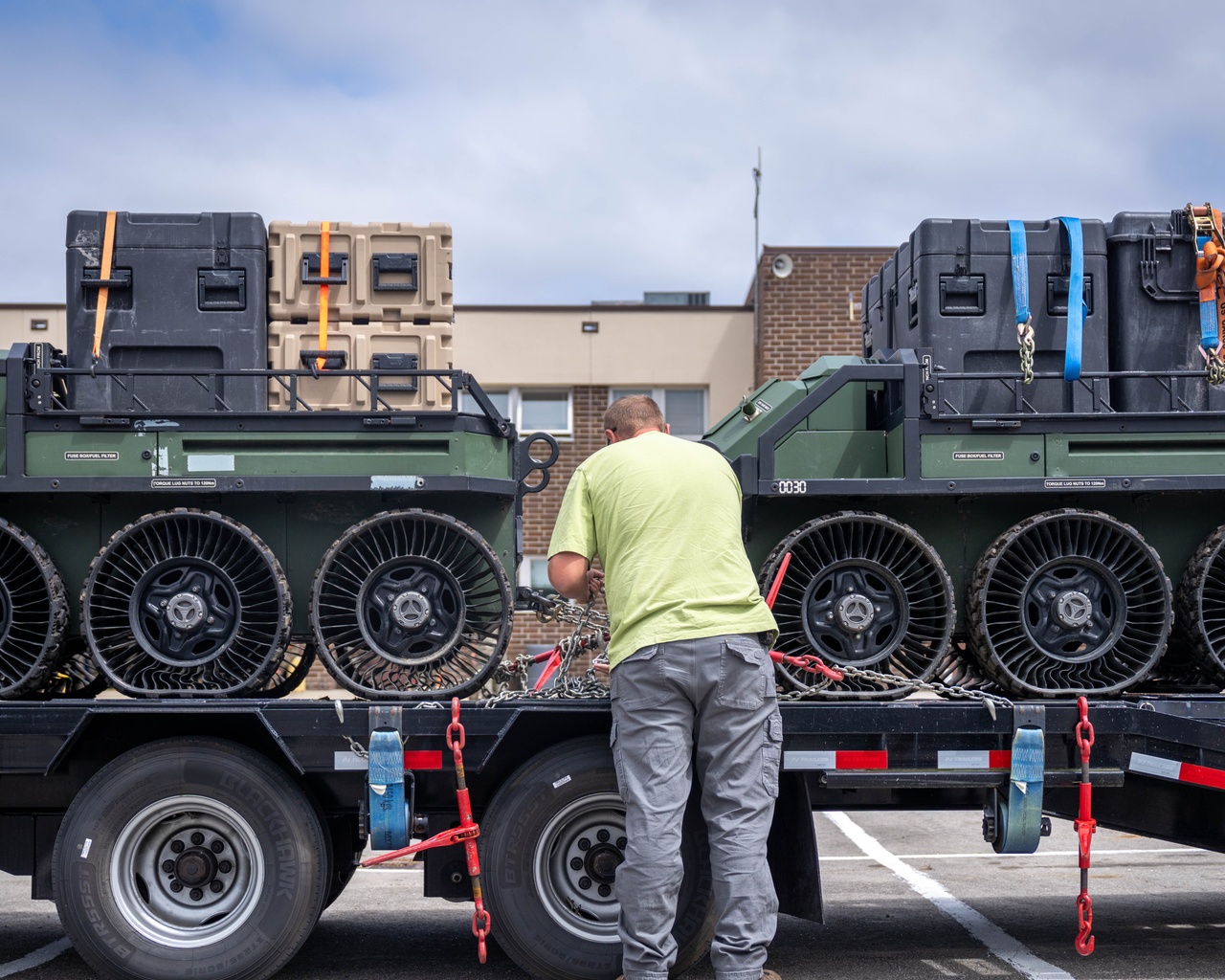
The Marine Corps has put a ground-autonomy startup on contract to build robots, not just prototype them. Seattle-based Overland AI received an Other Transaction agreement worth about $20 million to deliver military unmanned ground vehicles with software support, the company and defense outlets disclosed on June 29, 2026. The award puts about a dozen autonomous vehicles into production to resupply the service's counter-drone capability, and the company says it is the first ground-autonomy firm to prime a production contract for the U.S. military.
Background
Other Transaction agreements sit outside the traditional Federal Acquisition Regulation framework, and the Defense Department has leaned on them for years to pull non-traditional vendors and commercial technology into the force faster than a standard program of record allows. Most OTAs that companies like Overland AI have won to date covered prototyping and experimentation. Crossing from a prototype OTA into a production OTA is the harder step, because it commits government procurement dollars to fielded hardware rather than demonstrations.
Overland AI builds autonomy software and the vehicles it runs on. Its ULTRA platform weighs roughly 2,500 pounds and carries about 1,000 pounds of payload, putting it in the small-but-rugged class of uncrewed ground vehicles designed to move with a maneuvering unit rather than sit at a fixed base. The Marine Corps wants those vehicles tied to its air-defense mission. The Marine Air Defense Integrated System, or MADIS, is the service's counter-unmanned-aircraft capability, mounted on Joint Light Tactical Vehicles to detect and defeat hostile drones. MADIS falls within the broader Ground-Based Air Defense portfolio, an area the Corps has prioritized as small drones proliferate on the battlefield.
Key Details
The agreement is valued at about $20 million. Beyond the vehicles themselves, the deal covers Overland AI's OverWatch command-and-control system and OverDrive autonomy stack, along with spares and services, according to defense reporting. The autonomous vehicles run their own onboard perception, planning, and vehicle control, while human operators can still take manual command when needed. The vehicles will resupply MADIS within the Ground-Based Air Defense portfolio, carrying the consumables and equipment that keep a counter-drone system in the fight without exposing Marines to the resupply run. Reporting also flagged intelligence, surveillance, and reconnaissance as a potential additional use for the platform.
The quantity is modest by design. Defense reporting put the order at about a dozen vehicles, with initial deliveries expected roughly nine months after award. That timeline matters as much as the dollar figure: a nine-month path from contract to delivered hardware is fast for a defense production effort, and it reflects the appeal of the OTA mechanism and a commercial-derived platform that does not require years of bespoke development.
The ULTRA vehicle's specifications, roughly 2,500 pounds with a 1,000-pound payload, place it in a category meant to keep pace with dismounted and mounted formations while hauling a meaningful load. For an air-defense resupply mission, payload capacity and autonomous navigation are the two attributes that decide whether the system removes risk from Marines or simply adds another vehicle to manage.
The company's framing of the award is pointed. In its own announcement, Overland AI states the contract makes it "the first ground autonomy company to prime a production contract for the U.S. military." Priming a contract means holding the agreement directly with the government rather than working as a subcontractor under a larger integrator, and doing so on a production award rather than a prototype is the distinction the company is drawing. Company chief executive Byron Boots has framed the milestone as moving beyond experimentation and prototyping to production. The deal was awarded as an Other Transaction through the office of the Under Secretary of Defense for Research and Engineering under its Accelerate the Procurement and Fielding of Innovative Technologies, or APFIT, program.
What It Means for Contractors
The signal here is about a path, not a price tag. A roughly $20 million OTA is small against major defense awards, but the structure tells contractors something the dollar figure does not: the Marine Corps is willing to move a non-traditional autonomy vendor from prototype into production through an Other Transaction, and to do it on a roughly nine-month delivery clock. For startups and small companies building autonomous systems, that is a reference transaction worth studying.
Companies pursuing similar work should note the contracting pathway. The award flowed through APFIT, a program built specifically to push proven prototypes into production and fielding faster than a standard program of record can manage. Firms negotiating OTAs can point to APFIT as a model for converting a maturing prototype into committed production work, rather than waiting on the multi-year cycle a traditional acquisition would impose. That distinction matters for vendors weighing whether to chase a program of record or an OTA: the former offers scale and stability, the latter speed and a lower barrier to entry for commercial-derived technology.
The mission context also matters for positioning. The award ties autonomous ground vehicles directly to counter-drone resupply within Ground-Based Air Defense, an area drawing sustained investment as adversary drones multiply. Contractors with autonomy, robotics, or logistics-vehicle offerings should map their capabilities against named programs like MADIS rather than pitching generic autonomy. The Marine Corps bought a specific resupply function for a specific air-defense system, and that specificity is what got the deal across the line.
Finally, the "first to prime" claim, whether or not every competitor accepts it, underscores how the OTA-to-production transition is becoming the proving ground for the ground-autonomy market. The award also marks a shift from tele-operated and remote-controlled systems toward fully autonomous ones inside Marine Corps programs. Subcontracting under a prime integrator remains the common route, but this deal shows the government will hand a production agreement directly to an autonomy specialist when the requirement is well defined and the platform is ready. Vendors that can demonstrate fielded, payload-capable hardware on a short timeline are the ones positioned to follow.
For the wider unmanned-systems base, the takeaway is that prototype success is no longer the finish line. The services are increasingly willing to convert experimentation into production when a vendor can deliver in months, and the OTA remains the contracting tool that makes that conversion possible. Watch whether follow-on orders against this agreement, or comparable production OTAs from the other services, expand the dozen-vehicle buy into a larger fleet. Each successful conversion lowers the perceived risk of the next, and a visible win by a venture-backed autonomy firm tends to pull more commercial entrants toward defense work.
Sources
- Contracts for June 26, 2026 — U.S. Department of War
- Overland AI lands Pentagon contract to produce autonomous ground vehicles for Marine Corps — DefenseScoop
- USMC awards $20 million contract for first autonomous ground vehicles — Military Times
- Overland AI Is the First Ground Autonomy Company to Prime a Production Contract for the U.S. Military
