
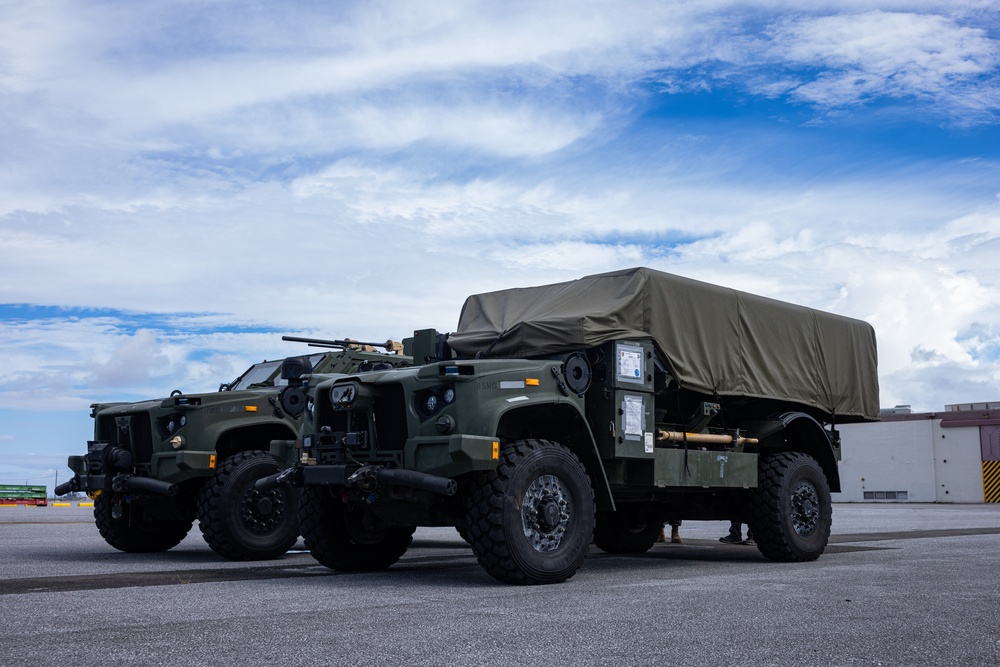
U.S. Marines with the 12th Marine Littoral Regiment (MLR), 3rd Marine Division formally received both the Navy-Marine Expeditionary Ship Interdiction System (NMESIS) and the Marine Air Defense Integrated System (MADIS) at Camp Courtney, Okinawa in June 2026, completing the regiment's full organic weapons package and establishing a permanent forward-deployed sea-denial and short-range air-defense capability in the first island chain. The 12th MLR joins the 3rd MLR in Hawaii as the second Marine Littoral Regiment to hold both systems simultaneously, closing out a multi-year fielding effort tied to the Marine Corps' Force Design initiative and its broader shift toward smaller, more lethal units built for the Pacific littoral environment.
Background
The Marine Corps stood up its first Marine Littoral Regiment — the 3rd MLR in Hawaii — as the initial operational unit under the Force Design initiative, the service's restructuring plan designed to produce units optimized for coastal and island operations in contested maritime environments. The 12th MLR followed at Camp Courtney, Okinawa, positioned within the first island chain and in close proximity to key maritime straits that would be central to any Western Pacific contingency.
NMESIS mounts the Naval Strike Missile on a Joint Light Tactical Vehicle and is designed as a ground-based ship-killing system for sea-denial operations near coastlines. The Naval Strike Missile provides a range of approximately 115 miles, and the launcher vehicle can be operated in semi-autonomous or fully autonomous modes, reducing the crew exposure required to fire a long-range anti-ship weapon from a coastal position. The system is designed to be highly mobile and rapidly deployable, allowing it to be concealed and dispersed across island terrain in ways that complicate adversary targeting.
MADIS addresses the air dimension of the littoral fight through a two-vehicle architecture. The first vehicle is a 4x4 platform equipped with 360-degree radar and an electronic warfare suite capable of detecting, tracking, and defeating unmanned aerial systems. The second vehicle mounts Stinger surface-to-air missiles, a 30mm cannon, and additional electronic warfare capability to engage fixed-wing aircraft, rotary-wing aircraft, and the full spectrum of low-altitude aerial threats. Together the two vehicles give a Marine Littoral Regiment organic defense against the drone and manned aircraft threats most likely to contest island positions.
The 3rd MLR in Hawaii fielded NMESIS in November 2024 and MADIS in December 2024, giving it an extended period to integrate and exercise the two systems before the 12th MLR's Okinawa receipt. Both systems were exercised during Resolute Dragon 2025 — a bilateral exercise with Japan — and during Balikatan 26 in the Philippines, where Marines deployed NMESIS across Philippine islands and demonstrated MADIS capabilities against unmanned aerial systems in live-exercise conditions.
Key Details
The Okinawa fielding completes what Marine Corps planners describe as the full combat weapons package for a Marine Littoral Regiment. NMESIS provides the regiment's primary capability to threaten surface combatants and deny sea lanes, while MADIS provides organic short-range defense against drone and aircraft threats overhead. The combination addresses a gap that Marine planners identified in modern littoral operations: ground forces operating on islands and coastlines face both a surface threat from naval vessels and an aerial threat from unmanned systems, and the two problems cannot be solved by a single platform.
NMESIS handles the maritime kill chain from a mobile ground position, enabling a small regiment element to strike surface targets at well over 100 miles without relying on fixed air or naval surface assets that may not be available in a contested environment. MADIS handles the airspace over the ground force. Operating together and dispersed across island terrain, the two systems allow the 12th MLR to both threaten adversary naval forces and defend its own positions with organic fires — a combination that significantly raises the cost of any adversary attempt to isolate or suppress a forward-deployed MLR element.
The mobility and concealment advantages of both systems are central to the MLR concept of operations. Unlike fixed installations or surface combatants, NMESIS and MADIS vehicles can relocate rapidly after firing or detecting a threat, denying adversary targeting solutions and forcing an adversary to expend significant intelligence, surveillance, and reconnaissance resources to locate and track a dispersed island-based force.
Mark Cancian, a senior advisor at the Center for Strategic and International Studies and a retired Marine colonel, has characterized NMESIS as the backbone of the Marine Littoral Regiment's combat capability — and getting it fielded as critical to the regiment's operational readiness. The Okinawa deployment places that capability within the first island chain, in a regiment permanently stationed at one of the most strategically sensitive locations in the Western Pacific.
What It Means for Contractors
- Raytheon and Kongsberg supply the Naval Strike Missile at the heart of NMESIS; with two Marine Littoral Regiments now fielded and potential follow-on requirements for stockpile replenishment, training rounds, and allied sales to Pacific partners, NSM production demand is set to grow in the near term.
- The MADIS platform integrates Stinger missiles and a 30mm cannon on a 4x4 vehicle architecture alongside a radar and electronic warfare suite; suppliers across the Stinger, cannon, radar, and EW segments will see sustained demand as the Marine Corps sustains two fielded regiments and works through training and readiness requirements.
- Logistics and sustainment contractors supporting Camp Courtney should expect increased tempo as the 12th MLR integrates two new major weapon systems requiring specialized maintenance pipelines and operator training programs distinct from legacy Marine ground equipment.
- The Marine Corps has not publicly disclosed total MADIS production quantities, leaving open the question of whether additional units will be procured for future MLR activations or for Marine Reserve integration — a potential source of follow-on contract activity for both the platform prime and subsystem suppliers.
- Pacific sealift and inter-island logistics providers face rising demand as the Marine Corps requires frequent movement of NMESIS and MADIS vehicles and associated ground support equipment across Japan's southwestern island chain to support the dispersed island-hopping operations both systems are designed for.
- Electronic warfare integrators and counter-UAS capability developers should monitor MADIS upgrade requirements: the system's performance against small unmanned aerial systems was a focus of Balikatan 26 and Resolute Dragon 2025 exercises, and continued operational use by two fielded regiments is expected to generate feedback-driven improvement requirements over time.
