
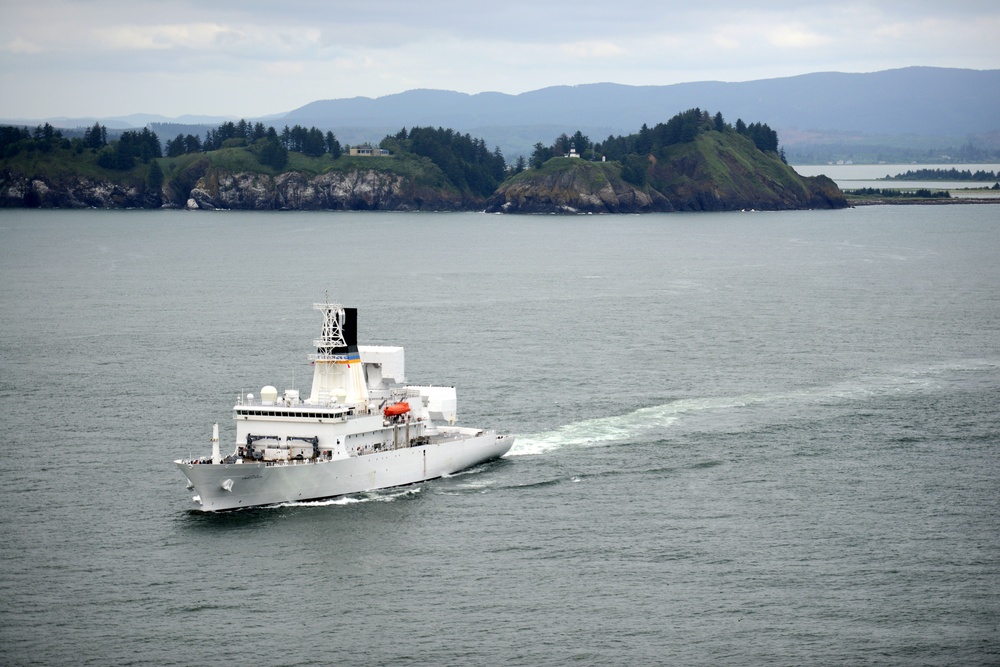
The Department of Transportation announced on July 17, 2026 a $2 billion investment to build two Missile Range Instrumentation Vessels at Hanwha Philly Shipyard, with TOTE Services managing construction under the Maritime Administration's vessel construction manager model. Transportation Secretary Sean P. Duffy and Office of Management and Budget Director Russell Vought made the announcement in Philadelphia. The two ships will replace a pair of 50-year-old vessels in the Department of War's Missile Defense Agency fleet, and the first is slated for delivery by June 2030.
Background
The ships being replaced are the Pacific Tracker, constructed in 1965, and the Pacific Collector, constructed in 1970, according to Naval News. Both support missile flight testing over the Pacific, and both are decades past the point where most commercial hulls are retired. Range instrumentation ships are a small, unglamorous corner of the fleet, but they are the sensors that certify whether an interceptor test worked. Without them, the data supporting a test campaign has to come from land sites and airborne assets that cannot always be positioned where the intercept happens.
The announcement came at the christening of the Lone Star State, the fourth of five National Security Multi-Mission Vessels the Department of Transportation is buying for the state maritime academies. That ship goes to Texas A&M Maritime Academy. Three NSMVs have been delivered so far; the Lone Star State is expected to follow in the coming months, and the fifth and final vessel is anticipated in mid-2027.
That program is the reason the MRIV award landed where it did. Under the vessel construction manager arrangement, MARAD contracts with a commercial ship manager, which in turn holds the shipyard contract and runs the program on the government's behalf. It is a deliberate departure from a traditional Navy shipbuilding contract, and MARAD credits it for the NSMV program's schedule performance. Maritime Administrator Stephen M. Carmel said in the DOT release that the agency's "proven vessel construction management model has a powerful track record of delivering critical maritime assets on time and on budget."
The companies put a number on that claim. TOTE Services and Hanwha say the VCM approach can reduce acquisition costs by at least 50 percent compared with traditional government acquisition strategies. That figure is a vendor estimate rather than an audited finding, and it addresses acquisition cost rather than lifecycle cost, but it explains why a civilian maritime construct is now being pointed at a defense mission.
Key Details
DOT describes the MRIV mission as providing "advanced tracking capabilities to observe missile interception tests over the Pacific Ocean, gather mission-critical data, and support range safety operations." The department named the Working Families Tax Cut Act as the funding source and framed the buy around the administration's push to restore American maritime dominance.
Hanwha Philly Shipyard builds both hulls in Philadelphia. Naval News reports that the design leverages the proven NSMV hull form along with the active production line, existing supply chain and skilled workforce already standing at the yard, which has grown from a few dozen workers to more than 2,000 production workers over the course of the NSMV program. Breaking Defense reports that Vought described the NSMV design as having a range of applications that naturally lent itself to the missile range instrumentation mission.
The ship has a name, and it carries a policy signal. The TOTE Services and Hanwha announcement, along with Naval News and Breaking Defense, identifies the vessel as the Golden Defender. Breaking Defense quotes Vought tying it directly to the administration's missile defense architecture: the ship "will not only support the president's policies of restoring American maritime dominance, but also support the president's Golden Dome missile defense system over the entirety of our nation." That linkage comes from Vought's spoken remarks as reported by trade press, and readers should treat the Golden Dome connection as his framing rather than a documented program requirement.
The Missile Defense Agency did not immediately respond to Breaking Defense's request for comment, and MDA has not disclosed a contract value or contract vehicle of its own. The $2 billion figure covers both ships; neither DOT nor the trade press has broken out a per-ship price.
What It Means for Contractors
The most useful signal here is procedural. A $2 billion missile defense shipbuilding buy was announced by the Transportation Secretary, at a maritime academy training-ship christening, and executed through a Maritime Administration construct. Companies that monitor war.gov contract announcements and SAM.gov solicitations as their primary pipeline sources would have had no reason to look at this event at all. If MARAD's VCM model keeps drawing defense work, then MARAD and its vessel construction managers become a business development target in their own right, not just a civilian maritime account.
The practical consequence is that subcontracting opportunity flows through TOTE Services and Hanwha Philly Shipyard rather than through a government prime competition. Suppliers who want on these hulls should be qualifying with the yard and the construction manager now, because the NSMV heritage means much of the vendor base is already locked in. Reusing an existing hull form, production line and supply chain is the stated reason this program can promise a 2030 delivery; it is also the reason the structural, propulsion and outfitting supply chain is largely settled. The competitive space is narrower than a $2 billion figure suggests.
Where it is not settled is the mission payload. Range instrumentation is a sensor, telemetry, tracking and data-handling problem, and nothing in the announcement addresses how that equipment gets bought or integrated. Radar, optics, telemetry receivers, range safety systems and the data architecture behind them are the technical heart of an MRIV, and they are the domain of defense electronics and systems integration firms rather than shipbuilders. Contractors in that space should treat this announcement as the start of a mission systems pursuit with MDA, on a schedule anchored to a June 2030 first delivery.
Finally, watch how the funding line behaves. DOT tied the money to the Working Families Tax Cut Act rather than a defense appropriation, which puts an MDA capital asset on a non-defense funding path. That is worth tracking for anyone forecasting how similar defense-adjacent programs might be resourced, and it is a reminder that the appropriation behind a program can be a better predictor of who runs the acquisition than the mission the program serves.
Sources
- U.S. Department of Transportation: Duffy, Vought Celebrate Christening of "Lone Star State," Announce $2 Billion Investment to Build Two New Military Ships in Philadelphia (July 17, 2026)
- TOTE Services & Hanwha Philly Shipyard Selected to Build U.S. Missile Defense Agency's Missile Range Instrumentation Vessels (company announcement)
- Naval News: Hanwha Philly Shipyard and TOTE Services Selected to Build New MDA Missile Range Instrumentation Vessels
- Breaking Defense: New "Golden Defender" missile monitor ship to be built at Hanwha Philly shipyard
