
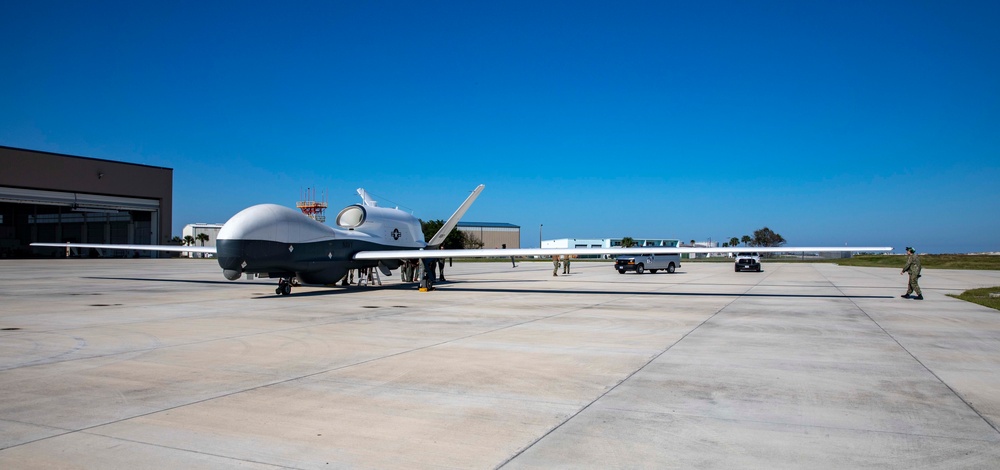
Denmark, Finland, Germany, and Norway announced on July 7, 2026 that they will procure up to five Northrop Grumman MQ-4C Triton high-altitude, long-endurance unmanned aircraft for NATO's intelligence, surveillance, and reconnaissance fleet, according to a NATO announcement issued at the NATO Summit Defence Industry Forum in Ankara, Türkiye.
Background
NATO has operated a multinational drone fleet through the Alliance Ground Surveillance (AGS) program, which flies five RQ-4D Phoenix aircraft out of Sigonella airbase in Italy, according to NATO's announcement and Breaking Defense. The RQ-4D, a NATO-configured variant of the Northrop Grumman RQ-4 Global Hawk, gives the alliance a shared, jointly funded ISR capability that individual member states do not have to buy or operate on their own.
The Triton announcement is one of several air-power deals NATO unveiled during the first wave of Summit-linked procurement news, alongside a deal for up to 10 Saab GlobalEye airborne early-warning aircraft and an Airbus A400M airlift initiative. Rather than expanding the jointly owned AGS fleet itself, Denmark, Finland, Germany, and Norway are procuring the Triton aircraft as a separate national-to-multinational acquisition that NATO says will operate alongside and complement the RQ-4D fleet already based at Sigonella. No dollar figure was disclosed, and the announcement functions as a procurement commitment rather than a definitized contract, consistent with how the other Summit-linked air-power deals were framed.
The GlobalEye acquisition is intended to replace NATO's aging E-3 airborne early-warning fleet and remains subject to further negotiation between the NATO Support and Procurement Agency and Saab before a contract is signed, according to Breaking Defense. The A400M initiative involves several allies pooling and sharing Airbus transport aircraft to address gaps in strategic airlift. Breaking Defense reported that NATO Secretary General Mark Rutte described the combined value of the Summit's air-power deals as running into the billions of dollars, though no line-item figure was attached specifically to the Triton procurement.
Key Details
The MQ-4C Triton is a maritime-focused variant of Northrop Grumman's Global Hawk-family airframe, built for the U.S. Navy and now sold to allied air forces through direct commercial sale and foreign military sale arrangements. According to NATO and Naval News, the aircraft the four allies are acquiring can sustain flights beyond 24 hours at altitudes above 15 kilometers (roughly 50,000 feet), giving crews a persistent, wide-area vantage point far above commercial air traffic and most weather. Naval News reported the Triton's reinforced airframe, de-icing systems, and lightning protection are built specifically for sustained maritime operations, and that the aircraft can cover an area of up to 4 million square nautical miles in a single flight.
The Triton's primary sensor is the AN/ZPY-3 Multi-Function Active Sensor radar, which provides 360-degree maritime surveillance coverage, supplemented by electro-optical/infrared cameras, signals-intelligence payloads, and a secure network relay function, according to Naval News. That sensor suite is built for tracking ships and other maritime activity over vast ocean areas, which lines up with NATO's stated purpose for the buy: protecting sea lines of communication and expanding surveillance coverage in the High North, the Baltic Sea, and Arctic approaches to allied territory.
NATO Secretary General Mark Rutte announced the acquisition as part of the alliance's first wave of Summit air-power deals, and Northrop Grumman framed the purchase as an extension of the AGS relationship. "Triton is poised to provide NATO new levels of capability and operational flexibility to monitor and protect maritime interests from the Mediterranean to the High North," said Jane Bishop, Northrop Grumman's vice president of global surveillance, in a statement carried by Breaking Defense.
Northrop Grumman will build the Triton aircraft themselves, but the program is structured as a transatlantic industrial arrangement rather than a straight U.S. export sale. Airbus Defence and Space and other European companies will supply ground infrastructure, data management systems, command-and-control integration, and mission support, giving European industry a defined role in standing up and sustaining the aircraft once delivered. NATO's announcement described the arrangement as leveraging transatlantic industrial relationships built over the past decade of AGS cooperation.
What It Means for Contractors
The Triton buy signals continued demand for high-altitude maritime ISR capability as NATO shifts more attention to Arctic and Baltic surveillance gaps, and it opens a second track of Triton-related work beyond the existing U.S. Navy and Australian Triton programs. Because the announcement is a multinational procurement commitment rather than a signed, priced contract, contractors should expect a definitization phase to follow in which the specific aircraft quantity, delivery schedule, and total contract value get finalized — that stage is typically where subcontracting opportunities become concrete enough to bid on.
The transatlantic industrial structure is the detail most worth tracking. Northrop Grumman holds the airframe and sensor scope, but Airbus Defence and Space's role in ground infrastructure, data management, and mission support means European systems integrators, IT contractors, and facilities firms in Denmark, Finland, Germany, and Norway are likely to see follow-on solicitations for ground station construction, data-handling infrastructure, and command-and-control integration work tied to wherever the four nations choose to base and operate their Triton aircraft. U.S. firms that already support Global Hawk or Triton ground segments for the Navy may find natural entry points as teaming partners on the European side of that infrastructure buildout, given the shared airframe lineage with the existing AGS RQ-4D fleet at Sigonella.
Maritime domain awareness and Arctic-focused sensor and communications vendors should also watch this program closely. NATO explicitly tied the Triton buy to protecting sea lines of communication and improving surveillance in the High North, which suggests follow-on interest in complementary capabilities — satellite communications relay, under-ice or cold-weather-hardened ground equipment, and data fusion tools that can integrate Triton's radar and signals-intelligence feeds with other alliance sensors. Because the AGS fleet at Sigonella is jointly funded and operated by NATO as an institution, while the Triton buy is being procured by four individual member states, contractors should also track whether the two fleets end up governed under separate contracting and sustainment structures, since that would create two distinct pipelines for maintenance, spares, and support work rather than one combined program office.
Firms with existing NATO AGS or Global Hawk/Triton sustainment contracts are best positioned to expand into this new procurement, but the explicit European-industry role in ground infrastructure and mission support means the door is open for firms without prior U.S. Navy Triton experience to compete for the European-side scope once the four governments move from this Summit announcement to formal solicitations.
