
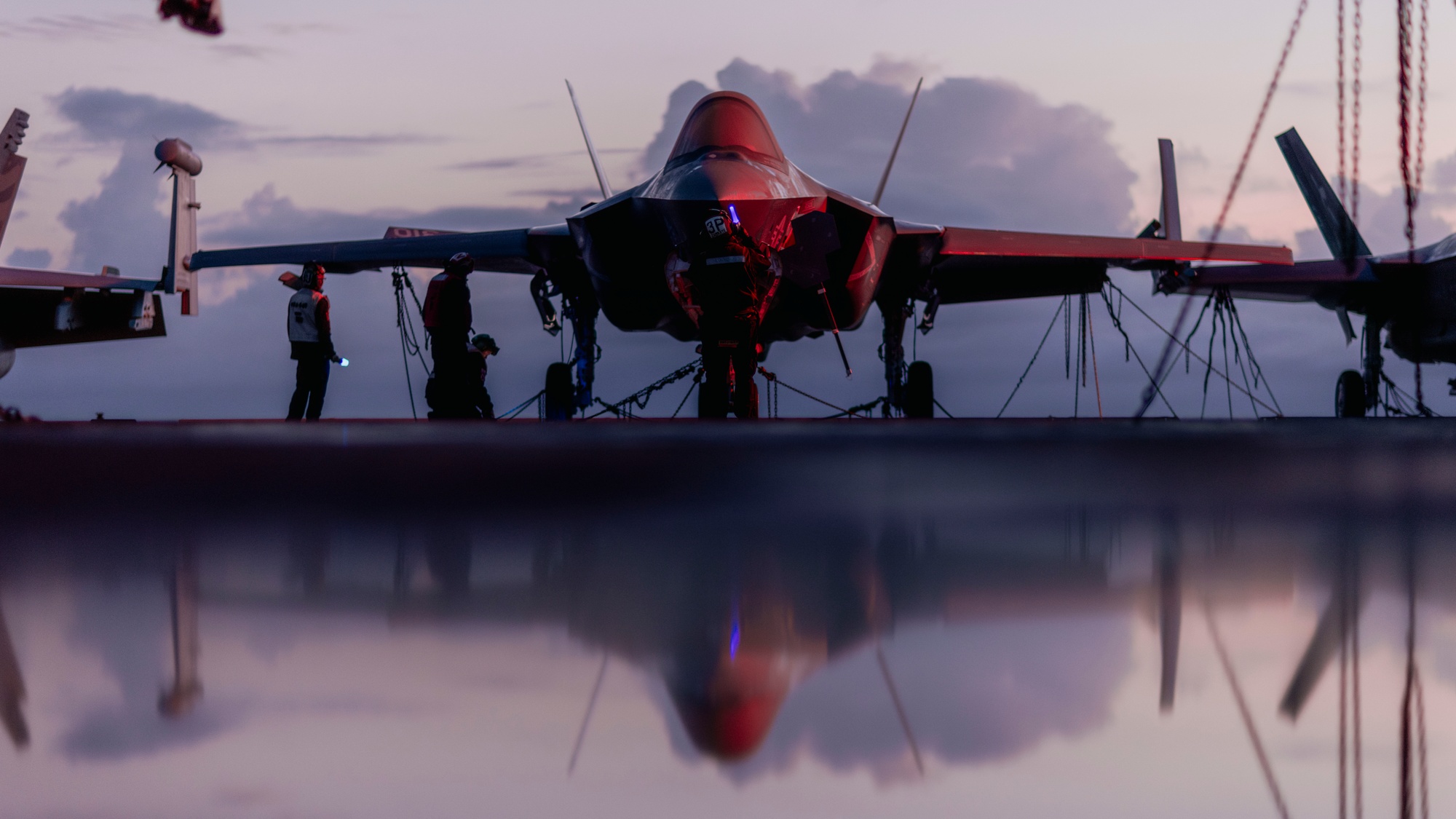
The Navy just made it faster and cheaper to open new F-35 bases around the world. A modification signed with Lockheed Martin on Sept. 18, 2026, adds $871,243,964 in ceiling capacity to the contract that pays for the initial equipment, spare parts and sustainment work needed to stand up F-35 operating locations for the Air Force, Marine Corps, Navy, U.S. coalition partners and foreign military sales customers alike, per a Department of War contract announcement posted the same day. The modification, numbered P00002, expands an existing cost-plus-incentive-fee indefinite-delivery/indefinite-quantity contract rather than creating a new one, and it does not itself buy a single jet.
What the $871 Million Ceiling Increase Actually Buys
The underlying contract, N0001926D0010, funds what the Pentagon calls "site activation and hardware non-recurring sustainment" for the F-35 Lightning II. In plain terms, that is the wave of support equipment, tooling and initial supplies a base or ship needs before it can maintain F-35s on its own — diagnostic racks, engine stands, weapons-loading gear, tow equipment and starter spare-parts kits, ordered ahead of a squadron's arrival rather than after.
"This modification increases the contract ceiling to provide additional capacity for support equipment under the F-35 Lightning II site activation and hardware non-recurring sustainment effort," the Department of War's daily contract announcement states.
The contract line does not serve one customer. It funds site activation for the Air Force and Marine Corps as well as the Navy, plus the F-35 program's Cooperative Program Partners — the allied nations that helped fund the jet's development — and countries buying the aircraft separately through Foreign Military Sales. Any of them opening a new land-based or shipboard F-35 site can draw against this ceiling.
The underlying vehicle is structured as a cost-plus-incentive-fee indefinite-delivery/indefinite-quantity contract, a combination built for exactly this kind of open-ended, multi-year sustainment work. The IDIQ format lets the Navy issue an unpredictable number of task orders over time rather than locking in a fixed quantity up front, while the cost-plus-incentive-fee structure reimburses Lockheed's allowable costs and ties part of its fee to performance rather than guaranteeing a flat profit margin. Raising the ceiling does not change either of those terms; it simply gives the government more room to keep ordering under the same rules as F-35 basing needs grow.
Sole-Source Award, No Money Obligated Yet
The Navy did not compete this modification. Lockheed Martin builds the F-35 and holds the technical data behind its support equipment, so the government treated the ceiling increase as a sole-source action rather than opening it to competing bidders — standard practice for sustainment add-ons to an aircraft program with a single manufacturer.
"Lockheed Martin Corp., Fort Worth, Texas, is awarded an $871,243,964 modification (P00002) to a cost-plus-incentive-fee indefinite-delivery/indefinite-quantity contract (N0001926D0010)," the official award notice reads, as reprinted by ClearanceJobs.
The $871 million figure is a ceiling, not a check. No funds are obligated at the time of the award; the Navy will obligate money only as it issues individual task orders against the higher cap over the life of the contract. That distinction matters for tracking federal spending: the headline number describes how much the government could eventually spend under this line, not what it has committed to pay Lockheed today. Naval Air Systems Command at Patuxent River, Maryland, is the contracting activity — which is consistent with a Navy-issued modification covering Air Force and Marine Corps site activation too, since the F-35 is flown by all three of those services under a shared NAVAIR-run sustainment structure.
El Segundo Carries the Load, Completion Set for 2031
Ninety percent of the work will happen in El Segundo, California; the remaining 10 percent falls to Fort Worth, Texas, where the jet is assembled. Contract completion is set for February 2031 — nearly four and a half years out, reflecting a modification that raises spending capacity rather than closing out a fixed scope of work. Individual site-activation orders will be issued against the new ceiling as additional F-35 locations come online over that span, both domestically and overseas.
That long runway matters because F-35 site activation is not a one-time event tied to this modification. Every new squadron stand-up, every new partner-nation base and every new at-sea F-35B or F-35C deployment location needs its own package of support gear before aircraft show up, and this contract is the vehicle the government uses to buy it. Neither source specifies why the work splits 90/10 toward California, but the pattern is consistent with El Segundo carrying most of the site-activation planning load while Fort Worth remains the F-35's final-assembly line.
What It Means for Contractors
The direct beneficiary of the award is Lockheed Martin, but the ceiling increase widens the pipeline for the companies that supply ground support equipment, tooling and sustainment services underneath Lockheed's prime contract. Because the Navy did not compete this modification, smaller suppliers will not bid the Navy directly for this work; their path in runs through Lockheed's subcontracting and supply-chain teams as the company issues its own purchase orders to fill specific site-activation task orders.
For those subcontractors, the practical takeaway is visibility rather than an immediate check. A ceiling that runs through February 2031 signals sustained demand for F-35 ground support equipment and sustainment services across a growing set of customers — new domestic squadrons, Cooperative Program Partner nations building out their own basing, and Foreign Military Sales buyers standing up their first F-35 sites. Companies positioning for that work should watch for Lockheed's own subcontract solicitations tied to specific site-activation orders rather than any future Navy synopsis, since the government-to-Lockheed award itself is already sole source and the money moves in task-order increments, not in one lump sum.
The award also underscores how much of F-35 sustainment spending is now driven by expansion rather than by the original U.S. fleet. As more partner nations and FMS customers open bases, the site-activation account — and the sole-source contract that funds it — is likely to keep growing regardless of how any single service's F-35 budget moves in a given year.
