
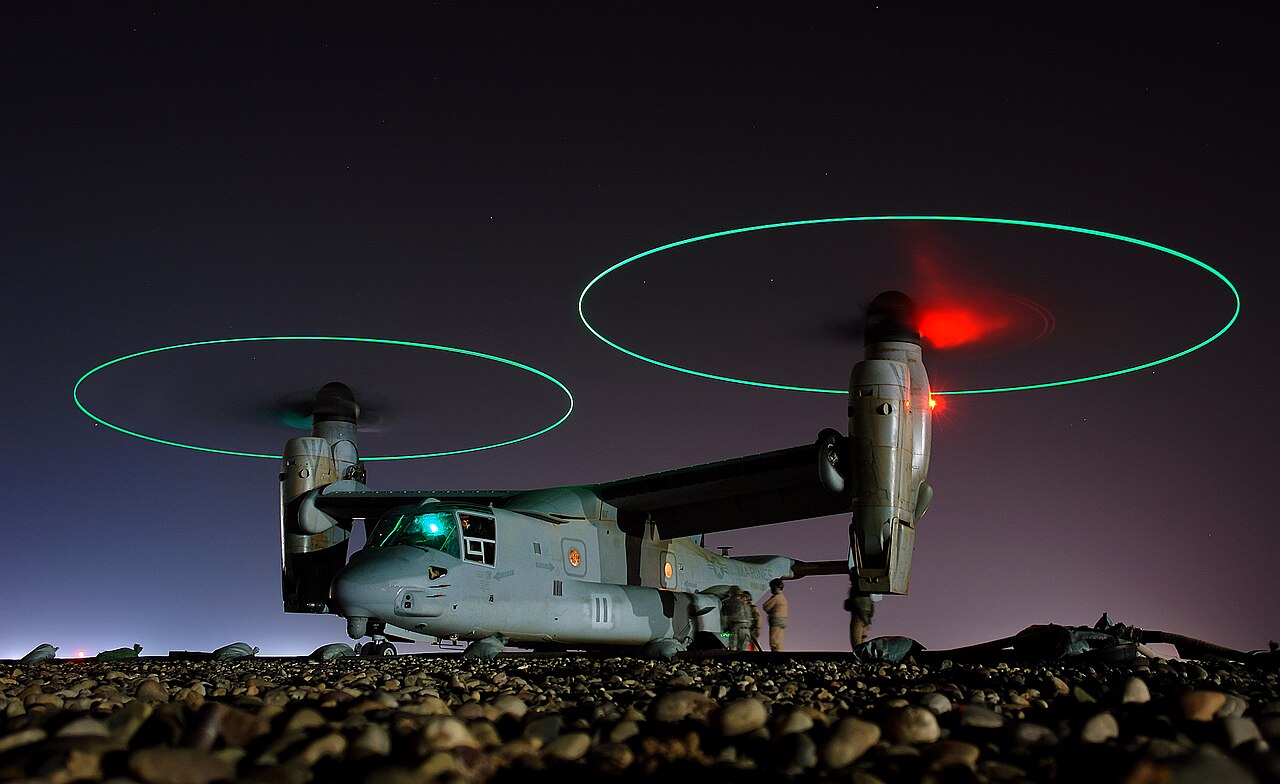
The V-22 Osprey's flight control electronics are being rebuilt from the computers up, and the Navy has put another $90.8 million behind the work. A Pentagon contract notice, republished in full by ClearanceJobs, shows Naval Air Systems Command placed a $90,826,949 cost-plus-incentive-fee order with the Bell Boeing Joint Project Office in Amarillo, Texas, on Oct. 15, 2026. The order covers what the notice calls the "continued redesign and development of the V-22 Osprey Flight Control System," and it touches every service that flies the tiltrotor, along with foreign buyers.
The order was placed against a basic ordering agreement and was not competitively procured. Naval Air Systems Command at Patuxent River, Maryland, is the contracting activity, and the work runs through October 2030.
What the $90.8M Order Buys for the Osprey Fleet
The notice lists three hardware pieces: replacement flight control computers, cockpit interface units and associated test equipment. The notice says the order serves the Air Force, Marine Corps, Navy and Foreign Military Sales (FMS) customers, so the redesigned system is meant for every U.S. service that flies the aircraft as well as export customers.
The hardware is only part of the order. Bell Boeing will also develop software, technical documentation, and logistics support products for future procurement and sustainment of the redesigned system. That language points past development. The documentation and logistics products are the groundwork the services would need to buy the new boxes in quantity and keep them supported in the field, though the notice does not say when or whether a production order will follow.
The notice gives the purpose as addressing aging electronic components, cybersecurity requirements and diminishing manufacturing sources. In practice, that describes a flight-critical computer built around parts that are getting harder to buy, and security standards that have moved since the original design.
How the 2026 Order Follows the $214M Redesign From 2021
This is not the start of the program. In September 2021, the same joint project office received a $214,394,944 cost-plus-incentive-fee order, N0001921F0327, against an earlier basic ordering agreement, N0001917G0002, according to the Defense Department announcement reproduced by Helihub. That order provided for the redesign and development of the V-22 Flight Control System, including the flight control computer, cockpit interface unit and associated test equipment. It was expected to be completed in June 2026.
The 2026 notice calls its work "continued" redesign but does not cite the 2021 order by number. The link between the two is drawn here from the matching scope, the same contractor office, the same contracting activity and the timing: the earlier order's completion date fell four months before the new one was signed. Taken together, the two orders carry a combined face value of $305,221,893 for flight control system redesign.
The two notices also differ in where the work happens. In 2021, the split was Ridley Park, Pennsylvania (54.92%); Endicott, New York (41.53%); Fort Worth, Texas (3.29%); and other U.S. locations (0.26%). The 2026 order puts work in Ridley Park (52%); Mesa, Arizona (42%); Fort Worth (5%); and other continental U.S. locations (1%). Endicott drops out entirely and Mesa takes nearly the same share. Neither notice explains the change or names the companies doing work at those sites.
Who Is Paying: Air Force Money Leads the First $4.87M
Only a small slice of the order's value is funded at award. The notice obligates three pots of money:
- Fiscal 2026 research, development, test and evaluation (Air Force) funds: $3,068,800
- Fiscal 2026 research, development, test and evaluation (Navy) funds: $369,250
- FMS customer funds: $1,431,200
That totals $4,869,250, or about 5.4% of the order's $90.8 million value. The Air Force supplies about 63% of the initial obligation, foreign customers about 29% and the Navy about 8%. The Air Force's lead share stands out in an order managed by Naval Air Systems Command. The pattern reverses the 2021 order, whose announcement obligated $26,974,249 in Navy research funds and $3,924,090 in Air Force funds at award.
The notice does not identify which FMS customers contributed. The remaining value of the order will presumably be funded in later increments, which means future budget cycles, particularly Air Force and Navy research accounts for fiscal 2027 and beyond, will likely decide how quickly the work moves.
Why a Sole-Source Order Was the Expected Route
The Bell Boeing Joint Project Office held the 2021 redesign order as well, and the new order continues that work. Placing the order against an existing basic ordering agreement without competition fits that arrangement. A BOA sets terms in advance, so individual orders like this one can be issued as requirements are defined without negotiating a new contract each time.
The cost-plus-incentive-fee structure is also typical for development work where the final cost is uncertain. The government pays allowable costs and the contractor's fee moves with performance against agreed targets.
What It Means for Contractors
For the prime, the order extends funded development on the V-22 flight control system into 2030 and sets up the documentation and logistics products that any production buy would need. The sustainment language in the notice is the clearest signal that the services expect to field the redesigned computers, not just prototype them.
For suppliers, the work-share change is the detail to watch. A site that held more than 41% of the 2021 order is absent from the 2026 notice, while Mesa, Arizona, now holds 42%. Electronics, test-equipment and software firms that support either location should track how subcontract packages for the replacement computers, cockpit interface units and test equipment are placed.
For firms working parts-obsolescence and cybersecurity hardening on other aging aircraft, the V-22 effort is a possible template. The Navy is paying to redesign flight-critical electronics rather than chase out-of-production components, and it is funding the technical data and logistics products up front.
Foreign Military Sales funding at award also matters. FMS customers contributed $1,431,200 at the start, so international V-22 operators are paying into the redesign from the beginning. That makes the export fleet part of the eventual market for the new hardware.
Sources
- Navy Awards Bell Boeing $91M Contract for Critical V-22 Osprey Upgrades (ClearanceJobs, Oct. 17, 2026; reproduces the Defense Department contract announcement)
- Bell Boeing awarded $214M order for V22 flight control system redesign (Helihub, Sept. 29, 2021; reproduces the Defense Department announcement)
