
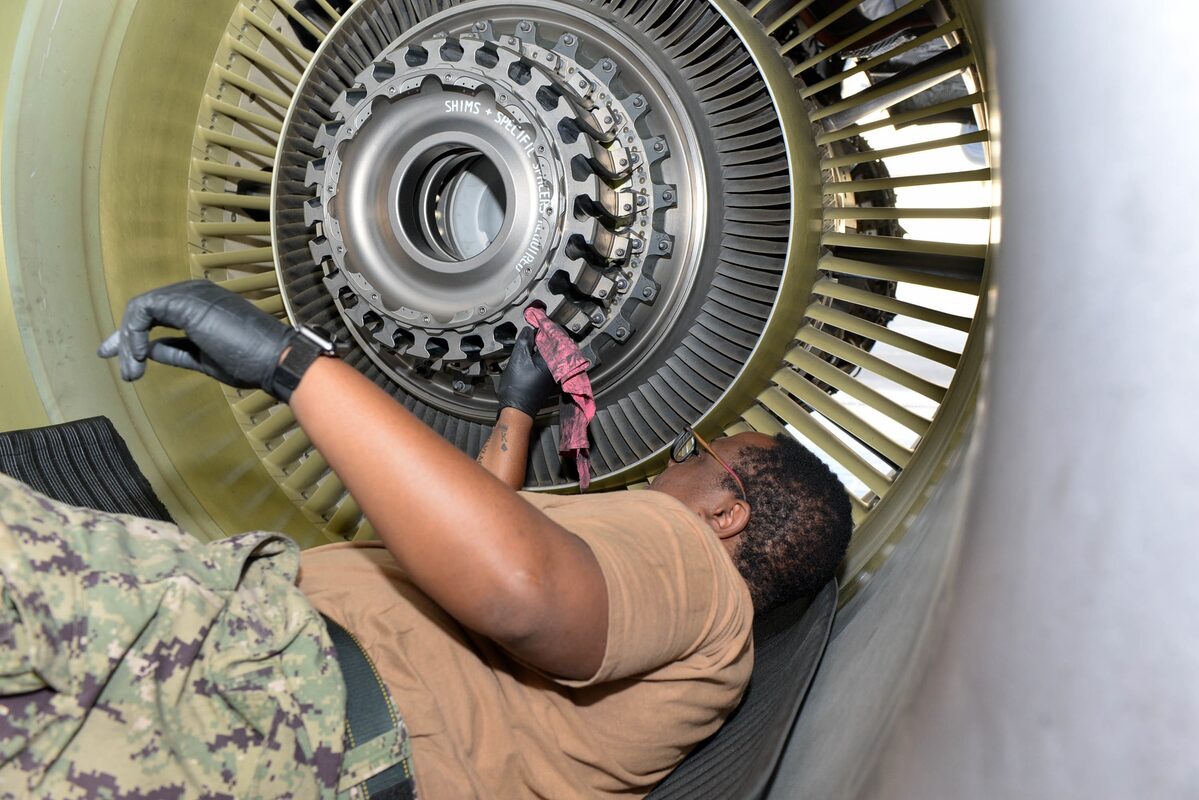
The Navy is restocking the engines that keep its P-8A Poseidon patrol jets flying, and it is doing it with one supplier and no competition. Naval Air Systems Command awarded CFM International Inc. of Cincinnati, Ohio, a $489,739,433 firm-fixed-price indefinite-delivery/indefinite-quantity contract for up to 24 CFM56-7B27AE core engines for the P-8A, plus one CFM56-7B24E core for the C-40A. Up to 12 of the P-8A cores are for the Navy and up to 12 are for foreign military sales customers. The award also covers associated engine covers, stands and cradles.
The Department of War announced the award on Sept. 16, 2026, under contract number N0001926D1008, with NAVAIR at Patuxent River, Maryland, as the contracting activity. Work runs through September 2031. CFM is the joint venture of GE Aerospace and Safran Aircraft Engines, according to Defence Blog. Army Recognition notes that each P-8A carries two engines, so the 12 Navy cores equate to the powerplants for six aircraft.
Why Is the Navy Buying CFM56 Cores Now?
The purchase follows a Navy admission that the P-8A engine pool is thin. When Boeing won a $156.2 million Navy contract for up to 31 P-8A engine build-up kits, Military Aerospace reported that the Navy's procurement justification said "the P-8A engine inventory remains short" and named the CFM56-7B27 as a specific engine requirement.
The same notice gives a performance figure that helps explain the pressure on spares. Military Aerospace quoted the Navy as saying that "Demonstrated CFM56-7B27 time on wing is approximately 6,000 hours, compared with a projected 10,000 hours based on commercial use and models." Six thousand hours is 60 percent of the 10,000-hour projection, so by the Navy's own figures the engines are delivering roughly 60 percent of the time on wing that planners modeled. An engine that comes off the aircraft earlier than planned draws on the spares pool sooner than a sparing plan built on the higher number would assume.
Military Aerospace also reported that the shortage resulted partly from an increase in the P-8A program of record and the addition of 11 aircraft since the previous spare-engine model was developed.
New cores are a direct way to refill that pool. Defence Blog reported that "Navy and contractor maintenance depots typically swap in a new core rather than replace an entire engine when a Poseidon's powerplant needs a major overhaul, which cuts cost and downtime compared with buying complete replacement engines." Defence Blog also cited Boeing figures showing more than 160 P-8s delivered worldwide, so the fleet that draws on this engine supply is large.
What Does a $489.7M Ceiling With Zero Obligated Actually Commit?
The dollar figure is a ceiling, not a purchase. The announcement states: "No funds will be obligated at the time of award; funds will be obligated on individual orders as they are issued." The Navy has secured a vehicle that lets NAVAIR place orders for cores through 2031, and it will obligate funds order by order.
That structure matters for anyone sizing the opportunity. The 24-core quantity is a maximum for the P-8A, split evenly between the Navy and its FMS partners, and the single C-40A core is separate. Actual obligations depend on how quickly the Navy and its foreign customers submit orders and what they can fund in each fiscal year.
The announcement also carries the line that draws the most scrutiny in any Pentagon award: "This contract was not competed." The announcement does not give a reason. Defence Blog supplies one, reporting that CFM is the sole producer of the CFM56-7B engine family, which it said is why the Navy did not compete the contract.
Where Will the CFM56 Core Work Get Done?
The announcement splits the work across three sites. Villaroche, France, takes 53 percent. Durham, North Carolina, takes 43 percent. Peebles, Ohio, takes the remaining 4 percent.
The buyer is the U.S. Navy, yet the majority of the performance sits in France. Durham and Peebles together account for 47 percent of the work in the United States. Suppliers hoping to serve this order from the U.S. side should look at those two sites first, though the announcement does not describe subcontracting.
How the $156.2M Boeing Kit Award Fits Together
The CFM order has a companion. Military Aerospace reported that the Boeing award covers up to 31 P-8A engine build-up kits, 18 for the Navy and 13 for FMS customers, plus two C-40A Quick Engine Change kits. Military Aerospace said the kits provide components and hardware to integrate CFM56-7B27AE core engines for P-8A aircraft and CFM56-7B24E core engines for C-40A aircraft.
Together, the two awards carry roughly $646 million in ceiling value ($489.7 million plus $156.2 million) against a problem the Navy defines as a spares shortage. The CFM contract obligates nothing at award, so the real measure of Navy urgency will be the order flow that follows. The kit count of 31 and the core count of 24 do not line up one for one, and the sources reviewed do not say how the Navy will pair them.
What It Means for Contractors
Watch the delivery orders, not the ceiling. With nothing obligated at award, revenue for CFM and its suppliers arrives when NAVAIR issues orders. Suppliers in the CFM56 chain should track order timing and quantities, because the ceiling overstates near-term cash flow.
Expect spares to stay a growth area. The Navy's own justification says P-8A engine inventory is short and that time on wing is running well below projection. Vendors that support engine covers, stands, cradles and engine build-up hardware have a documented demand signal.
Competition is not the route in on the cores. The Navy did not compete this award, and Defence Blog reports CFM is the sole producer of the engine. Openings for other contractors are more likely in sub-tier supply to CFM, in the build-up and quick-engine-change hardware, and in support work around the engines.
FMS demand is half the ceiling. Twelve of the 24 P-8A cores are earmarked for foreign customers. Their timing depends on partner-government funding and approvals, so vendors with FMS export experience are best placed for that half.
Plan around the 2031 window. Performance ends in September 2031. That gives suppliers a five-year horizon to align capacity, but only if orders arrive. Whether the 6,000-hour experience holds or worsens will drive how many cores the Navy orders.
Sources
- Contracts for Sept. 16, 2026 (U.S. Department of War)
- U.S. Navy orders new engine cores for its P-8A fleet (Defence Blog)
- Boeing wins potential $156.2 million Navy contract for P-8A engine build-up kits (Military Aerospace, Aug. 24, 2026)
- U.S. Navy Orders New P-8A Engine Cores to Keep Poseidon Fleet Ready for High-End Maritime Warfare (Army Recognition)
