
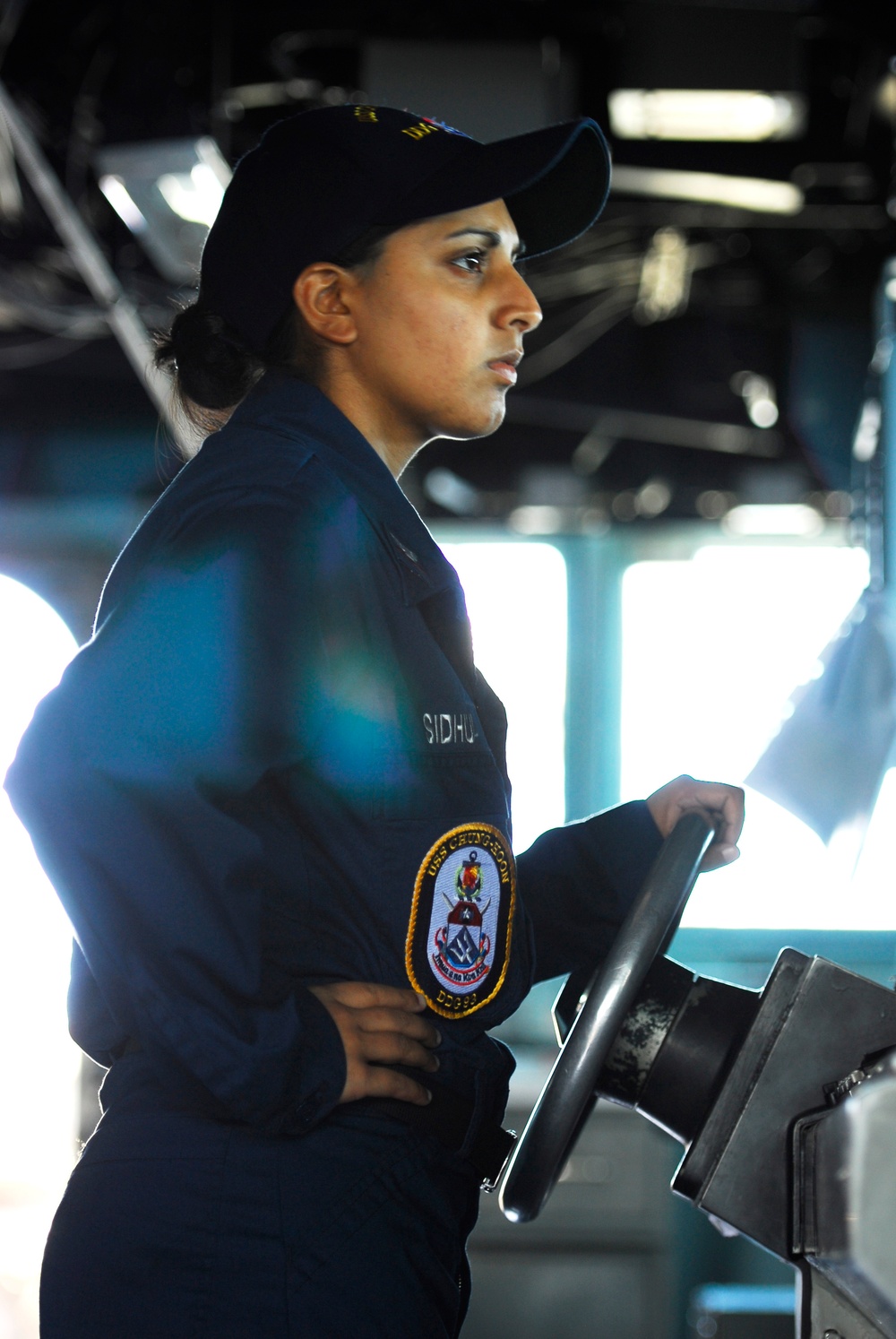
The U.S. Navy has accepted and delivered two modernized Flight IIA Arleigh Burke-class guided-missile destroyers, USS Chung-Hoon (DDG 93) and USS James E. Williams (DDG 95), after both ships completed their DDG Modernization 2.0 Depot Modernization Periods ahead of schedule, according to a June 26 release from the Mid-Atlantic Regional Maintenance Center (MARMC). The two deliveries push the program past an early proof point and hand the surface fleet a pair of destroyers with substantially upgraded electronic warfare and combat-system capability.
Both ships completed combat system sea trials, calibrations, and shakedowns successfully and ahead of schedule, the Navy said. They are the second and third ships to enter the fleet carrying Northrop Grumman's SLQ-32(V)7 SEWIP Block 3 integrated electronic warfare suite, following USS Pinckney (DDG 91).
Background
DDG Modernization 2.0, managed by the Program Office for DDG Modernization (PMS 451) within NAVSEA's Team Ships, is the Navy's restructured approach to keeping the Arleigh Burke fleet relevant for decades of additional service. The Arleigh Burke class is the backbone of the surface combatant force, and many Flight IIA hulls are reaching the midpoint of their service lives. Rather than retire those ships, the Navy is investing in depot-level modernization periods that refresh combat systems, hull, mechanical and electrical systems, and the electronic warfare capability that protects a destroyer against modern anti-ship missiles.
The SLQ-32(V)7 SEWIP Block 3 suite is the centerpiece of the electronic warfare upgrade. SEWIP, the Surface Electronic Warfare Improvement Program, has advanced through a series of blocks; Block 3 adds an active electronic attack capability, expanding the system beyond the detection and identification functions of earlier increments. Fielding it across the destroyer force is a multi-year effort, and each ship that enters the fleet with the suite installed marks incremental progress against that goal.
The Navy also signaled a follow-on phase. A future Phase 2 of the modernization effort is slated to add the Raytheon SPY-6(V)4 radar, the version of the Air and Missile Defense Radar tailored for backfit onto in-service Arleigh Burke destroyers. That radar promises a step change in sensitivity and the ability to track more targets at greater range, but it represents a separate, later tranche of work beyond the depot periods just completed.
Key Details
USS Chung-Hoon and USS James E. Williams each finished their Depot Modernization Periods ahead of schedule, a result the Navy attributed to a restructured management approach. The service credited its new Portfolio Acquisition Executive (PAE) for Maritime office, which it described as the single accountable organization coordinating the accelerated milestones. Consolidating accountability under one office is intended to reduce the schedule slips and cost growth that have historically plagued destroyer modernization availabilities.
The hands-on work was executed by a mix of government and industry organizations: MARMC, the Southwest Regional Maintenance Center, and General Dynamics NASSCO. That spread of execution agents reflects how modernization availabilities draw on both organic Navy maintenance capacity and private-sector shipyard labor.
Navy leaders framed the deliveries as evidence the program model works. Capt. Tim Moore, program manager for DDG MOD 2.0, said, "This destroyer modernization effort is the cornerstone of increasing service life and delivering decisive combat power." Rear Adm. Dan Lannamann, Commander of the Navy Regional Maintenance Center, credited "teamwork, technical expertise, and disciplined execution" for the on-time results.
For each ship, the completed package combined the SEWIP Block 3 installation with combat-system work and the sea trials, calibrations, and shakedown periods required to certify the upgrades before the Navy formally accepted delivery. Both destroyers cleared those gates without the schedule overruns that have marked some prior availabilities.
What It Means for Contractors
The two deliveries carry several signals for the government-contracting community. First, the modernization pipeline for the Arleigh Burke fleet is active and recurring. With dozens of Flight IIA hulls still ahead of their modernization windows, the demand for combat-system integration, electronic warfare installation, hull and mechanical work, and test-and-trials support is durable. Firms positioned at MARMC, the Southwest Regional Maintenance Center, and around General Dynamics NASSCO's facilities have visibility into a steady stream of availabilities.
Second, the prominence the Navy gave to the Portfolio Acquisition Executive for Maritime office matters for how future work is structured. By naming a single accountable organization for the accelerated milestones, the Navy is centralizing program oversight in a way that may reshape how task orders, schedules, and performance metrics are written. Contractors should expect tighter coordination and a clearer accountability chain, which rewards on-time, disciplined execution and penalizes schedule risk.
Third, the Phase 2 SPY-6(V)4 backfit represents a defined future opportunity. Raytheon holds the radar production line, but the broader effort to integrate, install, and test that radar across the destroyer fleet will generate subcontracting and support requirements over a multi-year horizon. Northrop Grumman's SEWIP Block 3 work, meanwhile, continues as additional ships rotate through their depot periods.
Finally, the ahead-of-schedule outcome itself is a marker. The Navy is publicly tying program credibility to disciplined delivery, and it is rewarding the execution agents that met the timeline. For prime contractors and subcontractors competing for surface-fleet modernization work, demonstrated schedule performance is becoming a differentiator the customer is willing to advertise.
The completion of the Chung-Hoon and James E. Williams modernizations does not close out DDG MOD 2.0; it validates the model the Navy intends to apply across the rest of the Flight IIA force. Each subsequent availability will test whether the centralized-accountability approach can keep delivering destroyers on time, and whether the industrial base can sustain the throughput the surface fleet requires.
