
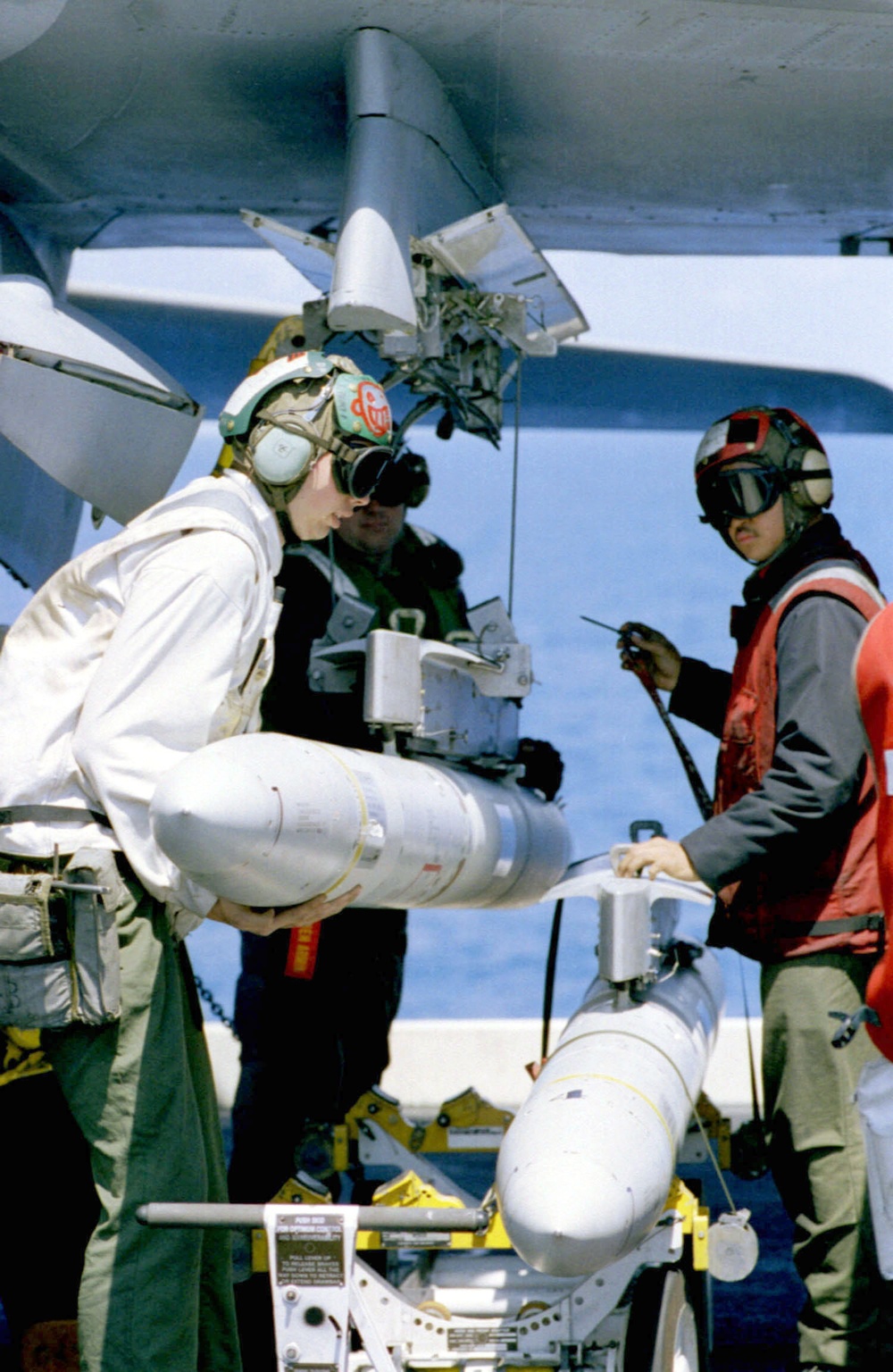
The Navy wants twice as many anti-radar missiles as it planned five months ago, and it is willing to look past Northrop Grumman to get them. A Naval Air Systems Command Request for Information posted July 1 asks industry whether it can deliver up to 600 "Advanced Emission Suppression Missiles" a year, double the 300-round target the service floated in February.
Background
The Navy's current anti-radar weapon, the AGM-88G Advanced Anti-Radiation Guided Missile-Extended Range, has one supplier: Northrop Grumman. AARGM-ER homes in on enemy radar emitters and destroys air-defense systems before they can threaten strike aircraft, a role that has grown more demanding as adversaries field mobile, frequency-agile radars with longer detection ranges.
That single-vendor arrangement is now under strain. The Navy is executing what officials have called a "strategic pause" in AARGM-ER procurement for fiscal 2027, according to the RFI reported by DefenseScoop. Pausing purchases of the only anti-radar missile in the fleet while adversary integrated air defense networks keep improving is not a position the service wants to hold for long, which is why Naval Air Systems Command's PMA-242 program office, Direct and Time Sensitive Strike Weapons, is now testing the market for a second source.
The February RFI asked whether industry could support 300 missiles annually. The July RFI doubles that ask to 600, a sign the Navy is thinking beyond simply diversifying suppliers and toward building a substantially larger magazine of anti-radar weapons than AARGM-ER production alone has delivered. Doubling a production target within five months, rather than waiting for a full budget cycle to revise it, points to a requirement being driven by an urgent operational assessment rather than routine program planning.
The driver behind both the pause and the wider search is the growing sophistication of Chinese integrated air defense systems, which field increasingly capable, mobile radars designed to detect and engage naval strike aircraft at long range. A Navy strike package that cannot reliably suppress those radars loses much of its ability to operate over contested territory, which is why the anti-radar mission has become a priority the Navy is unwilling to leave to a single production line.
Key Details
The RFI lays out specific technical and schedule requirements for any company that wants to compete for the Advanced Emission Suppression Missile program:
- Maturity bar: Any candidate design must already sit at Technology Readiness Level 6 or higher, a fully functional prototype demonstrated in a relevant environment, ruling out clean-sheet concepts still in early development.
- Aircraft integration: The missile must carry both internally and externally on the F-35 Lightning II, F/A-18E/F Super Hornet, and EA-18G Growler, the same platforms that currently employ AARGM-ER.
- Seeker performance: The Navy wants an "advanced anti-radiation seeker with broad frequency coverage" capable of engaging modern radars at "significant standoff distances," per the RFI language cited by C4ISRNET.
- Growth margin: The design must leave room for future sensor and effector upgrades "with minimal redesign," a hedge against radars and jamming techniques that keep changing after the missile enters service.
- Schedule: A 48-month period of performance is expected to cover design work, aircraft integration, and delivery of the first production lot.
- Quantities and pricing: Companies must submit capability statements and pricing for annual production quantities of up to 600 all-up rounds.
- Response deadline: Industry submissions are due July 31, 2026, giving companies roughly four weeks to respond.
PMA-242 has not named a preferred contractor or announced a follow-on solicitation timeline. An RFI is a market-research step, not a request for proposals, and the Navy uses the responses to decide whether, and how, to structure a competitive program going forward.
What It Means for Contractors
For Northrop Grumman, the RFI is a pointed signal rather than an immediate loss of business. The company remains the incumbent and the only proven source of a qualified anti-radiation missile for Navy strike aircraft today, and the pause in AARGM-ER buys does not cancel existing contracts. But a 600-round annual target for a competing program, paired with an explicit pause in AARGM-ER procurement, tells Northrop that the Navy is no longer content to rely on one production line for a weapon this central to suppressing enemy air defenses.
For everyone else, the RFI opens a door that has been effectively closed since AARGM-ER became the sole-source anti-radar missile for naval aviation. The TRL 6 requirement narrows the realistic field to companies with an anti-radiation or anti-radar seeker already flying or close to it, rather than firms proposing an entirely new missile body and guidance package from scratch. That still leaves room for established missile primes to offer variants of existing anti-radiation seekers, and for smaller firms with mature seeker technology to team with a prime that can handle aircraft integration and production scale-up.
The 48-month period of performance and the up-to-600-round annual ceiling both point toward a program the Navy intends to run at real production volume, not a boutique buy. Companies that can show a credible path to F-35, Super Hornet, and Growler integration, plus a supply chain that can hit 600 rounds a year if the Navy exercises the top of that range, stand to gain the most from responding by the July 31 deadline. Firms without an existing anti-radiation seeker in hand face a steep climb to meet the TRL 6 bar in the time available.
The broader signal for the contractor base is that the Pentagon's push to reduce single-vendor dependency on critical munitions is not limited to headline programs like long-range fires. Anti-radar missiles, essential to any strike package operating against a modern integrated air defense system, are now getting the same scrutiny. Companies that can demonstrate mature seeker technology and a plan to scale production quickly have a real opening to break into a market Northrop has held alone.
The July 31 deadline for capability statements and pricing at production quantities up to 600 rounds a year leaves little time to assemble a fresh cost model from scratch. Firms that already track production economics at multiple volume tiers will have an easier time turning around defensible numbers than those building that analysis for the first time under deadline pressure. The growth-margin requirement matters too: a design that can absorb future seeker or effector upgrades without a full redesign locks in years of follow-on modification work for whichever contractor wins, the same dynamic that has kept Northrop central to the AARGM-ER line.
