
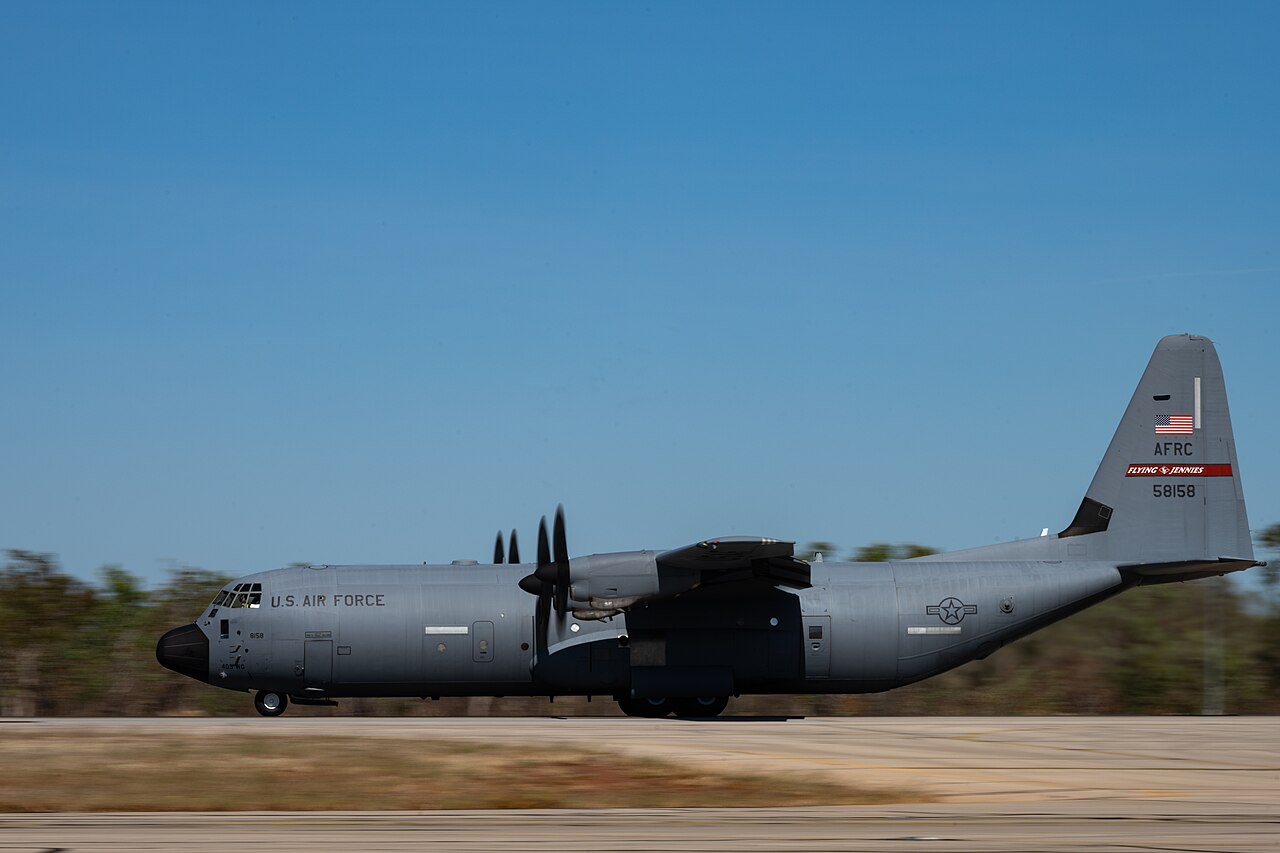
The Navy's replacement for the E-6B Mercury, the aircraft that relays orders from national leadership to submerged ballistic missile submarines, now has its first airframe. Lockheed Martin delivered a C-130J-30 Super Hercules to the Navy at its Marietta, Georgia, facility on Oct. 15, and the aircraft will be converted into the E-130J Phoenix II for the Take Charge and Move Out (TACAMO) mission. The handover moves the program out of the paperwork phase and into the hands of Northrop Grumman, which will turn a stock airlifter into an airborne nuclear command-and-control support platform.
Lockheed announced the delivery in a release dated Oct. 16. The War Zone reported the same day that the aircraft is the first of three C-130J-30s the Navy initially procured in September 2024.
Who Builds the E-130J Phoenix II?
The program splits work across three major contractors. Lockheed Martin builds the C-130J-30 airframe on its Marietta line. According to The War Zone, the airframe "will be transferred to Northrop Grumman, the E-130J program’s prime contractor and mission-systems integrator, for conversion." Collins Aerospace supplies the very low frequency (VLF) communications system, which The War Zone describes as "a key component of the TACAMO mission."
Lockheed's release frames the same arrangement from its side, stating that the aircraft "will be transferred to Northrop Grumman, the mission systems integrator, where the E-130J TACAMO industry team will complete the conversion."
Navy Capt. Roger Davis, program manager for the Airborne Strategic Command, Control and Communications program office (PMA-271), described what comes next. "Lockheed Martin's delivery of this battle-proven airframe provides the structural and performance backbone our mission requires as we transition into mission systems integration to field the E-130J Phoenix II," Davis said in the Lockheed release.
In a statement quoted by The War Zone, Davis added: "Today’s delivery from the historic Marietta line represents far more than a new airframe; it marks the foundation of our future strategic deterrence posture."
Trish Pagan, vice president of Lockheed Martin's Air Mobility & Maritime Missions, called the handover "a historic milestone for the U.S. Navy, Lockheed Martin, and the nation's strategic communications network."
What the TACAMO Mission Demands From the Airframe
TACAMO aircraft give the president, the secretary of defense and U.S. Strategic Command a way to reach nuclear forces, including submarines submerged at sea. The War Zone reports that the mission exists to preserve the ability to transmit emergency action messages even if conventional communications infrastructure is disrupted or destroyed.
The E-6B does this in part with a long trailing wire antenna that enables VLF transmissions to submerged boats, and The War Zone reports the E-130J will receive a comparable system during conversion. Hardening against electromagnetic pulse from nuclear detonations is another core requirement.
The choice of a C-130 also returns the mission to a familiar airframe family. The EC-130Q flew TACAMO from 1963 until 1993, when the jet-powered E-6 took over. Lockheed's release puts it this way: "For three decades, the EC-130Q variant served as the Navy's TACAMO platform." The E-6B later added the Looking Glass airborne command post role; The War Zone reports that the Navy plans for the E-130J to take on TACAMO while the Air Force pursues a separate replacement for Looking Glass.
Why the Navy Wants 31 E-130Js to Replace 16 E-6Bs
The Navy plans to acquire 31 E-130Js, according to The War Zone, which notes the figure would nearly double the 16 E-6Bs now in service. The total includes six developmental aircraft and 25 production examples. The War Zone adds that it remains unclear how many of the developmental aircraft will eventually be available for operational use.
A larger fleet gives the Navy more aircraft to cover training, maintenance and operational demands. The C-130J-30 can also operate from far more airfields than the 707-derived E-6B, including austere ones, which The War Zone has argued could make the fleet harder to target on the ground during a crisis. The trade-off is performance: a turboprop C-130J-30 cannot match the speed or altitude of an airliner-sized jet, which limits how quickly it reaches station and how high it can climb for communications line of sight.
Can Northrop Fit the Mission Gear Into a Smaller Airframe?
The delivered aircraft is not an operational TACAMO platform. The War Zone reports that the first airframe will now enter mission-systems modification, ground testing and developmental flight testing, and that further integration and testing must happen before the Navy can field the fleet.
That integration step carries the program's largest known risk. The War Zone notes that the Government Accountability Office previously warned that integrating the specialized mission equipment into the smaller C-130J-30 airframe could affect operational availability and create additional engineering and manufacturing difficulties. Packing a trailing wire antenna system, VLF transmitters and EMP hardening into a Hercules fuselage, rather than a 707-sized one, is the core engineering problem Northrop and Collins now own.
Meanwhile, the E-6B fleet the E-130J replaces is getting harder to keep flying. The War Zone describes the transition as intended to preserve one of the most critical links in U.S. nuclear command, control and communications as the E-6B becomes increasingly difficult to sustain. The C-130J, by contrast, remains in production, and The War Zone points out that its support base already extends across the U.S. military and beyond.
What It Means for Contractors
The E-130J is a multi-contractor program with a fixed industrial base at the top: Lockheed on airframes, Northrop as prime and integrator, and Collins on VLF communications. With 31 aircraft planned and only the first of three initial airframes delivered, the program's work runs years ahead, and the volume of modification, test and sustainment activity will scale with each conversion.
For suppliers and subcontractors, the near-term action sits in mission-systems integration, ground testing and developmental flight testing. Firms with experience in VLF and trailing-wire antenna systems, EMP hardening, C-130J modification and nuclear command, control and communications (NC3) certification are well placed to approach Northrop and Collins, the named integrator and VLF supplier, about teaming and supply opportunities.
The GAO's integration warning also matters for anyone bidding into the program. Fitting mission gear into the smaller C-130J-30 airframe is likely to put a premium on compact, lightweight equipment, and any schedule slip in the first conversion could shift timing for downstream test and support work. The move from a 707-based fleet to a Hercules-based one also changes the long-term sustainment picture: support for the C-130J already spans the U.S. military, which favors firms that already maintain Super Hercules fleets.
PMA-271, led by Capt. Davis, remains the Navy office to watch for program announcements as the first E-130J moves through conversion.
