
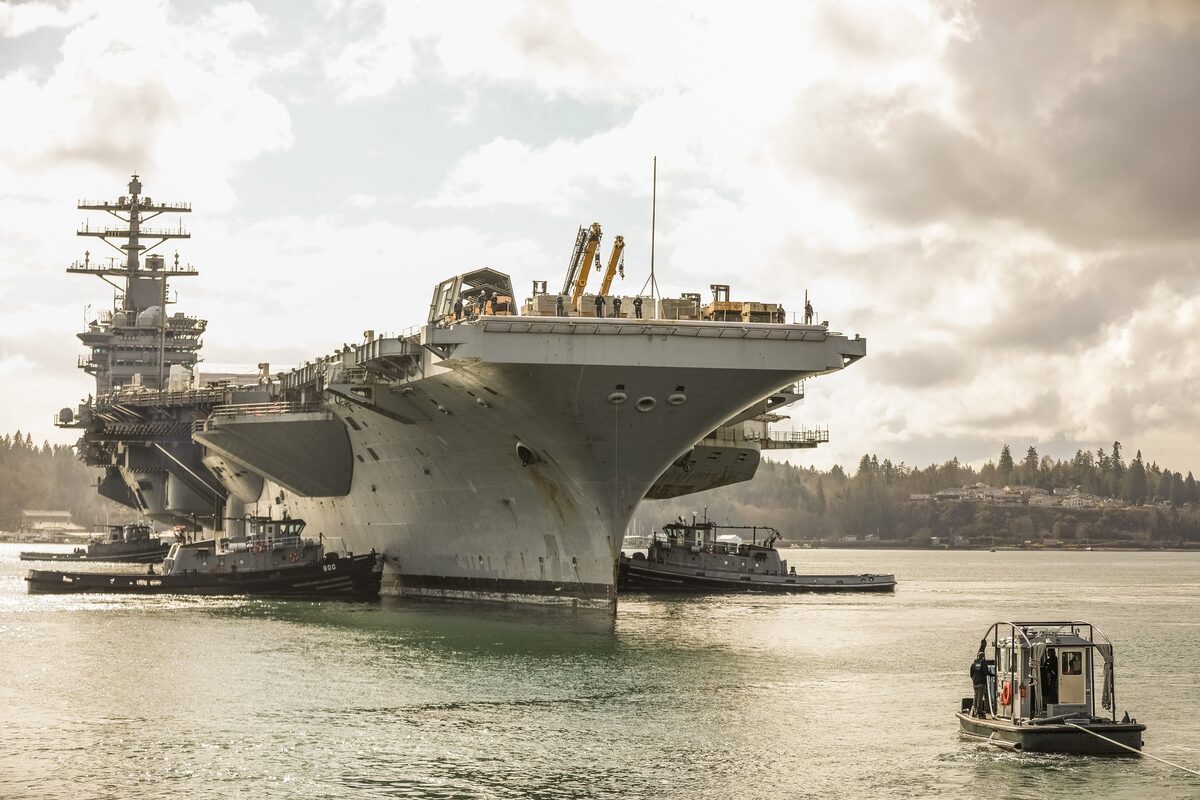
The U.S. Navy's rebuild of the shipyards that service its nuclear-powered aircraft carriers and submarines is going to cost taxpayers nearly ten times what the service originally told Congress — and lawmakers have no standing right to see the full bill as it keeps climbing, according to a Government Accountability Office report published Sept. 25, 2026.
GAO's review of Navy planning documents found the Shipyard Infrastructure Optimization Program, known as SIOP, will surpass $200 billion and take more than 50 years to finish. When the Navy launched SIOP in 2018, it projected the work would cost roughly $21 billion and wrap up in about 20 years, according to Breaking Defense. Eight years later, the price tag has grown by a factor of nearly ten and the timeline has more than doubled.
SIOP covers the Navy's four public shipyards — in Virginia, Maine, Washington state and Hawaii — which GAO describes as essential to keeping the fleet's nuclear-powered carriers and submarines fit to deploy. Much of the infrastructure at those yards predates the ships it now has to service, and the drydocks and support facilities need extensive reconstruction to keep pace with the current and future fleet. Because these four yards carry out that maintenance work, delays or cost problems at any one of them can ripple into how long carriers and submarines sit out of service rather than deploying.
How a $21 Billion Estimate Became $200 Billion
GAO's report says the Navy's original cost projection "omitted key costs" when SIOP was drawn up in 2018. Since then, several forces have pushed the number upward: commodity price increases across the construction industry, seismic retrofit requirements identified at Puget Sound Naval Shipyard in Washington, additional construction and repair projects layered onto the program since it began, and design changes driven by lessons learned on projects already under construction. Each of those factors compounds rather than replaces the others — a seismic retrofit discovered mid-program, for instance, changes the engineering baseline for every subsequent phase at that yard, which then feeds back into schedule and cost estimates for related projects elsewhere in the program.
"Developing the plans and cost estimates to rebuild the Navy's four public shipyards has taken the Navy years longer — and will cost much more — than originally anticipated due to multiple challenges and changes involved in the program," GAO wrote in the report.
Individual projects show how fast the numbers have moved even after Congress started funding them. The dry-dock projects at Portsmouth Naval Shipyard in Maine and Pearl Harbor Naval Shipyard in Hawaii "grew by more than $2.5 billion since funding was originally requested from Congress," GAO found, according to Breaking Defense's account of the report.
Why GAO Says Congress Is Kept in the Dark
The report's sharpest finding isn't just that costs ballooned — it's that Congress has no built-in way to track the growth. Major defense acquisition programs, the kind that buy missiles, aircraft and ships, are legally required to file annual status reports with cost and schedule baselines and risk data. SIOP, a construction and infrastructure program rather than a weapons buy, faces no equivalent mandate.
As GAO put it, "the Navy does not provide Congress with consolidated, standardized information on full program costs and risks because there is no requirement to do so." Lawmakers can piece together individual project costs from budget requests, but nothing forces the Navy to show the program's full $200 billion, 50-year picture in one place.
GAO also found the Navy has stood up multiple organizations to manage different pieces of SIOP without clearly documenting which office is responsible for what — an arrangement that makes it harder to track accountability as the program's scope keeps expanding.
To fix the visibility gap, GAO recommended that Congress consider requiring the Navy to submit annual, consolidated status reports on SIOP's costs and progress — a step that depends on Congress acting, not the Navy. GAO separately made three recommendations directly to the Navy: periodically reevaluate the program's objectives and resource needs; implement annual "Gate 6" sufficiency reviews to check that funding and planning are keeping pace with reality; and document the roles and responsibilities of the organizations managing the program. The Navy agreed with those three recommendations and outlined planned steps to implement them, giving GAO a basis to track progress in future reviews — though the one fix that would guarantee lawmakers see the full bill, the congressional reporting requirement, still has no force of law.
What It Means for Contractors
A 50-year, $200 billion construction program is effectively a standing pipeline of work for engineering, construction and shipyard-support firms, and SIOP's scale means that pipeline just got both bigger and longer than what was originally advertised to industry. Companies already working drydock reconstruction, seismic retrofits and facility upgrades at Norfolk, Portsmouth, Puget Sound and Pearl Harbor should expect the program's later phases to include additional scope beyond what was scoped in 2018, particularly around seismic work at Puget Sound and lessons-learned redesigns on projects already underway elsewhere.
GAO's push for tighter Navy oversight — periodic reevaluation, annual sufficiency reviews, clearer organizational accountability — also points toward more structured, better-documented contracting requirements down the line, since the Navy will need better internal cost and schedule data to comply with the recommendations it has already accepted. Contractors bidding into SIOP work should expect procurement and reporting processes to tighten as the Navy builds out the tracking systems GAO says it currently lacks, even as the underlying construction opportunity keeps growing.
The lack of a standardized reporting mandate also matters for firms trying to plan around SIOP's funding profile. Without consolidated annual reporting, industry has had to track cost growth project by project through individual budget requests rather than a single program-level picture — the same gap GAO flagged for Congress. If the Navy adopts GAO's recommended annual status reports and Gate 6 reviews, contractors should gain a clearer, more predictable view of which phases of the four-yard rebuild are funded, which are still in design, and where schedule risk is concentrated.
