
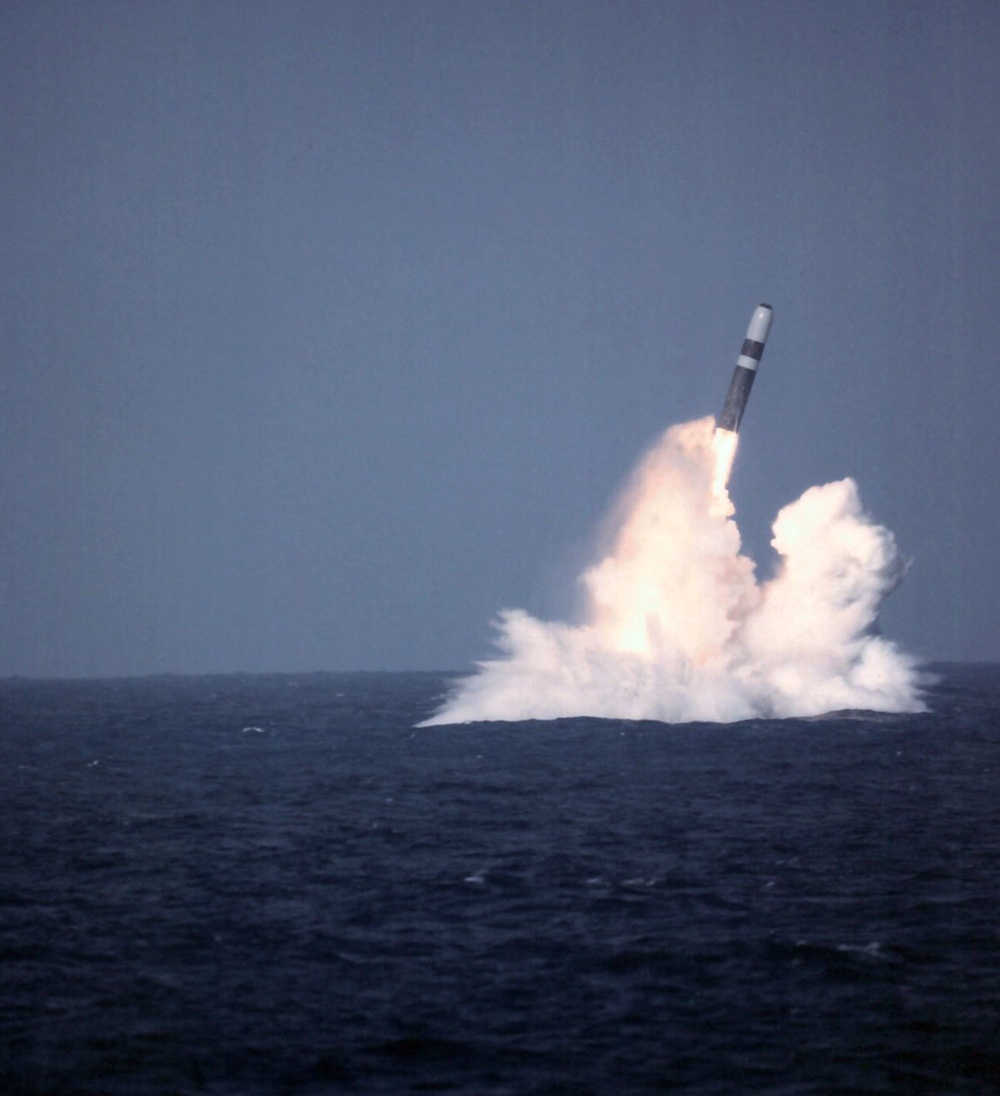
The U.S. Navy is paying to keep the brains of its submarine-launched ballistic missile in production. On June 24, 2026, Charles Stark Draper Laboratories Inc. of Cambridge, Massachusetts, received a $14,878,252 modification for production of the Trident (D5) Guidance Subsystem, according to the U.S. Department of War contract announcement. The award is modification P00006 to contract N00030-23-C-6008, administered by Navy Strategic Systems Programs, the office that manages the sea-based leg of the nation's nuclear deterrent.
Background
The Trident II D5 is the submarine-launched ballistic missile carried aboard the Navy's ballistic missile submarines, the most survivable element of the U.S. strategic triad. Unlike land-based silos or bomber bases, which adversaries can locate, the boomers patrol submerged and undetected, holding a retaliatory capability that underwrites deterrence. A missile is only as accurate as the system that tells it where it is and where it is going, and for the D5 that job belongs to its inertial guidance subsystem.
That subsystem is what this contract pays to keep producing. The announcement specifies that the requirement includes maintaining critical skills related to the assembly and test of the Alternate Pendulous Integrating Gyroscopic Accelerometer system and its sub-assemblies — the precision inertial instrument at the heart of the guidance package. Draper Laboratories, a not-for-profit research institution, designs and builds that hardware, and the funding keeps both the production line and the specialized workforce that supports it intact.
Inertial guidance is what lets a ballistic missile fly without any outside signal. Rather than relying on GPS or radio links that an adversary could jam, the system uses gyroscopes and accelerometers to continuously measure the missile's own motion and integrate it into a running estimate of position and velocity. An accelerometer such as the pendulous integrating gyroscopic type named in the award is among the most demanding components to build, because tiny errors in measuring acceleration compound over a long flight into large errors at the target. Keeping that instrument in production to exacting tolerances is precisely the kind of work the Navy is funding here.
The June 24 action is a modification, not a fresh contract. It adds funding and scope to the existing N00030-23-C-6008 vehicle, a pattern typical of strategic-weapons sustainment, where the government keeps a single qualified source on contract across multiple years rather than restarting the production line. Navy Strategic Systems Programs runs the cradle-to-grave management of the Trident system, from missile production to the guidance, fire control, and navigation subsystems that make it work.
Key Details
The announcement records a $14,878,252 cost-plus-fixed-fee modification, designated P00006, to the previously awarded contract N00030-23-C-6008 for production of the Trident (D5) Guidance Subsystem. The contracting activity is Strategic Systems Programs in Washington, D.C. Fiscal 2026 weapons procurement (Navy) funds in the full amount of $14,878,252 are obligated at the time of award.
The work is geographically split across three sites: Cambridge, Massachusetts, where Draper is headquartered, accounts for 50 percent; Pittsfield, Massachusetts, 25 percent; and Clearwater, Florida, the remaining 25 percent. The announcement lists an expected completion date of Aug. 29, 2028, putting a multi-year horizon on this tranche of guidance production and the skills-retention work tied to the inertial accelerometer system.
The dollar value here is modest by the standards of strategic programs, reflecting that this is an incremental production and sustainment action rather than a new development effort. It is one line in a continuing relationship measured in years and across many such modifications — its P00006 designation marks it as one in a sequence of adjustments to the contract — each adding the funding needed to keep guidance hardware flowing and the assembly-and-test workforce in place.
The mechanics matter for readers who track these announcements. Because the work is a modification rather than a standalone award, it does not appear as a new opportunity on any solicitation board; it surfaces only in the daily contract digest. That makes the war.gov release the authoritative record of the action's value, vendor, and contract number, and the GlobalSecurity.org mirror the most accessible independent reproduction of that same text. Both place the work squarely within Navy Strategic Systems Programs' ongoing management of the Trident guidance line.
What It Means for Contractors
For companies that watch the strategic-weapons market, the Draper award is a reminder of how narrow and durable the supplier base is in this corner of defense spending. Nuclear-deterrent work concentrates in a small number of qualified incumbents holding decades of certification, security clearances, and irreplaceable institutional knowledge. A precision inertial instrument like the Alternate Pendulous Integrating Gyroscopic Accelerometer is not a commodity a new entrant can bid on; it is a sustained sole-source relationship anchored in design authority. That structure makes the prime position extraordinarily defensible, but it also means the opportunities for newcomers sit in the supply chain beneath the prime rather than at the contract level.
The explicit language about "maintaining critical skills" is itself a signal. The government is paying not only for hardware but to keep a specialized assembly-and-test workforce employed and qualified, because letting those skills lapse would be far costlier to rebuild than to sustain. Subcontractors and component suppliers should read the steady drumbeat of D5 guidance modifications as evidence of long-horizon, low-volume demand. Firms that supply precision components, radiation-hardened electronics, specialized test equipment, or obsolescence-driven part replacements for inertial systems sit in a market with unusual visibility into future need. Obsolescence management in particular is a recurring theme in strategic sustainment, because the original parts for legacy hardware often no longer exist and must be requalified or redesigned.
The award also underscores the premium the government places on continuity in nuclear-deterrent programs. Strategic Systems Programs structures these contracts to avoid the risk and disruption of switching producers, which favors stability over price competition. For contractors, the lesson is that breaking into this space depends less on undercutting an incumbent and more on earning a qualified, cleared, and certified position in a supply chain the government is unwilling to disturb. Once established, that position tends to persist across the same multi-year vehicles that produced this modification.
Finally, the announcement is a useful marker for anyone tracking where strategic modernization money is going. The three-state footprint and the 2028 completion horizon show a sustained, distributed production effort rather than a one-off buy. Guidance, fire control, and navigation subsystems will all see continued funding, and contract actions like this one map the cadence of that spending for firms positioning to support it.
