
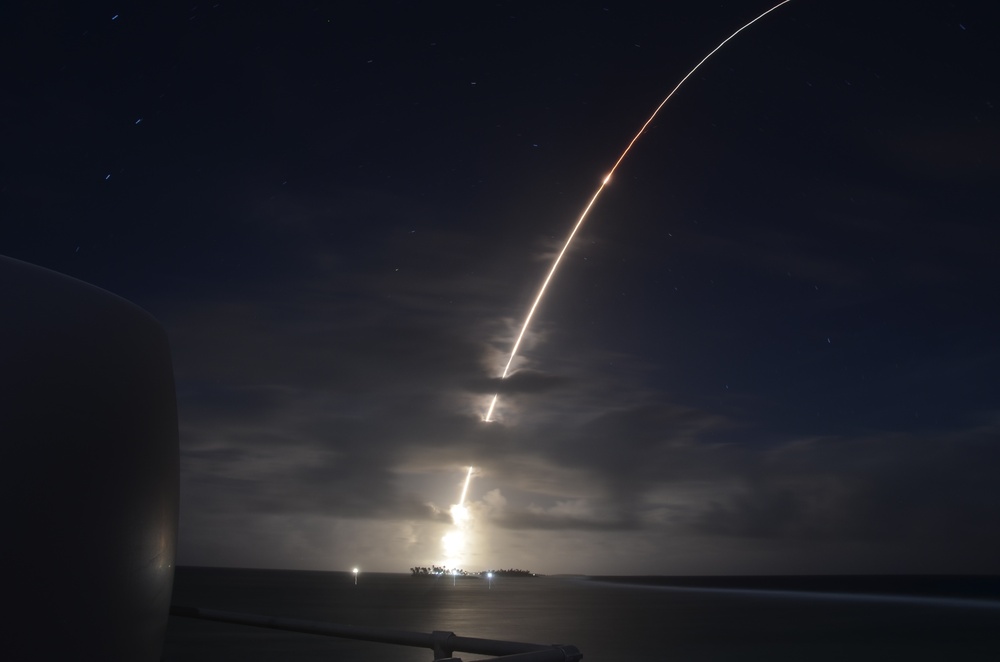
Northrop Grumman will remain the only company launching the target missiles that test America's missile defense shield through 2035, after federal officials decided no other contractor could compete for the job. The Missile Defense Agency awarded Northrop Grumman Systems Corp.'s Chandler, Arizona, operation a $508,490,719 sole-source follow-on contract, according to a Department of War contract announcement posted Sept. 4, 2026. The deal covers flight-test support for the remaining Intermediate Range and Intercontinental Ballistic Missile targets in the agency's inventory, plus integrated logistics for all government-furnished equipment tied to Missile Defense System testing, with work running from this month through August 2035.
Why MDA Skipped Competition Entirely
The contract is structured as a mix of cost-plus-fixed-fee, cost-reimbursable, and fixed-price-incentive work, and it was never opened to bidding. The government's own procurement notice spells out why in a single line: "One offer was solicited and one offer was received." That sentence, taken verbatim from the Sept. 4 announcement, is the Missile Defense Agency's formal justification for a noncompetitive award — a determination that Northrop is the only source capable of meeting the requirement.
Sole-source awards of this size require agencies to document that no other firm can realistically perform the work, and target-vehicle production is a narrow field. Northrop Grumman has continuously supported the IRBM and ICBM target-missile lines the Missile Defense Agency relies on to simulate incoming threats during intercept testing. Swapping in a new supplier mid-program would mean re-qualifying hardware, retraining range crews, and risking gaps in a test schedule the Pentagon has spent years building toward. GovCon Wire's coverage of the award traces the sole-source approach back to a February 2024 special notice, in which the agency said it was acting "under statutory authority permitting noncompetitive awards when only one source can meet the agency's requirements," citing Northrop's role as the original equipment manufacturer along with its technical data and program history.
What the $508.5 Million Buys Through 2035
The contract HQ0855-26-C-E001 funds two distinct lines of work. The first is flight-test support for the IRBM and ICBM targets still remaining in the Missile Defense Agency's test inventory — the missiles fired downrange so that the interceptors comprising the broader Missile Defense System have something realistic to shoot at. The second is integrated logistics support covering all government-furnished equipment used across Missile Defense System testing broadly, not just target launches, meaning Northrop's responsibilities extend into range support and equipment sustainment beyond the missiles themselves.
Work will be performed at three sites: Chandler, Arizona; Corinne, Utah; and Elkton, Maryland. The Missile Defense Agency, headquartered in Huntsville, Alabama, obligated $8,786,477 in fiscal 2026 research, development, test and evaluation funds at the time of award — a small down payment against the contract's roughly $508.5 million ceiling, with additional funds expected to be obligated incrementally as flight tests are scheduled and executed over the nine-year performance period.
A Fast-Growing Underlying Contract
This is a follow-on, not a fresh start. The award builds on an existing target-support vehicle that has grown substantially over time. GovCon Wire's reporting notes that a May 2025 modification alone added $25.7 million in target-system manufacturing and support work, pushing the cumulative value of the underlying contract from $1.9 billion to roughly $1.92 billion — meaning the new $508.5 million action adds meaningfully to a program that was already among the largest single-vendor arrangements in the Missile Defense Agency's target portfolio. The agency's reliance on one contractor for both target hardware and the logistics tail supporting broader test infrastructure concentrates a large share of testing risk — and testing budget — in a single company's hands.
That concentration is not new. Northrop has supplied MDA's ballistic missile targets for years, and the government has repeatedly chosen to extend and enlarge the existing arrangement rather than open a new competition for the work. The Sept. 4 announcement does not include a public statement from either the agency or the company explaining the decision beyond the one-line sole-source justification, which is typical for daily DoD contract announcements — these notices report procurement facts, not policy rationale, and rarely carry executive quotes.
The steady growth of the underlying vehicle also tracks the Missile Defense Agency's broader testing tempo. As the agency works through an increasingly crowded schedule of intercept demonstrations across its missile-defense portfolio, the supply of realistic IRBM and ICBM target missiles becomes a scheduling bottleneck as much as a budget line. Each flight test consumes a target vehicle that must be built, qualified, and shipped to a range on schedule; a production slip at Northrop's target line can cascade into a slipped intercept test months later. Locking in target support through 2035 gives MDA planners a fixed cost and delivery baseline to build test calendars around, even as the contract's ceiling value continues to climb with each modification.
What It Means for Contractors
For companies outside Northrop Grumman, this award is a reminder that the Missile Defense Agency's target-missile supply chain is effectively closed for the current test campaign's duration. Firms interested in target-vehicle work have limited near-term entry points; the practical opportunities lie in subcontracting under Northrop rather than competing directly for the prime role, at least through the current performance period ending in 2035. Companies that supply solid rocket propulsion, guidance hardware, or range instrumentation may find subcontract openings as Northrop scales up to meet the flight-test schedule at its Chandler, Corinne, and Elkton facilities.
For contractors watching MDA's broader test infrastructure spending, the logistics-support component of this award — covering government-furnished equipment across Missile Defense System testing generally — signals that the agency is bundling sustainment work with target production rather than breaking it out for separate competition. Companies positioning for range operations, calibration, or equipment maintenance contracts at MDA test sites should expect similar bundling in future actions tied to this program. Finally, the sole-source justification itself signals incumbency advantages that new entrants will need years, not one proposal cycle, to overcome: an agency documenting "one offer was solicited and one offer was received" has already concluded that no other firm was positioned to bid.
