
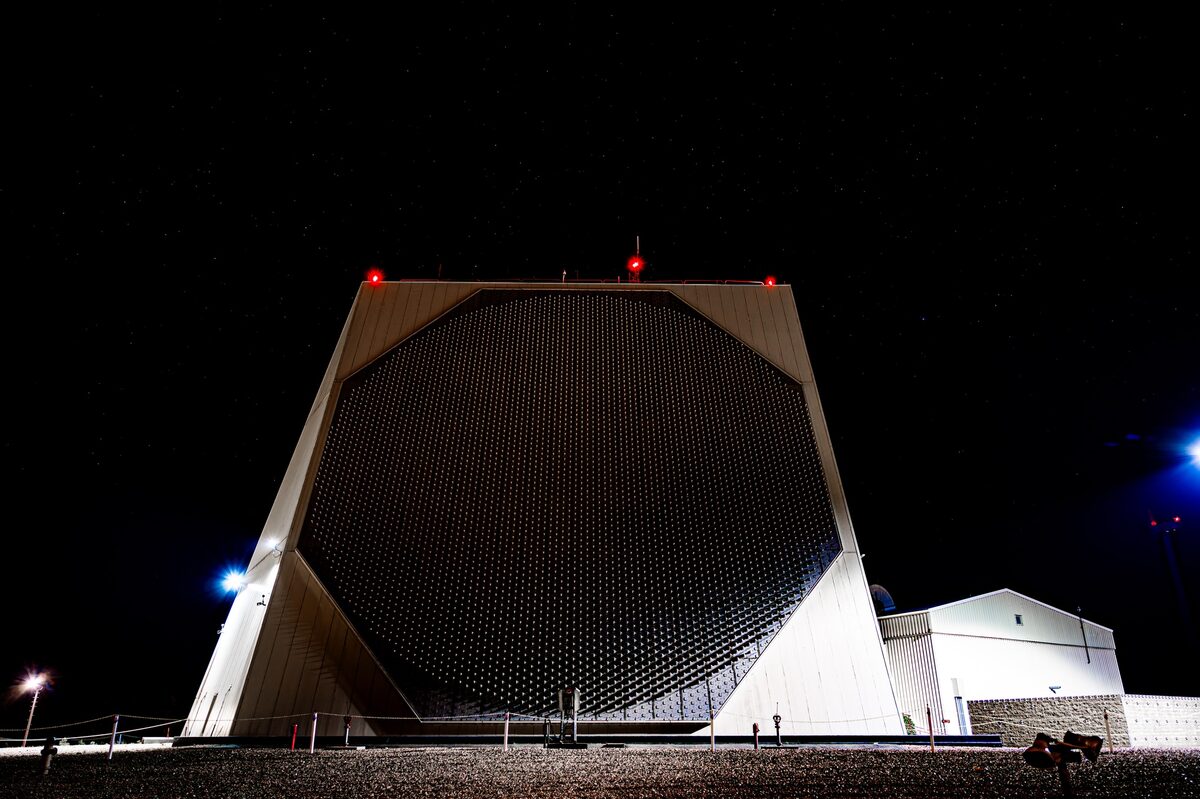
The Space Force just put a name on the company that will build the ground-based radar half of its new moving-target-tracking network — and a rough timeline for when it has to work. Northrop Grumman has been named prime contractor for the Resilient Radar System-Ground (RRS-G), the ground-radar piece of the service's Ground Moving Target Indicator (GMTI) program, a senior Space Force general confirmed this month. The system is expected to launch within the next two years, giving the service a second, complementary sensor architecture alongside the space-based Air Moving Target Indicator (AMTI) satellites SpaceX is already building under a separate, up to $4.2 billion contract.
The RRS-G award is not the SpaceX deal GovConFeed has previously reported. It is a distinct piece of a much larger architecture the Space Force is racing to stand up: a combination of ground radar and orbiting satellites meant to track moving vehicles, ships and aircraft anywhere on Earth, then feed that data into weapons-engagement decisions in near-real time. Officials have described the two programs as complementary rather than redundant — AMTI watches from orbit, RRS-G watches from the ground, and together they are meant to close gaps that either sensor alone would miss, particularly against adversaries capable of jamming or destroying a single layer of the network.
Why the Space Force Split Ground Radar From the SpaceX Satellite Deal
GMTI and AMTI are related but separate lines of effort. AMTI is the space-based constellation — the satellites that will watch for moving targets from orbit, with the first one under a related effort set to launch this month, September 2026. Twelve vendors are competing for space-based AMTI contracts, and SpaceX holds one of those contracts, worth up to $4.2 billion, for constellation buildout.
RRS-G is the ground-radar complement to that space layer, and Northrop Grumman's selection as prime contractor fills in a piece of the architecture that had been unnamed until now. Northrop framed the win around its existing radar and battle-management pedigree. "We have a deep, operational understanding of the threats our warfighters face and are focused on delivering capability at the speed and scale required to stay ahead of them," the company said in a statement carried by Breaking Defense.
The dollar figures behind the buildout are large on both sides of the ledger. The Space Force's FY2027 budget request includes roughly $1.02 billion for GMTI procurement and more than $7 billion in AMTI reconciliation funds, on top of about $1.1 billion in combined research and development spending across the two efforts. That is a lot of money chasing a single operational problem: knowing where things are moving on the ground and in the air, continuously, without depending on aircraft or satellites that adversaries can target or jam.
What the 77th Surveillance Squadron Does With the Data
Naming a prime contractor for the radar is only half the equation. The Space Force also has to build the unit that turns raw GMTI and AMTI data into something a commander can act on. It activated the 77th Surveillance Squadron under Space Delta 7 on July 31, 2026, specifically to fuse that data for weapons-engagement decisions.
Gen. Stephen Whiting, commander of U.S. Space Command, described the shift as a genuine departure from how the joint force has tracked moving targets in the past. "This will be new and different as we elevate AMTI and GMTI to space," Whiting said, according to Air & Space Forces Magazine.
But service officials are being careful not to overpromise. Col. Ryan Frazier acknowledged that even with RRS-G online and the 77th Surveillance Squadron fusing data, the capability the Space Force is targeting for 2028 will be "usable" rather than complete. "Is it everything the joint force requires? I think that will probably extend beyond '28," Frazier said.
That distinction matters for how Congress and combatant commanders should read the 2028 target date. It is a milestone for an initial operational capability, not a finish line for the full GMTI/AMTI architecture — and it suggests follow-on contract actions, upgrades and additional funding requests are already baked into the program's own internal planning, even before RRS-G radars are built.
What It Means for Contractors
For companies chasing space-domain awareness and moving-target-indication work, the RRS-G award is a signal that the Space Force is deliberately splitting its GMTI/AMTI architecture across multiple primes rather than consolidating it under one vendor. Northrop now owns the ground-radar lane; SpaceX holds one of the AMTI constellation contracts; and eleven other competitors remain in the running for additional AMTI satellite work. That structure leaves room for subcontractors and smaller radar, sensor-fusion and ground-processing firms to compete for work under Northrop's RRS-G effort even though the prime slot itself is filled.
The FY2027 budget lines — roughly $1.02 billion for GMTI procurement and more than $7 billion in AMTI reconciliation funding — also indicate this program has real money behind it beyond a single award announcement, which typically means additional solicitations, task orders and integration contracts follow as the architecture matures toward the 2028 target. Companies with ground-radar, space-based sensor or battle-management-fusion capabilities should expect the Space Force to keep parceling out pieces of this architecture rather than closing the field after RRS-G and the initial AMTI awards.
Contractors should also note the tight schedule: an RRS-G launch expected within two years and a 2028 target for "usable" fused GMTI/AMTI capability leaves little room for schedule slip. Firms bidding into this space should expect the Space Force to prioritize vendors who can demonstrate schedule discipline and integration readiness over those offering marginally better technical performance on a longer timeline.
The activation of the 77th Surveillance Squadron is itself a market signal worth watching. A dedicated unit built to fuse GMTI and AMTI data for weapons-engagement decisions will need ground-processing infrastructure, secure networking and software tooling that go well beyond the radar hardware itself. Companies specializing in data fusion, cloud-based sensor processing or command-and-control software should watch for solicitations tied to Space Delta 7 as that unit builds out its mission, since the hardware awards to Northrop and SpaceX are unlikely to be the last major contract actions tied to this architecture before the 2028 target date arrives.
