
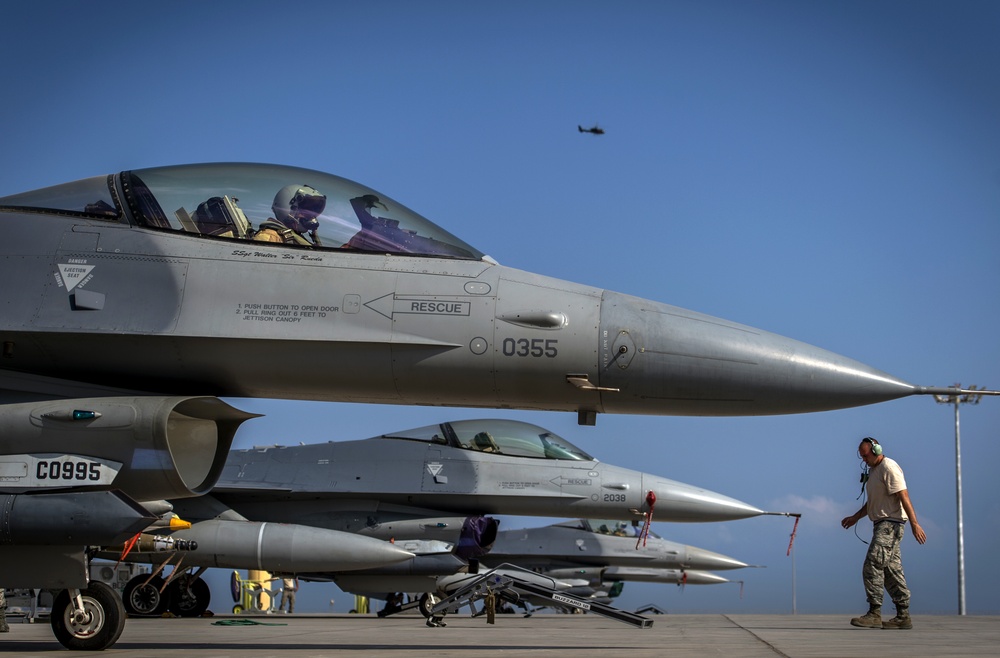
Block 50 F-16 crews flying suppression-of-enemy-air-defenses missions over the Middle East are now doing so with an electronic warfare suite the Air Force just moved to buy in volume. Northrop Grumman Systems Corp. of Rolling Meadows, Illinois, won an $87,417,804 modification on Sept. 24, 2026, funding low-rate initial production of the AN/ALQ-257 Integrated Viper Electronic Warfare Suite, known as IVEWS. The modification, disclosed in the Department of War's daily contracts announcement, pushes the cumulative value of the underlying contract to $1,921,299,231, up from $1,833,881,427. Work under the deal, contract FA8615-17-C-6047, runs through Dec. 31, 2029, and is managed by the Air Force Life Cycle Management Center at Wright-Patterson Air Force Base, Ohio.
The modification, designated P00188, obligates $11,000,000 in fiscal 2025 research, development, test and evaluation funds and $68,372,717 in aircraft-procurement funds. That combination signals a program moving from engineering work into hardware production, a shift that matters because IVEWS has already been carrying that engineering work into combat.
A Jamming Suite Proven Over the Middle East
IVEWS is an ultra-wideband suite built to warn pilots of radar threats, jam them actively and geolocate the emitters, giving a single F-16 the ability to pinpoint a threat rather than just detect it. According to Air and Space Forces Magazine, Block 50 F-16s carrying the suite flew suppression-of-enemy-air-defenses missions during Operation Epic Fury, the combat operation in the Middle East. Since flight testing began in 2024, the system has logged more than 550 hours across 300 sorties, a testing tempo that lines up with the decision to move straight into low-rate production rather than a longer evaluation cycle.
Northrop Grumman has framed that combat use as validation of a system the company has been building toward program-of-record status for years. "You cannot defeat what you cannot see. A modern EW suite is essential for operations in contested airspace. We are producing fully functional, flight-proven systems now. From day one, our customers gain the ability to geolocate threats with a single aircraft, and the confidence that comes with having a U.S. program of record system on board," said Shalini Gupta, the company's vice president of electronic warfare and targeting, in a statement to Air and Space Forces Magazine.
How an Urgent Operational Need Unlocked $187 Million
The production push traces back to the operational side of the Air Force, not the acquisition side. In 2025, the Air Force issued an urgent operational need statement for IVEWS at Central Command's request, a designation that lets a program skip ahead of standard budget queues. Congress backed the request with $187 million written into the fiscal 2026 reconciliation bill specifically to speed qualification and flight testing, according to Air and Space Forces Magazine.
Lt. Gen. Derek France, then the commander of Air Forces Central, later described the broader push to upgrade older airframes rather than retire them. "This is one of many efforts to keep our fourth-gen platforms competitive as the adversary advances. That's the bumper sticker, if you will," he said, in remarks reported by Air and Space Forces Magazine. The comment captures the logic behind the IVEWS investment: the F-16 fleet is not being replaced anytime soon, so the Air Force is spending to keep it survivable against modern air defenses instead.
What the $87.4 Million Buys
The low-rate initial production tranche covers 72 Block 50 F-16s, the same variant that carried IVEWS into Operation Epic Fury. That is a fraction of the fleet the Air Force ultimately wants covered. Full-rate production, if approved, is planned to scale IVEWS across the entire 450-aircraft F-16 fleet, a run that would make this month's contract modification an early installment on a much larger production line rather than a one-off buy.
The gap between 72 aircraft and 450 is where the program's near-term risk sits. Low-rate production exists to prove that a design proven in flight test and combat can also be built repeatably at the rates a fleet-wide rollout requires. The Air Force's willingness to fund both RDT&E and aircraft-procurement dollars in the same modification suggests it is treating that transition as already underway rather than still pending a separate decision.
The contract itself has a long history behind this week's number: FA8615-17-C-6047's designation dates to 2017, and the modification reflects a shift from a development-heavy contract to one now absorbing production-scale hardware buys. The Air Force Life Cycle Management Center routed both the research funding and the procurement funding through that existing contract vehicle rather than standing up a separate production award, a choice that kept the urgent operational need moving without a new competition.
What It Means for Contractors
The award reflects an approach the Air Force has taken with IVEWS: funding an urgent, combat-informed upgrade to an existing airframe rather than waiting for a next-generation program to mature. For Northrop Grumman, the modification cements IVEWS as a program of record with a funding trajectory that should extend well past 2029 if full-rate production materializes, and its combat debut gives the company a proof point it could point to in future F-16 electronic-warfare upgrade competitions.
For the broader industrial base, the contract is a signal that urgent operational need statements, backed by direct congressional funding outside the normal budget cycle, remain a live path to accelerated production dollars. Subcontractors supplying radar-warning receivers, jamming electronics and signal-processing hardware for the AN/ALQ-257 should expect order volume to track the production ramp from 72 aircraft toward the full 450-aircraft fleet, with the pace set less by Northrop Grumman's manufacturing capacity than by how quickly the Air Force decides to authorize full-rate production. Companies competing for similar fourth-generation upgrade work now have a concrete data point on how fast an urgent operational need statement, paired with congressional funding, can turn into an eight-figure production contract.
