
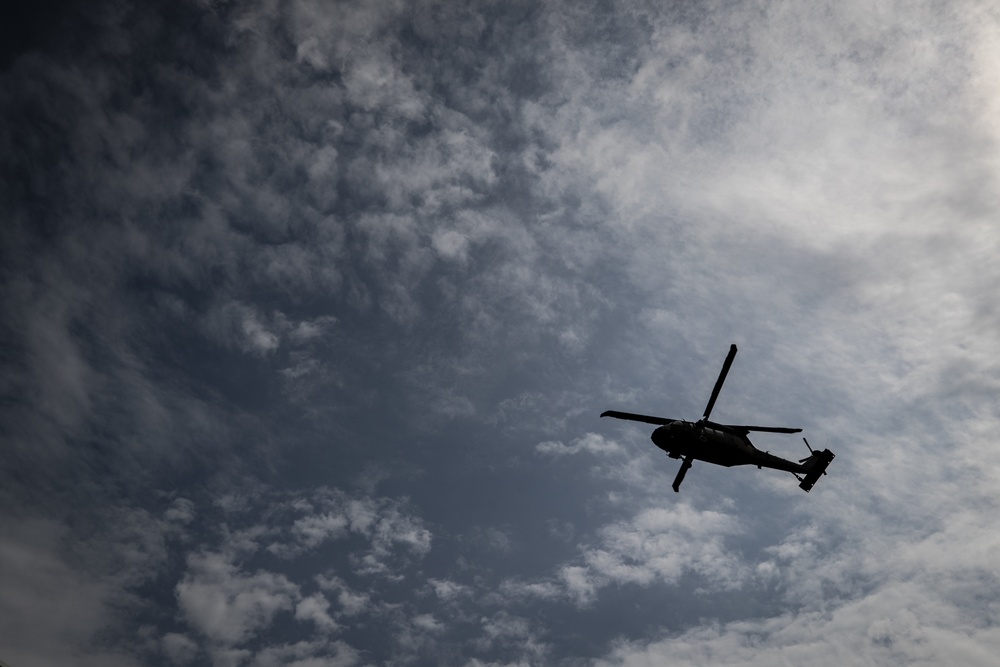
Norway's army and special operations forces are about to fly a common helicopter fleet, after the State Department cleared a $2.3 billion sale of 21 UH-60M Black Hawks, laid out in a Federal Register notice published Sept. 22, 2026. Lockheed Martin's Sikorsky division, based in Stratford, Connecticut, is named as the prime contractor, with no prior related Foreign Military Sale case on the books for this specific purchase.
The Defense Security Cooperation Agency delivered the underlying report to Congress on Aug. 21, 2026, and the notice was formally published a month later as Transmittal No. 26-83. The filing is a Section 36(b) notification under the Arms Export Control Act, the mechanism that requires DSCA to give Congress advance notice of a major foreign arms sale before a Letter of Offer and Acceptance can be finalized. The estimated total splits into $1.2 billion in Major Defense Equipment and $1.1 billion in other items and services, a mix that signals a deal built as much around sensors, weapons and support infrastructure as around the airframes themselves.
What Norway Is Buying for $2.3 Billion
The headline item is 21 UH-60M Black Hawks, but the equipment list runs well past the aircraft. Norway would receive 46 T700-GE-701D engines — more than two per helicopter, covering spares — along with 25 AN/AAR-57 Common Missile Warning Systems, 25 Common Infrared Countermeasure (CIRCM) systems and 25 AN/APR-39E(V)2 radar warning receivers meant to detect and defeat infrared- and radar-guided missile threats to the fleet. The package also includes 50 EAGLE-M+429 embedded GPS/INS navigation units, 100 AN/ARC-231A VHF/UHF/SATCOM radios and 18 M240H machine guns, on top of an extensive list of non-MDE support equipment, spare parts and publications that make up the $1.1 billion balance of the deal.
That density of self-protection and communications gear on a 21-aircraft order points to a fleet built for both conventional Army lift missions and special operations work, where survivability systems and secure radios matter as much as the airframe.
Why DSCA Says the Sale Improves NATO Interoperability
The policy justification attached to the notification frames the sale in alliance terms rather than platform terms. "This proposed sale will support the foreign policy and national security objectives of the United States by improving the security of a NATO Ally that is a force for political stability and economic progress in Europe," the DSCA Policy Justification for Transmittal No. 26-83 states. The agency's case is that giving Norway's Army and Special Operations Forces a single, common rotary-wing platform — rather than a mix of legacy types — tightens interoperability with U.S. and NATO forces operating in the same theater.
DSCA also addressed the readiness question that accompanies every major FMS case: whether selling front-line U.S. equipment abroad strains the domestic supply chain. "There will be no adverse impact on U.S. defense readiness as a result of this proposed sale," the justification states, and the agency separately affirms that Norway has the capacity to absorb the aircraft and support equipment into its force structure.
A String of Norwegian Arms Deals in 14 Months
The Black Hawk case does not stand alone. It is the latest in a run of Norwegian Foreign Military Sales purchases stretching back to mid-2025, according to The Defense Post. Norway bought a $2.6 billion order for HH-60W combat rescue helicopters in July 2025, followed by up to 50 MK 54 lightweight torpedo systems for $162 million in September 2025. This past August, Oslo added $270 million in M795 155mm artillery projectiles, before the Black Hawk case became public days later.
Taken together, the sequence shows a Norwegian buildup that spans rotary-wing aviation, artillery ammunition and undersea warfare — consistent with a NATO member on Russia's northern flank restocking and modernizing across multiple services at once rather than prioritizing a single capability gap.
Fielding Will Require Dozens of U.S. Personnel in Norway
Implementation of the sale is not a simple equipment handoff. The notification estimates that roughly 15 U.S. government personnel and 15 contractor personnel will need to travel to Norway for fielding, checkout, training and logistics support once the case moves forward. That footprint reflects the complexity of standing up a new helicopter type — from aircrew and maintainer training to integrating the missile warning, countermeasure and communications systems into Norwegian operations — rather than a one-time delivery.
Congress's notification period gives lawmakers a window to object before the case is finalized. Barring an objection, the case proceeds to a formal Letter of Offer and Acceptance between Washington and Oslo.
What It Means for Contractors
Sikorsky secures a new international UH-60M production line customer, giving the Stratford plant added export volume to help sustain the line. The subsystem list is where the broader industrial base benefits: GE Aerospace's T700 engine line, named in the notice by its T700-GE-701D designation, picks up an order for 46 units, and the makers of the AN/AAR-57, CIRCM, AN/APR-39E(V)2, EAGLE-M+429 and AN/ARC-231A systems each gain a discrete follow-on order tied to a 21-aircraft fleet.
For smaller contractors, the 15-person contractor fielding and training requirement is a near-term services opportunity distinct from the hardware sale itself, covering aircrew and maintenance training, logistics support and checkout work in Norway once the LOA is signed. None of this is guaranteed revenue yet — the case must clear the congressional notification period and result in a signed LOA before contracts are let — but the absence of any prior related FMS case for this specific buy means the contracting relationships, from Sikorsky's subcontractor selections to sustainment support agreements, are still being set as the case moves forward.
