
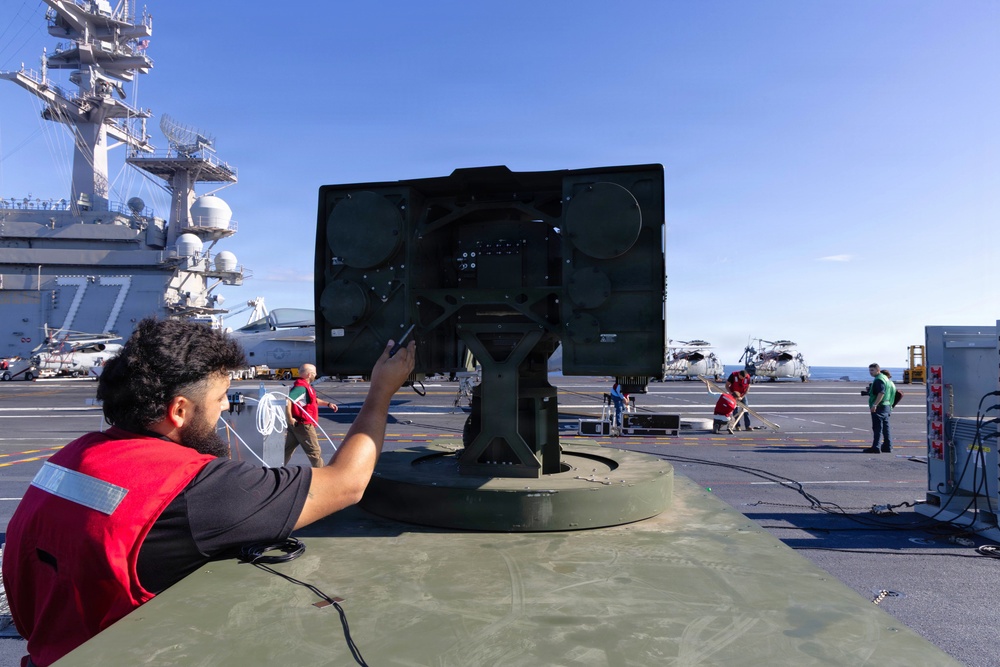
The Department of War announced two Other Transaction Agreements worth $86 million on July 9, 2026, sending directed-energy work to nLIGHT Defense and Lockheed Martin Aculight under the Joint Laser Weapon System program, with a combined ceiling of $847 million if both companies exercise their full options.
Background
The Pentagon has spent more than a decade funding directed-energy demonstrators that could shoot down cheap drones and, eventually, cruise missiles, but most of that work stalled in the prototype stage. JLWS, run out of the Pentagon's Research and Engineering directorate, is structured to push past that stall point by funding two vendors in parallel to build containerized, modular laser systems that can move from a test range onto an actual ground vehicle or ship. The program falls under Scaled Directed Energy, one of six Critical Technology Areas the directorate is advancing under Pentagon Chief Technology Officer Emil Michael as the military looks to push more cost-effective counter-drone tools into production rather than leaving them as lab demonstrations.
The urgency traces directly to conflicts the Pentagon has been watching closely. Drone swarms have become a standard tactic in Ukraine, where both sides use cheap first-person-view quadcopters and larger loitering munitions to overwhelm air defenses built for manned aircraft and ballistic missiles. In the Middle East, cruise missile and one-way attack drone salvos have driven the same conclusion inside the Pentagon: interceptor missiles that cost hundreds of thousands of dollars apiece cannot be the only answer to threats that cost a few thousand dollars to build. A laser, once built and fielded, fires for the cost of the electricity that powers it, giving commanders a "deep magazine" that does not run out the way a missile battery does.
That economic mismatch, sometimes called the cost-curve problem, has shaped acquisition strategy across the Pentagon for several years, but JLWS marks one of the more concrete attempts to field an answer rather than continue funding lab demonstrations. Past directed-energy efforts, including earlier Army and Navy laser programs, proved the underlying physics worked but repeatedly struggled to move from a single test unit to something a maintainer could operate and repair in the field. By funding two vendors under OTAs with a shared power and packaging roadmap, the Pentagon's Research and Engineering directorate is betting that competition and a containerized, modular design standard will succeed where earlier single-vendor demonstrator programs did not.
Key Details
The two OTAs together total $86 million. nLIGHT Defense, based in Camas, Washington, and Lockheed Martin Aculight will each build toward the same technical benchmarks under the program as the Pentagon compares their approaches before committing further funds.
To address what the Pentagon describes as "urgent operational demands," initial prototypes are set to deliver approximately 150 kilowatts of power aimed at the small-drone threat driving the program's urgency. The program's roadmap calls for later iterations to scale to 300–500 kilowatts, the power range the Pentagon considers necessary to intercept cruise missiles rather than just drones. That scaling work leans on the High Energy Laser Scaling Initiative, an existing Pentagon effort under which a 500-kilowatt integrated system will be developed concurrently using a laser source built under that same initiative.
Pentagon Chief Technology Officer Emil Michael framed the award as a homeland-defense move as much as a battlefield one. "We must actively defend the homeland against emerging threats," Michael said. "We are partnering with industry to rapidly deliver deep magazine directed energy capabilities to the Joint Force that can be seamlessly deployed across multiple domains." The reference to multiple domains points to JLWS's design goal: the same modular laser package should be adaptable to ground vehicles and naval platforms rather than requiring a bespoke build for each service.
Choosing two vendors rather than one is itself a signal of how the Pentagon wants to manage risk on directed energy. Running nLIGHT and Lockheed Martin Aculight against the same requirements lets acquisition officials compare beam quality, thermal performance, and manufacturing readiness before committing the bulk of the $847 million ceiling to a winner, or to both, depending on how the systems perform in field testing.
What It Means for Contractors
The OTA structure itself matters for anyone tracking this award. Other Transaction Agreements sit outside the Federal Acquisition Regulation, which lets the Pentagon move faster and lets non-traditional players like nLIGHT compete on more even footing with a prime such as Lockheed Martin Aculight. But OTAs also mean the government retains significant leverage on follow-on production decisions, and a company's performance on the initial deliverable weighs heavily on whether it sees a share of the $847 million ceiling or gets cut at the next milestone.
nLIGHT's win is a marker for the broader shift in directed-energy supply chains. The company built its business on high-power fiber lasers and optical components rather than traditional weapons integration, and its share of the $86 million award shows the Pentagon is willing to fund component-level specialists directly rather than routing all directed-energy dollars through legacy primes. Suppliers of fiber laser components, beam directors, thermal management systems, and power electronics should expect subcontracting opportunities to open up under both award lines as the two teams build toward field-ready hardware.
The power-scaling roadmap also tells contractors where the money goes next. A jump from 150 kilowatts to 300–500 kilowatts is not an incremental engineering step; it requires new thermal management, beam control, and power generation approaches, and the High Energy Laser Scaling Initiative exists specifically to fund that harder problem. Companies with expertise in high-power electronics, cooling systems, and adaptive optics have a specific, named initiative to target for follow-on solicitations tied to JLWS.
Finally, the "seamlessly deployed across multiple domains" language in Michael's statement points toward integration work beyond the laser itself. Ground vehicle and naval platform integrators, along with companies building the containerized power and cooling modules that let a laser system plug into an existing platform without a full redesign, sit downstream of this award and should watch for integration-focused solicitations as nLIGHT and Lockheed Martin Aculight move their prototypes toward platform testing over the next several years.
