
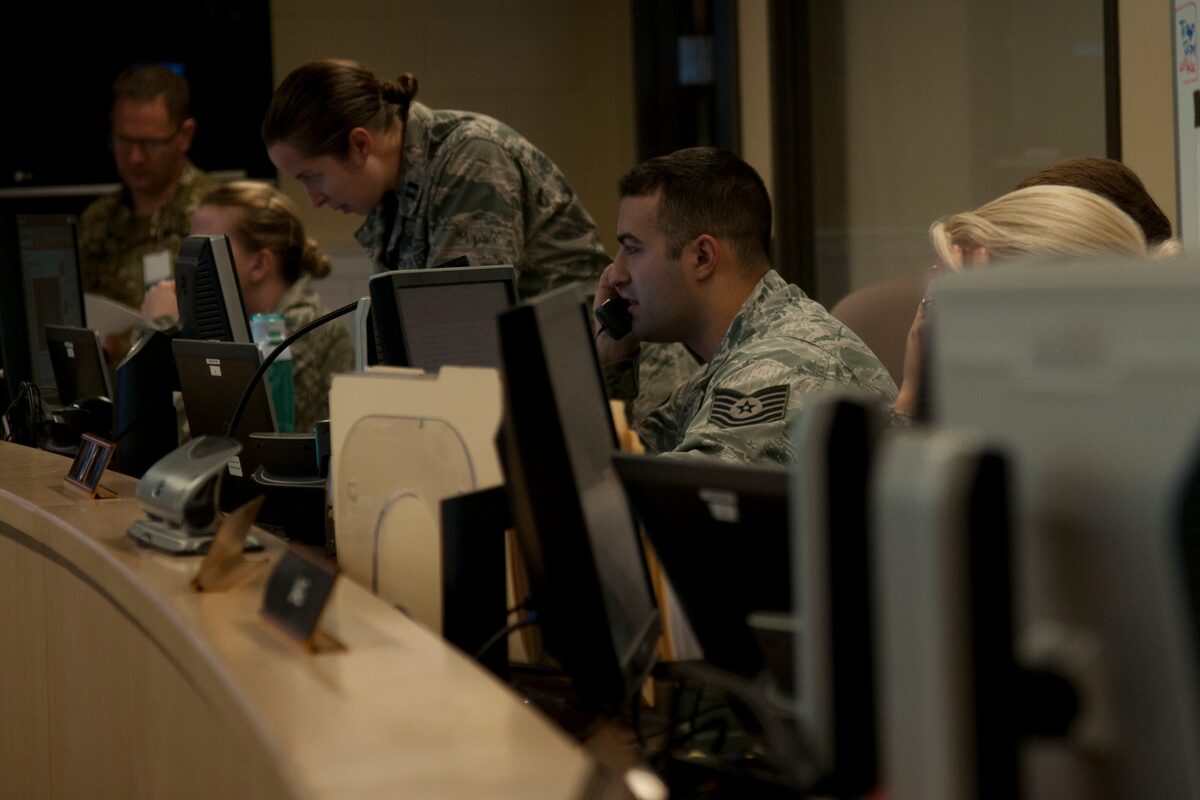
The Department of War has announced Agent Network, an artificial-intelligence effort that continuously scans defense-intelligence and operational systems to compress the time between collecting intelligence and presenting commanders with targeting options. The Chief Digital and Artificial Intelligence Office (CDAO) introduced the project on June 25, 2026, designating it the second of seven "Pace-Setting Projects" under the AI Acceleration Strategy the department unveiled in January 2026. The system is being run in partnership with U.S. Pacific Command, U.S. Southern Command, and U.S. European Command.
Agent Network deploys AI-enabled agents that monitor networks around the clock and surface options for human decision-makers. According to the department, the agents do not autonomously select or strike targets; commanders retain targeting and decision authority. The pitch to operators is speed: turning streams of sensor and intelligence data into informed choices faster than analysts working manually across disconnected systems.
Background
The AI Acceleration Strategy, released in January 2026, laid out a sequence of Pace-Setting Projects intended to push artificial intelligence from experimentation into operational use across the joint force. Agent Network is the second such project to be named publicly. Where earlier efforts emphasized model development and data plumbing, this project targets the decision cycle itself — the chain that runs from collection through analysis to a recommended course of action.
The effort builds directly on Palantir's Maven Smart System, the targeting and battle-management software the department has expanded over several years, and integrates Lumbra, described as an agentic AI operating system. Maven provides the established backbone for fusing intelligence feeds and managing targets; Lumbra supplies the agentic layer that lets software components act on that data continuously rather than only when an operator runs a query. Both companies declined to comment.
The department framed the announcement around demonstrated battlefield relevance. Officials noted that Maven supported roughly 1,000 targets during Operation Epic Fury, the operation against Iran, establishing that the underlying system can function at scale under operational conditions. Agent Network extends that foundation with autonomous scanning and option-generation rather than replacing it.
Key Details
CDAO leader Cameron Stanley characterized the project in operational terms: "This is warfighting AI at operational scale." In testing, the department reported that users tracked more than 500 assets to generate over 300 targeting solutions — figures meant to show the system can manage a dense operating picture and produce a high volume of usable options without overwhelming the people reviewing them.
The architecture centers on agents that watch defense-intelligence and operational networks and assemble candidate options as the picture changes. Rather than waiting for an analyst to pull threads together, the agents present commanders with assembled choices, with the stated goal of delivering new options within seconds. Humans remain in the loop at the decision point, consistent with the department's repeated insistence that the system informs rather than acts.
The three combatant commands involved span distinct theaters and mission sets. U.S. Pacific Command anchors the Indo-Pacific focus that drives much of the department's technology investment; U.S. Southern Command and U.S. European Command bring different geographic and operational demands that test how the agents perform against varied data environments. Running the project across multiple commands at once is intended to surface integration problems that a single-theater pilot would miss.
The department was explicit that Agent Network is not yet fielded. It still requires "rigorous testing, operational evaluation, and oversight" before operational deployment. That framing positions the current phase as evaluation rather than production use, with the testing record cited as evidence of progress rather than a finished capability.
What It Means for Contractors
For the defense-technology base, Agent Network signals where CDAO is steering its AI investment: toward the decision layer that sits on top of established data and targeting infrastructure. The reliance on Maven and Lumbra shows the department leaning on incumbents with proven systems, but the surrounding requirements — testing, operational evaluation, verification, and oversight — define a wide aperture for companies that do not own the core platform.
The emphasis on "rigorous testing, operational evaluation, and oversight" before fielding points to demand for test-and-evaluation services, verification and validation tooling, and the engineering needed to certify AI behavior for operational use. Vendors that can demonstrate reliable performance under contested or degraded conditions, document model behavior, and support human-on-the-loop assurance stand to benefit as the department moves agentic systems from demonstration toward deployment.
The multi-command structure also matters for positioning. Integration work spanning U.S. Pacific Command, U.S. Southern Command, and U.S. European Command implies a need for systems that travel across theaters, data standards, and security environments. Companies offering data integration, secure interoperability, and agent orchestration that functions across heterogeneous networks fit the gap between the named platform providers and the operational commands.
Finally, Agent Network is the second of seven Pace-Setting Projects, and the department has signaled more are coming. Contractors tracking the AI Acceleration Strategy should read this announcement as a template: capabilities built on existing program-of-record systems, validated against demonstrated operational scale, and advanced through structured testing before fielding. Aligning offerings to that pattern — incremental, evaluation-heavy, and tied to combatant-command requirements — is likely to match how the remaining projects are awarded and matured.
Sources
- DOW Unleashes 'Agent Network' to Transform AI-Enabled Battle Management and Targeting (Department of War / CDAO release, June 25, 2026)
- Agentic-AI tool aims to give US commanders new target options 'within seconds' (Defense One)
- New AI 'Agent Network' Could Gather Intel Faster for Strike Packages (Air & Space Forces Magazine)
