
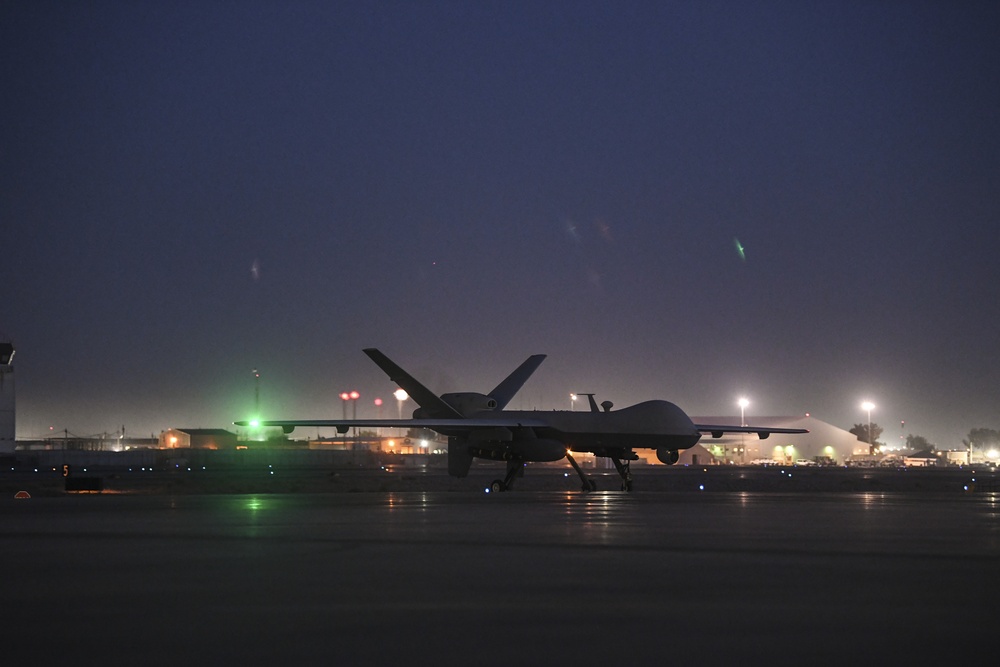
The U.S. military is preparing to pull MQ-9 Reaper drones off patrol in Africa and send most of them south, a shift that will thin the aircraft available for tracking ISIS and al-Shabaab fighters just as Washington ramps up military pressure on Latin American drug cartels. CNN reported Sept. 18, citing six sources familiar with the planning, that Reapers currently assigned to U.S. Africa Command are being lined up to transfer to U.S. Southern Command, the combatant command responsible for Central America, South America and the Caribbean.
One of the six sources told CNN that "most" of AFRICOM's Reaper fleet would ultimately move. The aircraft are intended to support counternarcotics and counterterrorism operations the Pentagon expects to expand across Latin America, including potential missions in Ecuador, which began joint operations with the U.S. military earlier this year against groups Washington has designated terrorist organizations. The Pentagon declined to comment on the redeployment when CNN asked.
Why Ecuador and the "Shield of the Americas" Are Driving the Move
The drone shift lines up with a broader buildup of American military involvement in the region. Task & Purpose reported Sept. 19 that the reallocation coincides with regional governments signing on to the U.S.-led "Shield of the Americas," formally called the Americas Counter Cartel Coalition, a coalition built around joint strikes and surveillance against cartel networks. Defense Secretary Pete Hegseth has been building the political groundwork for months. His National Defense Strategy, released in January, named defense of the U.S. homeland and the Western Hemisphere the Pentagon's top priority.
Hegseth made the shift explicit in August, when he praised Ecuador, Honduras, Guatemala, Jamaica and Colombia for partnering with U.S. forces on operations against what he called "narco-terrorists." Speaking at a joint conference in Panama that month, Hegseth said Colombia had specifically asked for American help. "Colombia has already requested the Department of War join Colombia in its fight against narco-terrorism, authorizing joint military operations to destroy terrorists and terror networks," Hegseth said, according to CNN's report.
Ecuador has already become a testing ground for the buildup. Task & Purpose reported that Ecuadorian officials confirmed last month that U.S. Green Berets were carrying out joint operations in the country against cartels, and that two U.S. warships and additional Marines had arrived. Since then, Marines assigned to Littoral Combat Force-24 have interdicted, boarded and sunk multiple vessels allegedly operating as floating refueling stations for traffickers. Top U.S. military and diplomatic officials have also visited Colombia and Peru in recent weeks, and Peru has since agreed to join the counter-cartel coalition.
The $52 Million Pulled From Iraq, Slovakia, North Macedonia and Tunisia
The drone move is not the only resource being redirected toward the region. Task & Purpose reported that the State Department notified Congress this week it is shifting $52 million in foreign military financing away from Iraq, Slovakia, North Macedonia and Tunisia and toward Colombia, Ecuador, Peru and Panama. The notification framed the reallocation in explicitly hemispheric terms, telling lawmakers the funds would help "combat narcoterrorism in our backyard and help continue to secure the Panama Canal."
Together, the drone transfer and the financing switch point to the same conclusion: the Pentagon and State Department are treating Latin American cartel operations as a priority that outranks longer-running commitments in the Middle East, Eastern Europe and North Africa, at least for the aircraft and dollars now in motion.
What AFRICOM Gives Up
The drawdown comes as AFRICOM's Reapers remain in active use. The command carried out a strike in Somalia as recently as Sept. 17 against what it described as an alleged al-Shabaab weapons store, underscoring that the counterterrorism mission against ISIS and al-Shabaab affiliates has not paused even as the aircraft that support it are being pulled for other theaters. It is not publicly known exactly how many Reapers are moving out of Africa or what the drawdown will mean for the pace of AFRICOM's ongoing strikes and surveillance flights once the transfer is complete.
CNN's sources also disclosed that the drone shift is not settled. A separate source told the network there are ongoing internal discussions about diverting some of the reallocated Reapers to the Middle East instead of Latin America, after the U.S. military lost MQ-9s during its conflict with Iran. That option would compete directly with SOUTHCOM's claim on the aircraft and suggests the Pentagon has not finalized how it will divide a finite Reaper fleet across three regions with rising demand.
A Middle East Option Still on the Table
The competing claims on the aircraft matter because Reapers lost over Iran cannot simply be replaced on a short timeline, and Central Command has its own surveillance and strike requirements in a region where tensions with Iran remain unresolved. Whether the Pentagon ultimately sends the bulk of the reallocated drones to SOUTHCOM, splits them between SOUTHCOM and CENTCOM, or reconsiders the scope of the AFRICOM drawdown will likely depend on how quickly the anticipated Latin American operations materialize.
What It Means for Contractors
General Atomics, which builds the MQ-9 Reaper, and the network of contractors that provide sensors, maintenance, ground control stations and satellite communications for the platform should expect increased sustainment and logistics work tied to standing up Reaper operations in the SOUTHCOM area of responsibility. New or expanded ground infrastructure, basing arrangements and intelligence-processing contracts in Central and South America are plausible follow-on requirements once the transfer locations are confirmed. Companies with existing AFRICOM support contracts should watch for potential contract modifications or reduced task orders as the drone presence there shrinks. The $52 million in redirected foreign military financing also signals near-term opportunities for firms that supply equipment and training to the security forces of Colombia, Ecuador, Peru and Panama, while firms with FMF-funded contracts in Iraq, Slovakia, North Macedonia and Tunisia may see those programs slow. None of the funding or basing details have been finalized publicly, and the Pentagon has not confirmed the scope of the move.
