
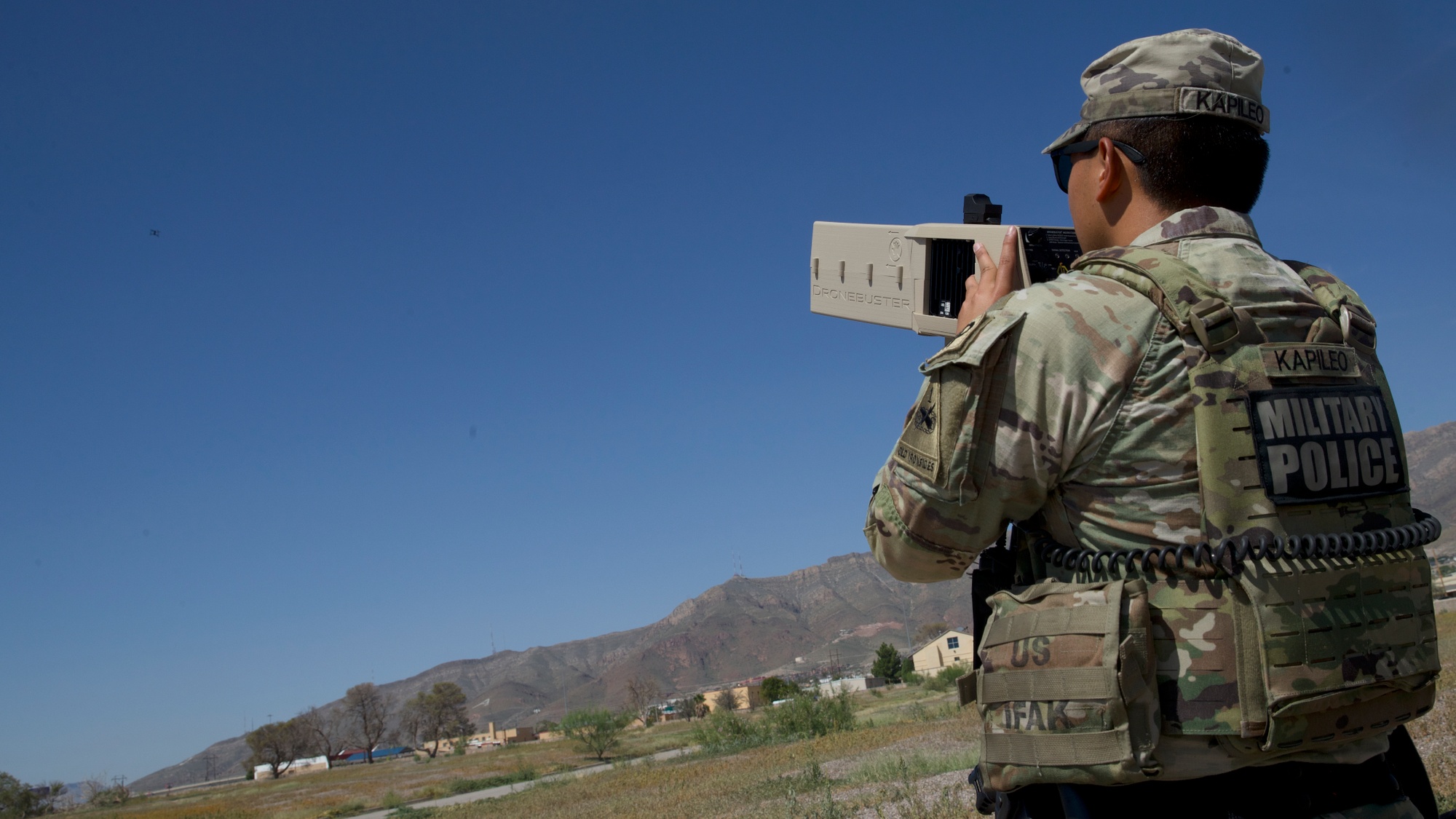
The Department of Homeland Security and the Department of Justice published an interim final rule on July 6, 2026, giving state, local, Tribal, and territorial law enforcement and correctional agencies the legal authority to detect, track, and, in certain cases, disable drones for the first time. The rule implements the SAFER SKIES Act framework enacted in the fiscal year 2026 National Defense Authorization Act and immediately reshapes the buyer base for the counter-UAS industry.
Background
Congress passed Title LXXXVI of the FY2026 NDAA, known as the SAFER SKIES Act, as part of the broader defense authorization signed into law on December 18, 2025. Sections 8601 through 8607 of that title responded to a problem federal agencies had flagged for years: state and local police who encountered hostile or suspicious drones over stadiums, prisons, critical infrastructure, and public events had no independent legal authority to counter them. Federal law reserved detection and mitigation authority almost exclusively for a short list of federal agencies, leaving local departments to call federal partners and wait.
Section 8606 directed DHS and DOJ, in coordination with the Department of Defense and the Department of Transportation, to write regulations spelling out exactly how SLTT agencies could exercise new counter-UAS authority. The rule published July 6 is that regulation. DHS and DOJ issued it as an interim final rule, meaning it took effect immediately on July 1, 2026, even as the departments continue to accept public comment before finalizing it.
Before this rule, the counter-UAS market for physical detection and mitigation gear ran almost entirely through federal customers with existing statutory authority to act against drones, including the Department of Defense and DHS. Local police who spotted a drone circling a courthouse, a stadium during a game, or a jail yard had authority to investigate and, in some cases, pursue criminal charges after the fact, but no independent authority to detect the aircraft's signal or bring it down while the incident was in progress. That gap persisted even as drone incursions over stadiums, correctional facilities, and other sensitive sites continued, a pattern documented in the congressional and DOJ record that supported the SAFER SKIES Act.
Key Details
The rule builds a two-tiered training and certification system. The first tier authorizes personnel to conduct detection-and-warning operations, using sensors to identify and track drones without interfering with their flight. The second, more demanding tier authorizes mitigation, meaning agencies may disrupt, disable, or otherwise take control of a drone found to pose a credible threat. Officers must complete tier-appropriate training, including coursework offered through the FBI's National Counter-UAS Training Center, before they may exercise either authority. A current detection-and-warning certification is a prerequisite for obtaining and maintaining mitigation certification, so mitigation-tier officers carry additional requirements beyond the detection tier.
Agencies cannot simply buy any counter-drone system on the market and put it to use. The rule limits SLTT agencies to technologies that appear on a jointly maintained authorized-technology list developed by DOJ, DHS, the Defense Department, the Department of Transportation, the Federal Communications Commission, and the National Telecommunications and Information Administration. That interagency vetting process functions as a qualified-products list: a vendor's counter-UAS system cannot legally reach the state and local market until it clears review by six federal bodies with jurisdiction over spectrum use, aviation safety, and national security.
The rule also imposes real-time coordination duties on agencies that use mitigation authority. Departments must provide real-time notification to air traffic control before and during any mitigation action to protect manned aircraft operating nearby, and they must submit a post-operation report to the Attorney General and the Secretary of Homeland Security within 48 hours of a mitigation action, describing the date, time, and location of the incident, the credible threat involved, the type of mitigation capability employed, and any known operational effects. Section 8605 of the SAFER SKIES Act backs these requirements with civil fines of up to $100,000 per violation, or suspension of an agency's C-UAS authority, for any counter-UAS action taken outside the coordination structure the rule establishes.
The rule also addresses spectrum coordination and airspace approval, two issues that had complicated earlier counter-UAS proposals. Many detection and mitigation systems rely on radio-frequency sensing or jamming that can interfere with licensed spectrum users, which is why the FCC and NTIA sit alongside DOJ and DHS on the authorized-technology list rather than being consulted only informally. The rule states that it does not change SLTT agencies' independent obligations under the Communications Act and FCC rules on spectrum licensing and harmful interference. Airspace approval requirements tie the rule back to the FAA's existing authority over the national airspace system, ensuring that a local agency's mitigation action does not create a hazard for aircraft that have no connection to the drone incident itself.
What It Means for Contractors
The rule converts a federal-and-defense-only counter-UAS market into one that also includes police departments, sheriff's offices, and corrections agencies across the country. That expansion only benefits vendors whose systems make it onto the authorized-technology list, so companies that have not yet engaged DOJ, DHS, DoD, DOT, the FCC, and NTIA on certification now have a defined, if narrow, path to do so. Firms that already sell into federal counter-UAS programs may have an early advantage, since much of the technical vetting federal buyers require is likely to overlap with the criteria the interagency list will apply.
Training providers also gain a defined near-term opportunity. Because officers cannot exercise detection or mitigation authority without completing NCUTC-delivered or NCUTC-approved instruction, demand for that coursework will track the pace at which SLTT agencies pursue certification. Companies that pair a listed technology with an approved training pathway are positioned to capture both the equipment sale and the recurring training relationship as agencies rotate personnel through certification.
The rule's compliance architecture, including real-time FAA notification and the 48-hour post-operation reporting requirement, also creates demand for software and record-keeping tools that help agencies document mitigation events and demonstrate compliance. Vendors building case-management or incident-reporting layers around their detection hardware can address a real operational burden the rule places on every SLTT agency that adopts mitigation authority, distinct from the sensor and effector hardware itself.
Because the rule is an interim final rule with an open comment period, the authorized-technology list and the specific training curricula it references are likely to be refined before the framework is finalized. Contractors should track the comment docket alongside the rule itself, since changes to certification criteria or the technology list during that process will determine which systems retain eligibility once DHS and DOJ finalize the regulation.
