
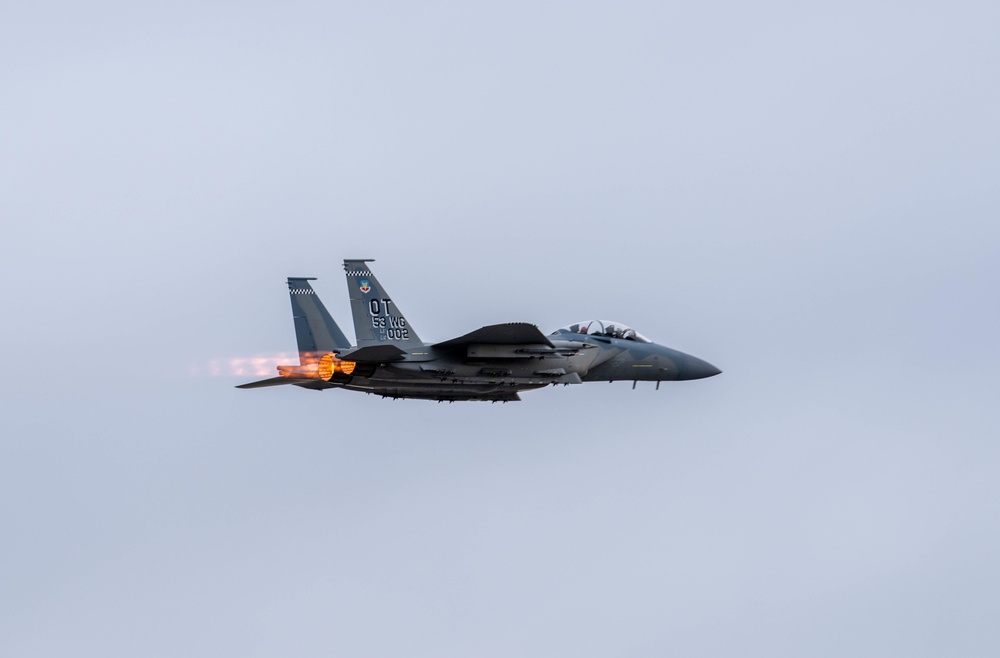
The Senate Armed Services Committee voted 18 to 9 on June 11, 2026 to advance the fiscal year 2027 National Defense Authorization Act, which authorizes a total national defense spending level of approximately $1.14 trillion and includes several acquisition policy provisions that will directly affect the defense industrial base, according to the Senate Armed Services Committee. Among the most significant acquisition provisions are authorization for multiyear procurement of F-35 Lightning II and F-15EX Eagle II aircraft, and a new prohibition on defense contractors using profits from federal contracts to fund stock buyback programs. The bipartisan 18-9 vote reflects broad support for the legislation's core defense investment priorities, though the margin includes both Republican and Democratic members who will likely seek amendments to specific provisions during floor consideration.
The FY2027 NDAA now proceeds to the full Senate floor for debate and amendment, where it will eventually be reconciled with the House version of the NDAA in a conference committee process. The final bill enacted into law often differs substantially from either chamber's initial version, as controversial provisions are modified, deleted, or replaced during conference negotiations. However, the committee's inclusion of specific provisions like the multiyear aircraft authorizations and the stock buyback prohibition signals legislative intent that will carry weight even if specific details are adjusted in conference.
Multiyear Aircraft Procurement Authorizations
The SASC's authorization of multiyear procurement for both the F-35 and F-15EX represents a significant acquisition policy development for both programs and their industrial bases. Multiyear procurement authority allows the government to contract for two to five fiscal years' worth of production in a single contract, providing the contractor with advance planning certainty in exchange for contractual commitments to production quantity and cost reduction. Under 10 U.S.C. § 3501, multiyear contracts require congressional authorization and specific certifications from the Secretary of Defense that the program meets statutory criteria including substantial continuity of production, and that multiyear contracting will result in significant savings compared to annual procurement.
For Lockheed Martin's F-35 program, multiyear authorization would allow the company to plan its workforce, supply chain, and manufacturing investments based on contractually committed demand over multiple years — a significant operational advantage for a program of the F-35's complexity and supply chain depth. The F-35 supply chain spans hundreds of suppliers across more than 40 states, and multi-year demand commitment allows those suppliers to make their own investment decisions with greater certainty, reducing costs and improving supply chain resilience compared to annual procurement that creates uncertainty throughout the supply network.
For Boeing's F-15EX program, multiyear authorization would support the Air Force's efforts to sustain a production line the service views as an important complement to the F-35 for air superiority missions where the F-15EX's larger weapons payload and range provide operational advantages. The F-15EX production line employs thousands of workers at Boeing's St. Louis facility, and multiyear contracting would give Boeing the planning certainty needed to sustain the workforce and manufacturing capability for sustained production commitments. Air National Guard F-15C/D replacement requirements and potential export sales to allied nations provide additional demand context supporting the multiyear authorization.
Stock Buyback Prohibition
The SASC bill includes a novel provision prohibiting defense contractors from using profits derived from Department of Defense contracts to fund stock repurchase programs. Stock buybacks have been a contentious topic in defense policy circles for several years, with critics arguing that major defense contractors have used defense contract profits — ultimately derived from taxpayer funding — to enrich shareholders through buybacks rather than investing in production capacity, workforce development, and research and development that would deliver long-term industrial base benefits. Proponents of buybacks argue they represent a legitimate return of capital to shareholders when companies do not have sufficiently productive investment opportunities and that restricting them would not necessarily increase productive investment in the defense sector.
The provision, if enacted, would require defense contractors to certify that profits from DoD contracts are not being used for stock repurchase activities. Implementing this requirement faces practical challenges: defense contractor profits are fungible with other company revenues and losses, and attributing specific profit amounts to specific DoD contracts would require accounting approaches that do not currently exist in practice. The legal mechanism for implementing such a prohibition without running into constitutional constraints on companies' use of legitimately earned profits is also unclear, and the provision will likely face legal and legislative challenges if included in enacted legislation.
What It Means for Contractors
For Lockheed Martin and its F-35 supply chain, multiyear authorization from SASC is a positive legislative signal, though authorization alone does not create a contract. DoD must still negotiate and execute a multiyear contract under the authorization, meeting the statutory certification requirements and Congressional notification requirements. If the authorization is included in the enacted NDAA and DoD executes a multiyear contract, the resulting demand certainty will benefit the entire F-35 supply chain across all tiers of subcontractors and suppliers.
For Boeing and the F-15EX industrial base, multiyear authorization provides similar benefits — planning certainty, supply chain stability, and potential unit cost reductions from economic order quantities and manufacturing efficiency improvements that multi-year production enables. Boeing has actively advocated for F-15EX multiyear authority, and the SASC vote reflects success in that advocacy. The F-15EX multiyear authorization, if enacted, would lock in the production schedule for several years, reducing the program's vulnerability to year-to-year budget pressures that have complicated production planning in prior years.
The stock buyback provision represents a significant policy direction that larger defense contractors with active buyback programs should monitor carefully. Even if modified or removed in conference, its inclusion in the SASC bill signals Congressional attention to how defense contractor profits from government contracts are deployed. Large contractors should prepare to engage on this policy topic through advocacy channels and assess how their shareholder return policies might be characterized in this debate as it evolves through the legislative process. Transparent communication with Congressional staff about how contract profits are invested in productive business activities — R&D, capital expenditure, workforce development — is an important element of that advocacy effort.
