
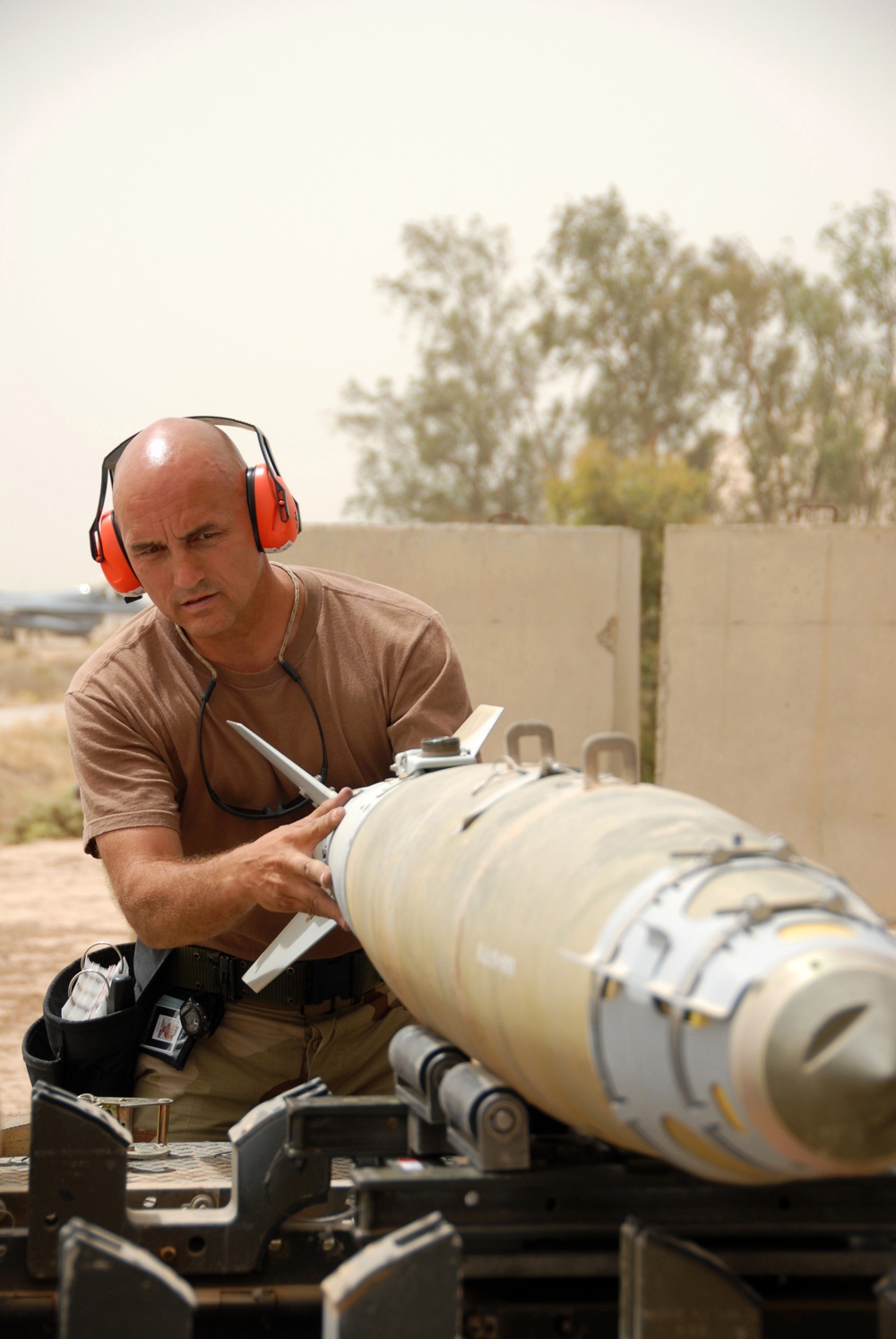
Saudi Arabia is about to refill a bomb stockpile that heavy aerial combat with Iran has been steadily emptying, under a Foreign Military Sale the State Department has cleared for more than $5 billion in JDAM-ER guidance kits and general-purpose bombs. The Defense Security Cooperation Agency notification, reported by Janes on September 7, 2026, covers 5,004 KMU-572 and 5,000 KMU-556 guidance kits paired with 5,004 BLU-111 500-pound bombs and 5,000 BLU-117 2,000-pound bombs. Boeing builds the JDAM-ER kits. The same window produced two smaller Middle East notifications, for Oman and Iraq, that moved through the pipeline alongside the Saudi package.
What's in the $5 Billion Package
The core of the sale is 10,000 JDAM-ER guidance kits, split between the KMU-572 and KMU-556 variants, bolted onto roughly 10,000 unguided bombs — the 500-pound BLU-111 and the 2,000-pound BLU-117. Janes puts the total value at approximately $5 billion. Breaking Defense, reporting on September 4, 2026, puts the combined figure for all three notifications that cleared in the same window at roughly $6.1 billion: the roughly $5 billion Saudi JDAM-ER case, a separate $750 million line for 60 AGT-1500 tank engines for Saudi Arabia's M1 Abrams fleet built by Honeywell, plus the smaller Oman and Iraq packages detailed below. The State Department's own justification for approving the sale, as quoted by Janes, frames it in coalition and interoperability terms rather than combat-replenishment terms: "The proposed sale will improve Saudi Arabia's airborne defence capability to counter current and future regional threats, strengthen its homeland defence, and improve interoperability with systems operated by US forces and other Gulf region partners."
JDAM-ER is not a new weapon design so much as a range extension. It adds a pop-out wing kit to the standard JDAM tail assembly, letting the bomb glide rather than fall ballistically once released. Breaking Defense puts that glide range at just over 45 miles, or roughly 70 kilometers — enough to clear the bomb of the immediate target area, but modest next to true long-range standoff weapons, meaning aircraft carrying JDAM-ER still have to fly relatively close to the target compared with those longer-range options. Splitting the order between the 500-pound BLU-111 and the far heavier 2,000-pound BLU-117 also gives Saudi mission planners two distinct effects to draw from — a lighter weapon for targets where the blast radius has to stay tight, and a bunker-class weapon for hardened or dispersed targets — rather than one warhead size applied to every strike package.
Why Saudi Arabia Needs 10,000 New Guidance Kits Now
Neither Janes nor the State Department statement it quotes explains the timing in operational terms. Breaking Defense does. Its analysis, drawing on CSIS munitions estimates, ties the size and speed of the request to Saudi munitions depletion amid heavy aerial bombardment during the kingdom's conflict with Iran. Sustained strike operations burn through precision-guided munitions inventories far faster than peacetime training does, and a request sized at roughly 10,000 kits and bombs in a single notification is consistent with a customer working to rebuild depth rather than add incremental capability.
The Abrams engine line item reinforces that reading. Sixty AGT-1500 gas turbine engines is not a modernization buy for a handful of upgraded tanks — it is closer to fleet sustainment at scale, the kind of order that follows heavy usage rather than a capability gap identified in peacetime planning. Pairing air-delivered standoff munitions with ground-vehicle powerplants in the same general window points to a customer replenishing across domains at once, not shopping for one new system. The gap between Janes' roughly $5 billion figure for the JDAM-ER case alone and Breaking Defense's roughly $6.1 billion figure is not a disagreement over the same number — Breaking Defense's total folds in the $750 million Abrams engine line plus the separate, smaller Oman and Iraq notifications on top of the Saudi munitions case.
Oman and Iraq Get Companion Deals
The Saudi case was not the only Middle East FMS notification to move in this window. Oman received approval for $188 million in F-16 sustainment services, a support package rather than new aircraft or weapons; the State Department notice lists no principal contractor for that case. Iraq's notification covers Bell 412EPX helicopters valued at $150 million, with Bell-Textron as the prime contractor. Both are far smaller than the Saudi case and read as routine sustainment and fleet-support business rather than combat replenishment, but their arrival alongside the JDAM-ER notification underscores how much Foreign Military Sales activity the region is generating in a single week.
FMS cases for Gulf partners route through the same DSCA notification process regardless of size, and Congress gets the same 30-day review window whether the case is worth $150 million or $5 billion. That the Oman and Iraq notifications cleared alongside the much larger Saudi package suggests DSCA's regional caseload is running heavy across the board this fall, not just on the headline munitions deal. None of the three notifications has drawn a hold from Congress as of this reporting.
What It Means for Contractors
Boeing picks up prime responsibility for 10,000 JDAM-ER kits, a production run large enough to backstop its guidance-kit line for multiple quarters even before the case is finalized into a signed contract. Honeywell's AGT-1500 engine order does the same for its tank-propulsion sustainment business, and Bell-Textron's Iraq helicopter case adds another rotary-wing sustainment data point to a Gulf market that has kept the 412 line active for years. None of these are new-program wins — every contractor named here is the incumbent on an established platform — but the dollar volume matters for planning purposes. A single roughly $5 billion munitions case gives Boeing's guidance-kit suppliers a multi-year demand signal, and it gives Congress 30 days to object before the case proceeds to contract.
For subcontractors feeding into JDAM-ER kit production or AGT-1500 overhaul work, the DSCA notification itself — not the eventual signed contract — is usually the first firm signal that volume is coming, since Foreign Military Sales cases typically convert to production contracts once the congressional review period closes without objection. Suppliers tracking the Gulf market more broadly should also note that Oman's and Iraq's smaller sustainment cases are the kind of recurring business that keeps existing production lines funded between the larger, headline-generating munitions packages like this one.
