
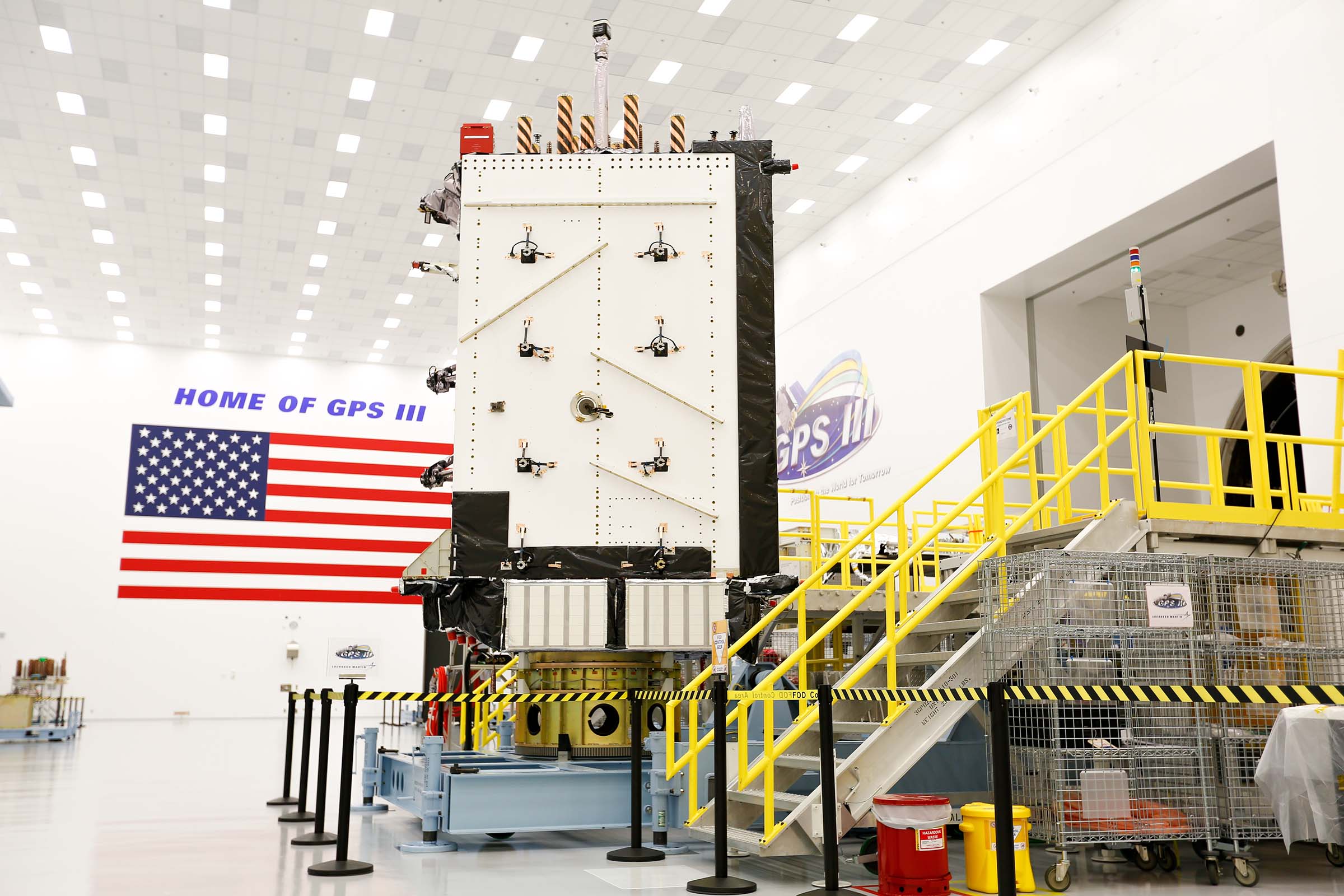
The U.S. Space Force awarded Lockheed Martin a $514 million contract on June 15, 2026, for the production of two additional GPS IIIF satellites — Space Vehicles 23 and 24 — expanding the modernized constellation to 14 spacecraft and deepening the Pentagon's commitment to GPS resilience in contested environments.
Background
The GPS IIIF program builds on the GPS III baseline, of which all ten satellites are now in orbit. The final Block III vehicle, SV10, reached orbit in 2026, formally closing out that production line. Lockheed Martin has manufactured GPS satellites for the U.S. government for decades, and in 2018 the company signed a block-buy contract for GPS IIIF with options covering up to 22 spacecraft. The latest contract action exercises those options for SV23 and SV24, raising the firm production commitment to 14 satellites and continuing a modernization arc that will eventually replace aging legacy GPS vehicles in the operational constellation.
GPS IIIF represents a substantial leap over GPS III in contested-environment performance. The defining addition is Regional Military Protection, a directional anti-jamming capability built into the fully digital navigation payload that delivers an approximately 63-fold increase in jamming resistance over the previous generation. That number reflects the operational reality that adversaries have invested heavily in GPS jamming and spoofing equipment deployed across multiple theaters, making constellation-level anti-jam protection a top-tier Space Force priority rather than a future aspiration. The fully digital payload architecture also allows signal processing improvements to be uploaded via software rather than requiring an entirely new satellite design, providing flexibility to respond to evolving threats without replacing hardware on orbit.
Beginning with SV13, the satellites fly on Lockheed's LM2100 Combat Bus, a cyber-hardened spacecraft platform designed for the radiation environment of medium Earth orbit where GPS satellites operate. The Combat Bus incorporates hardening against electronic warfare and cyber intrusion attempts. Each GPS IIIF satellite also carries hosted payloads: a laser retroreflector array enabling precise orbit determination by ground stations, and a search-and-rescue payload that connects the constellation to the international distress signal system, preserving the dual-use civil value the GPS program has delivered since its inception. An expanded M-Code encrypted military signal provides additional protection against adversary exploitation and improves positioning accuracy for capable military receivers across all domains.
Key Details
Lockheed Martin will manufacture SV23 and SV24 at its Denver-area production facilities. Three GPS IIIF satellites earlier in the production sequence have already completed the core mate milestone — the structural integration phase where subsystems are joined to the spacecraft bus — indicating a production cadence capable of supporting planned launch timelines. The company uses digital twin modeling and augmented reality to simulate and accelerate spacecraft production before hardware testing begins, reducing integration risk and compressing test campaign timelines.
Launches for SV23 and SV24 are expected between 2027 and the mid-2030s depending on launch manifest scheduling, which the Space Force manages separately from production contracts. A related $105 million award covers launch, early-orbit, and disposal operations as well as ground control segment modernization, ensuring the command-and-control architecture can handle the expanded constellation's operational requirements as new satellites join the network.
The full GPS IIIF program, if all 22 options are exercised, would give the Space Force a production contract spanning more than two decades of GPS modernization. Each satellite launched displaces a legacy vehicle that lacks Regional Military Protection, the updated digital payload, and the cyber hardening of the LM2100 Combat Bus. As those older satellites age past their design lives, the IIIF program represents the Space Force's primary mechanism for maintaining a robust, jam-resistant positioning capability through the 2040s. Lockheed Martin's production of three vehicles already past the core mate milestone indicates the program is executing on schedule.
“Modernizing the constellation with highly resilient, next-generation space vehicles ensures warfighters have access to the GPS capabilities they require for their missions,” said Christina Mancinelli, Vice President of Global Communications and Navigation at Lockheed Martin.
What It Means for Contractors
For defense contractors with GPS-adjacent programs, the award confirms Space Force investment in the GPS constellation will continue through the 2030s at a pace supporting stable industrial base planning. Companies supplying components to the LM2100 bus, digital navigation payload subsystems, SAR hardware, laser retroreflector assemblies, and ground segment software are positioned for sustained work as the Space Force exercises remaining options on the 2018 contract. The program's Denver production hub also sustains the Colorado aerospace corridor, which supports Lockheed Martin's broader national security space portfolio.
The approximately 63-fold anti-jamming improvement from Regional Military Protection creates downstream demand for military GPS receiver modernization across every platform category. Aviation integrators, naval systems programs, and ground combat vehicle programs will need to field receivers capable of accessing M-Code and RMP-protected signals that GPS IIIF broadcasts. That receiver modernization cycle represents a contracting opportunity distinct from satellite production and touches upgrade and new-start programs across all services over the coming decade.
The $105 million ground and launch infrastructure award demonstrates that GPS constellation management requires a parallel industrial effort beyond satellite manufacturing. Ground systems need updates to command and monitor each new bus design, launch integration requires vehicle-specific work, and the growing use of digital twin modeling and augmented reality creates demand for advanced manufacturing software and the systems engineering firms that build and maintain it.
The GPS IIIF commitment — now locked in through 14 satellites with options to 22 — gives the program one of the more stable long-term contract pipelines in the national security space portfolio at a moment when GPS resilience has moved from a planning concern to an active operational requirement across all warfighting domains.
Small and mid-tier suppliers should also note that the program's block-buy contract structure, originally signed in 2018 and now extending production into the next decade, provides multiyear demand signals that support tooling and workforce investments difficult to justify on shorter-cycle contracts. Vendors already qualified on GPS III components retain a strong position for IIIF work given shared heritage hardware. New entrants should focus on subsystems unique to the IIIF variant — particularly Regional Military Protection antenna arrays, digital signal processors, and next-generation M-Code receiver cards — where the qualification base is smaller and competition for new business is more accessible than on the mature bus and bus-structure elements.
