
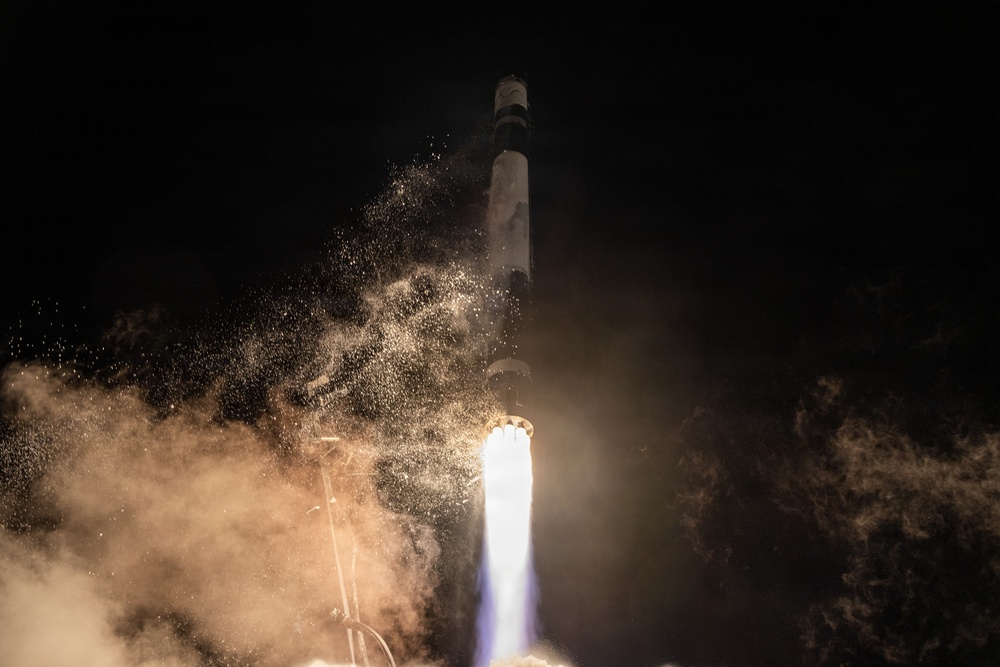
The U.S. Space Force's Space Systems Command confirmed that Rocket Lab's Electron rocket lifted off from Launch Complex-1 in Mahia, New Zealand, at 3:19 a.m. Pacific time on June 19 — exactly 16 hours and 42 minutes after the Space Force issued a formal notice-to-launch order. The mission, designated Victus Haze, shattered the previous rapid-launch record of 27 hours set by Victus Nox in 2023 and beat its own 24-hour launch requirement by more than seven hours.
Background
The Tactically Responsive Space (TacRS) demonstration series was created to solve a specific operational problem. Modern adversaries can track, target, and destroy U.S. satellites in low Earth orbit, stripping warfighters of the intelligence, communications, and navigation support that modern military operations depend on. The series is designed to prove the Space Force can compress the cycle from satellite loss to satellite replacement — a capability that changes the risk calculus for any adversary weighing whether a first strike against U.S. space assets is worthwhile. TacRS tests that assumption by placing replacement satellites in orbit within days of a launch order, not weeks or months after a factory completes a new spacecraft.
Victus Haze is the fourth TacRS demonstration. The third, Victus Nox, flew in 2023 and established the rapid-launch record at 27 hours from notice to orbit. That benchmark stood for nearly three years. Earlier demonstrations validated the concept over longer preparation timelines; each successive mission compressed the clock further and expanded what the satellite is required to accomplish after reaching orbit. Victus Haze brought both the launch timeline and the scope of the on-orbit mission to a new level simultaneously.
Victus Haze also marked a structural change in how the program is organized. For the first time, a single prime contractor — Rocket Lab — provided the launch vehicle (Electron), the spacecraft (Pioneer), and post-launch on-orbit operations under one contract. Previous TacRS missions divided those responsibilities across multiple contractors, creating coordination overhead and potential failure points at each handoff. The all-in-one vertical integration model consolidated end-to-end accountability into a single company and proved it could execute faster than distributed architectures.
Key Details
The timeline unfolded in three distinct stages. Rocket Lab lifted off 16 hours and 42 minutes after receiving the Space Force's formal notice-to-launch — beating the mission's 24-hour launch requirement by more than seven hours and improving on the previous record by more than 10. Rocket Lab's team then activated and commissioned Pioneer in 37 hours and 36 minutes after liftoff, beating the mission's 72-hour commissioning deadline by more than 34 hours. With the satellite operational ahead of schedule, Pioneer immediately began Rendezvous and Proximity Operations (RPO) with True Anomaly's Jackal-004 satellite, already positioned in low Earth orbit.
True Anomaly, a Colorado-based space defense startup, launched Jackal-004 in May 2026 as the designated target object for Victus Haze. Mission documents describe Jackal-004 as a “non-compliant” satellite — the operational stand-in for an unidentified or potentially adversarial object that the Space Force would need to approach, inspect, and characterize in a real-world contingency. True Anomaly received a $30 million contract for the Jackal spacecraft.
Rocket Lab's Electron is a two-stage carbon-composite rocket designed for small satellite launches on compressed schedules. Launch Complex-1 in New Zealand operates under a New Zealand government license, providing scheduling flexibility unavailable at congested domestic ranges and eliminating the FAA license amendment process that can add days to a domestic launch window — a structural advantage for rapid-response missions.
The mission scope expands TacRS beyond rapid launch. Earlier demonstrations treated getting hardware to orbit quickly as the primary objective. Victus Haze added the next operational layer: once on orbit, can the satellite maneuver to a designated zone, locate another object, and execute a rendezvous and inspection mission — all on a timeline measured in hours? Pioneer's performance across all three mission stages confirmed the answer is yes.
What It Means for Contractors
The Victus Haze results define a new performance baseline for tactically responsive space contracts. Three implications stand out for companies competing in this mission area.
First, the all-in-one prime model is now validated. Rocket Lab's ability to execute launch, spacecraft manufacturing, and on-orbit operations under a single contract proved faster than the distributed architectures used in earlier TacRS missions. Future solicitations in this program and related space reconstitution work are likely to favor integrated offerings over multi-vendor teams. That benefits vertically integrated space companies and adds pressure on single-domain specialists — launch-only or spacecraft-only firms — to build credible partnerships before bids close.
Second, RPO capability has moved from experimental to demonstrated. Contractors who can build satellites capable of maneuvering in LEO to rendezvous with, inspect, and characterize other objects now have a documented government acquisition pathway. True Anomaly's Jackal program is the first proof point, but demand for RPO-capable spacecraft is growing across Space Force, NRO, and Space Development Agency programs as each organization works to monitor and characterize increasingly contested orbital environments. Companies developing autonomous rendezvous guidance systems, compact propulsion for small satellites, and onboard sensor suites for proximity operations are positioned for follow-on contracts as the Space Force institutionalizes on-orbit inspection requirements.
Third, 16 hours resets the definition of “responsive” in program planning documents. The 72-hour standard cited in earlier Space Force guidance is now a floor, not a ceiling. Program offices writing future TacRS requirements will benchmark against Victus Haze's performance, not Victus Nox's. That compresses delivery expectations across every tier of the supply chain — propulsion, avionics, ground software, and range operations — and raises the qualification threshold for companies seeking to participate in future responsive space contracts.
The broader context is the Space Force's rapid reconstitution priority: the ability to replace destroyed satellites quickly enough to deny adversaries a lasting advantage from a first strike. Victus Haze demonstrates that reconstitution timelines are now measured in hours, not the weeks or months required to build and launch a replacement spacecraft from scratch. Contractors building satellites, launch vehicles, and ground systems for any space architecture program should treat that as an active procurement driver, not a future planning assumption. The next TacRS solicitation will likely target a timeline that Victus Haze itself would not satisfy.
