
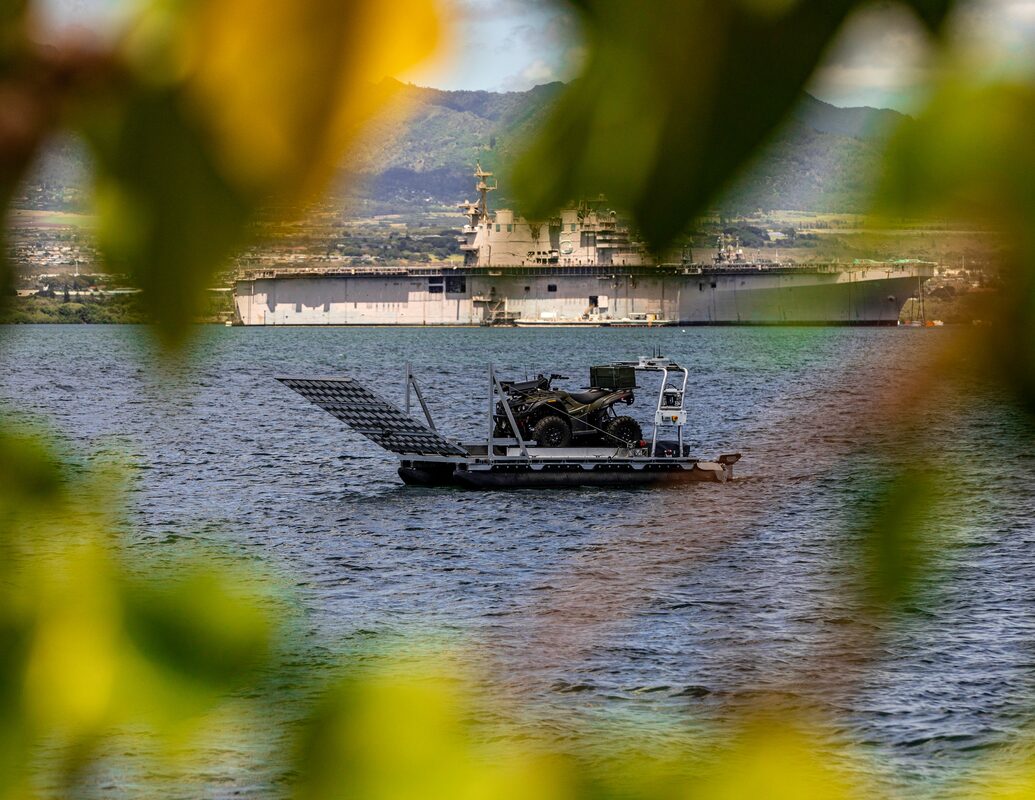
U.S. Transportation Command is asking industry and academia to help it figure out whether AI-navigated, uncrewed cargo vessels can keep military supply lines moving when the sea lanes are contested. The command issued a request for information through a SAM.gov opportunity, inviting non-federal organizations to enter Cooperative Research and Development Agreements (CRADAs) to study Maritime Autonomous Surface Ships, or MASS, for transporting personnel and cargo. White papers are due July 6, 2026. The effort signals that Transcom intends to treat autonomous surface vessels as a serious logistics tool rather than a laboratory curiosity, and it gives contractors a low-cost door into a mobility mission that has historically run on crewed sealift.
Background
Transcom is the combatant command responsible for moving the joint force and its equipment across the globe, a mission that leans heavily on aging surge-sealift capacity and a shrinking pool of qualified mariners. As potential adversaries field longer-range precision weapons, the command has grown increasingly vocal about the vulnerability of large, crewed logistics ships steaming through narrow chokepoints and littoral waters. Uncrewed vessels offer a way to push cargo forward without putting crews directly in harm's way, and to distribute logistics across many smaller, harder-to-target platforms instead of a few high-value hulls.
The MASS concept folds AI into that calculation. According to the solicitation, the vessels would rely on sensors and AI-enabled navigation features operating with varying degrees of human control, ranging from remote supervision to higher levels of onboard autonomy. The CRADA model is deliberate: rather than buying a finished product, Transcom wants to co-develop knowledge with partners who bring their own technology and funding to the table. CRADAs let a government laboratory or command and a private entity share personnel, facilities, and intellectual property on a research problem without the command obligating procurement dollars.
Key Details
The request invites participants to study what the command describes as the uses, limitations, and delivered value of Maritime Autonomous Surface Ships for moving military personnel and cargo. The research scope is broad. It covers short-range deliveries, port security, and infrastructure protection, and it asks partners to assess feasibility across inland waterways, coastal zones, and the open ocean. Crucially for a contested-logistics mission, the work is meant to probe survivability against cyber intrusion, electronic warfare, physical attack, and extreme weather, the threat set that would actually determine whether an uncrewed cargo boat survives long enough to deliver its load.
Transcom also wants partners to think in time horizons, examining how the technology and its proliferation might mature across two-, five-, and ten-year windows. The CRADAs themselves are forecast to run roughly two years, though the command notes that duration can be tailored to the parties' interests by mutual agreement. Importantly, the command is not offering funding. Instead, it is offering access to its installations and facilities, its subject-matter experts, and information on its surge-sealift needs, the operational picture that lets a developer tune a concept to real mobility demands rather than a hypothetical use case. That structure rewards companies that already have a maturing platform or autonomy stack and are looking for a credentialed government testbed and a clearer read on requirements.
The push fits a wider pattern across the U.S. military, where commands are increasingly applying uncrewed and AI-enabled systems to missions long considered too dull or too critical to automate. Logistics, with its repetitive routes and punishing manpower demands, is a natural early target, and Transcom's interest in MASS reflects a judgment that autonomy is ready to be studied for cargo movement in environments where crewed ships face unacceptable risk.
What It Means for Contractors
For industry and academic partners, this is an opportunity to establish position before a formal program of record exists. A CRADA is not a contract award, and no money changes hands from the government side, so firms must weigh whether to invest their own resources for access and influence. The payoff is significant: partners that shape Transcom's understanding of MASS feasibility, survivability, and value now will be far better placed when the command translates that research into requirements and, eventually, acquisition. Early collaborators tend to write the vocabulary that later solicitations adopt.
The breadth of the scope also widens the field of plausible bidders. This is not solely a play for shipbuilders. Autonomy-software developers, sensor integrators, cybersecurity firms, electronic-warfare specialists, and naval-architecture researchers all map onto pieces of the stated research agenda. Companies whose strength is hardening systems against cyber intrusion, electronic warfare, or kinetic attack should note that survivability is an explicit pillar of the study, not an afterthought, which creates room for defensive-technology vendors to participate alongside platform makers.
Prospective partners should move quickly given the July 6 deadline and tailor their white papers to the specific research questions Transcom has flagged, including operating environment, degree of human control, and the threat set. Firms already working on uncrewed surface vessels for the Navy or commercial maritime customers can frame existing capability against Transcom's logistics-specific needs. Academic institutions with autonomy, maritime-systems, or AI test-and-evaluation programs are explicitly welcome and may find the facility access and requirements data more valuable than any near-term revenue. Because the engagement runs through a CRADA rather than a procurement, legal and IP teams should be involved early to structure data rights and protect proprietary technology before committing.
The larger takeaway is directional. Transcom is telling the market that contested logistics is moving toward uncrewed, AI-navigated surface platforms, and it is willing to open its testbeds to partners who bring the technology. Contractors that engage now, even without a funding line, are buying a seat at the table for what could become a substantial future requirement in military mobility.
