
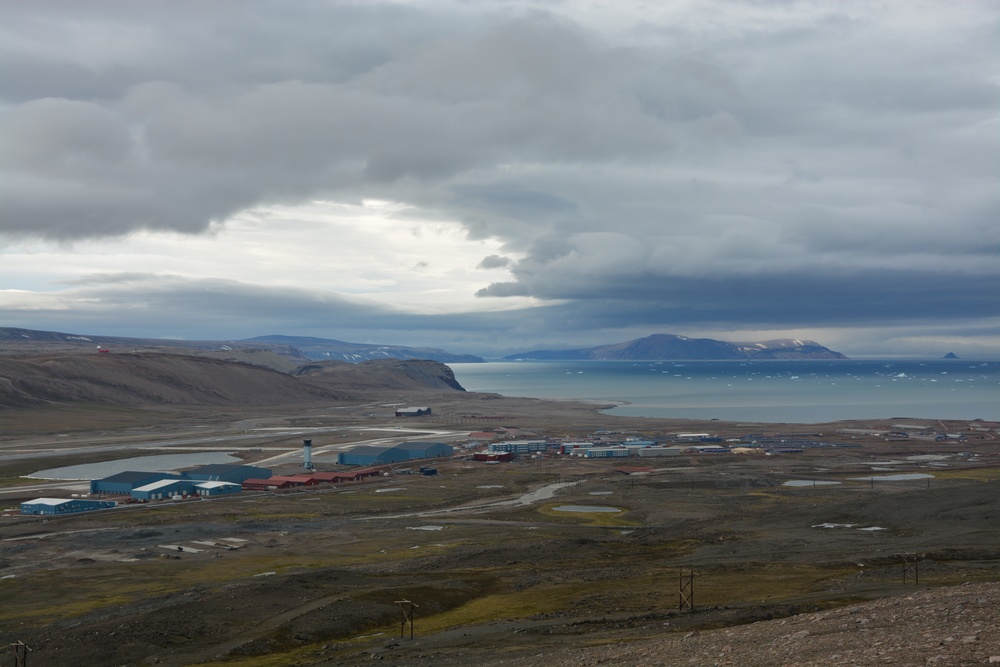
The United States is about to build its first new military bases in Greenland since the early Cold War, after President Trump signed a security agreement with Denmark and Greenland that replaces the 75-year-old US-Denmark defense treaty and hands the Pentagon sweeping new access to the Arctic island. For defense contractors, the deal converts eight months of annexation threats and NATO tension into a concrete construction, logistics and missile-defense workload spread across three sites.
Trump signed the pact in New York on Sept. 22 alongside Danish Prime Minister Mette Frederiksen and Greenland Prime Minister Jens-Frederik Nielsen, immediately after delivering his address to the UN General Assembly. The agreement replaces the 1951 US-Denmark defense treaty that had governed the American military presence on the island for three generations. "Today we are signing an even bigger and better agreement," Frederiksen told reporters at the signing, calling it "a deal that can last forever."
"This deal is good for the United States, it's good for Greenland, for Denmark, for the NATO alliance, and therefore also good for Europe," Frederiksen said.
Two Cold War Sites Return to Active Duty
The pact gives the US military unrestricted access to Greenland's territory and surrounding waters, including the right to fly and land anywhere on the island. It also authorizes the Pentagon to establish "defense areas" at two specific sites that have not hosted an active American military presence in decades, according to Reuters reporting carried by Defense News.
The first is Narsarsuaq, in southern Greenland, home to Bluie West One, a former US air base that closed in the 1950s, according to Reuters reporting carried by Defense News. The second is Mestersvig, on the remote east coast, which currently serves as an outpost for the Sirius Dog Sled Patrol, the Danish special forces unit that patrols Greenland's northeastern coastline by dog sled. Both sites would return to a form of military use they have not seen since the Cold War's early decades.
"We'll be building two very major military bases," Trump told the UN General Assembly the same day, confirming the scale of the construction program without detailing timelines, troop levels or funding.
Pituffik's Missile-Defense Mission Grows
Beyond the two new defense areas, the agreement calls for the modernization and expansion of Pituffik Space Base on Greenland's northwest coast — the only American installation remaining on the island and the anchor of the US early-warning and missile-defense posture in the Arctic. Pituffik currently supports roughly 150 personnel, a fraction of the Cold War-era footprint of more than 10,000 troops spread across 17 American installations across Greenland.
Breaking Defense reported that the agreement "calls for the modernization and expansion of US Pituffik Space Base in Greenland, which currently supports DoD early warning and missile defense capabilities." That language points to upgraded radar, satellite-tracking and interceptor-support infrastructure at a base that already anchors the northern edge of US ballistic-missile early-warning coverage — precisely the kind of program that tends to draw in the same contractor base building out other missile-defense sites for the Space Force.
Sovereignty Reaffirmed, Ownership Question Left Open
The signed text reaffirms Danish sovereignty over Greenland and recognizes Greenlanders' right to self-determination under international law — language Copenhagen and Nuuk pushed hard for after Trump spent early 2026 threatening to annex the island, including by military force, to preempt Russian or Chinese influence in the Arctic. Those threats triggered a diplomatic crisis inside NATO and pushed Denmark and Greenland into months of negotiation that produced Tuesday's signing.
Even with the sovereignty language in the final text, Trump would not say whether the agreement takes US ownership of Greenland off the table entirely, leaving that question open even as the security and basing terms were finalized in writing.
NATO Secretary General Mark Rutte welcomed the agreement, saying it "enhances our collective security." Rasmus Søndergaard, a senior researcher for foreign policy and diplomacy at the Danish Institute for International Studies, offered a more measured read on what the deal actually resolved: "worst outcomes have been averted."
What It Means for Contractors
Three separate sites now carry construction and sustainment scope that did not exist a year ago. Narsarsuaq and Mestersvig will need runway, hangar, power, fuel and housing infrastructure built essentially from scratch at remote Arctic locations with no existing US logistics chain — work that would typically be structured as military construction design-build awards, with heavy-lift airlift and sealift contracts layered on top to move materials that cannot go by road. Mestersvig's use by the Sirius Dog Sled Patrol also means any US construction there will proceed alongside an active Danish special-operations unit, adding a coordination layer contractors bidding the work should expect.
Pituffik's expansion is the more immediate and better-defined opportunity. As an existing Space Force installation already tied into DoD's early-warning and missile-defense architecture, upgrades there are likely to move through existing military space and missile-defense modernization funding channels, drawing on the radar and satellite-ground-system contractors that already hold work at comparable Arctic and polar sites. Firms with active missile-warning or space-surveillance radar contracts elsewhere in the DoD portfolio are the most likely near-term beneficiaries once specific program dollars are attached to the "modernization and expansion" language in the agreement.
No dollar figures, timelines or specific contract vehicles have been released for any of the three sites. Contractors should watch for follow-on budget requests and site-specific solicitations, which typically lag a signed international agreement by months rather than weeks — but the political urgency behind this deal, coming directly out of a NATO crisis, makes an accelerated funding push more likely than a slow rollout.
